

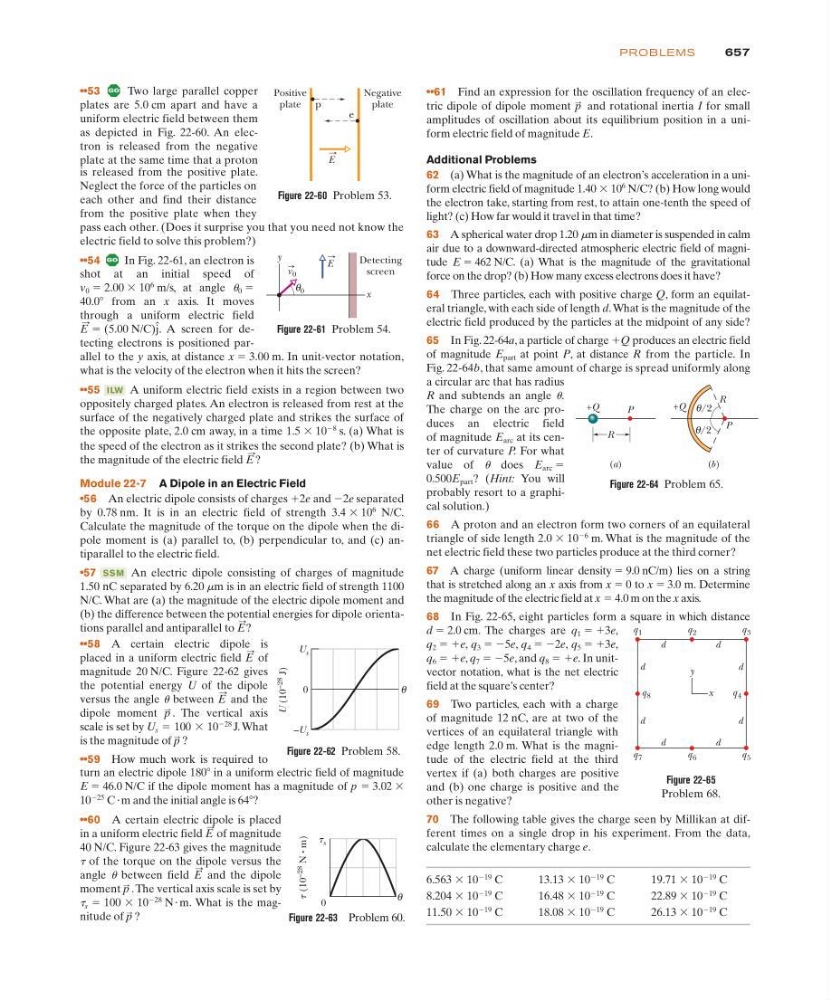
657
PROB LE M S
••53
Two large parallel copper
plates are 5.0 cm apart and have a
uniform electric field between them
as depicted in Fig. 22-60. An electron is released from the negative
plate at the same time that a proton
••61 Find an expression for the oscillation frequency of an electric dipole of dipole moment and rotational inertia I for small
amplitudes of oscillation about its equilibrium position in a uniform electric field of magnitude E.
Additional Problems
62 (a) What is the magnitude of an electron’s acceleration in a uniform electric field of magnitude 1.40 ϫ 10
6
N/C? (b) How long would
the electron take, starting from rest, to attain one-tenth the speed of
light? (c) How far would it travel in that time?
63 A spherical water drop 1.20 mm in diameter is suspended in calm
air due to a downward-directed atmospheric electric field of magnitude E ϭ 462 N/C. (a) What is the magnitude of the gravitational
force on the drop? (b) How many excess electrons does it have?
64 Three particles, each with positive charge Q, form an equilateral triangle, with each side of length d.What is the magnitude of the
electric field produced by the particles at the midpoint of any side?
65 In Fig. 22-64a, a particle of charge ϩQ produces an electric field
of magnitude E part at point P, at distance R from the particle. In
Fig. 22-64b, that same amount of charge is spread uniformly along
a circular arc that has radius
R and subtends an angle u.
The charge on the arc produces an electric field
of magnitude E arc at its center of curvature P. For what
value of u does E arc ϭ
0.500E part ? (Hint: You will
probably resort to a graphical solution.)
66 A proton and an electron form two corners of an equilateral
triangle of side length 2.0 ϫ 10
Ϫ6
m. What is the magnitude of the
net electric field these two particles produce at the third corner?
67 A charge (uniform linear density ϭ 9.0 nC/m) lies on a string
that is stretched along an x axis from x ϭ 0 to x ϭ 3.0 m. Determine
the magnitude of the electric field at x ϭ 4.0 m on the x axis.
68 In Fig. 22-65, eight particles form a square in which distance
d ϭ 2.0 cm. The charges are q 1 ϭ ϩ3e,
q 2 ϭ ϩe, q 3 ϭ Ϫ5e, q 4 ϭ Ϫ2e, q 5 ϭ ϩ3e,
q 6 ϭ ϩe, q 7 ϭ Ϫ5e, and q 8 ϭ ϩe. In unitvector notation, what is the net electric
field at the square’s center?
69 Two particles, each with a charge
of magnitude 12 nC, are at two of the
vertices of an equilateral triangle with
edge length 2.0 m. What is the magnitude of the electric field at the third
vertex if (a) both charges are positive
and (b) one charge is positive and the
other is negative?
70 The following table gives the charge seen by Millikan at different times on a single drop in his experiment. From the data,
calculate the elementary charge e.
6.563 ϫ 10
Ϫ19
C
13.13 ϫ 10
Ϫ19
C
19.71 ϫ 10
Ϫ19
C
8.204 ϫ 10
Ϫ19
C
16.48 ϫ 10
Ϫ19
C
22.89 ϫ 10
Ϫ19
C
11.50 ϫ 10
Ϫ19
C
18.08 ϫ 10
Ϫ19
C
26.13 ϫ 10
Ϫ19
C
p
:
is released from the positive plate.
Neglect the force of the particles on
each other and find their distance
from the positive plate when they
pass each other. (Does it surprise you that you need not know the
electric field to solve this problem?)
••54
In Fig. 22-61, an electron is
shot at an initial speed of
v 0 ϭ 2.00 ϫ 10
6
m/s, at angle u 0 ϭ
40.0Њ from an x axis. It moves
through a uniform electric field
. A screen for detecting electrons is positioned parallel to the y axis, at distance x ϭ 3.00 m. In unit-vector notation,
what is the velocity of the electron when it hits the screen?
••55
A uniform electric field exists in a region between two
oppositely charged plates. An electron is released from rest at the
surface of the negatively charged plate and strikes the surface of
ILW
E
: ϭ (5.00 N/C)j ˆ
the opposite plate, 2.0 cm away, in a time 1.5 ϫ 10
Ϫ8
s. (a) What is
Detecting
screen
y
x
θ 0
E
v 0
Figure 22-61 Problem 54.
Figure 22-60 Problem 53.
Positive
plate
Negative
plate
p
e
E
U (10 –28
J)
U s
0
–U s
θ
Figure 22-62 Problem 58.
(10
–28
N •
m)
0
θ
s
Figure 22-63 Problem 60.
+Q
+Q
P
R
(a)
( b)
P
R
/2
θ
/2
θ
Figure 22-64 Problem 65.
d
d
d
d
d
d
d
d
q 4
q 8
q 5
q 6
q 7
q 3
q 2
q 1
y
x
Figure 22-65
Problem 68.
the speed of the electron as it strikes the second plate? (b) What is
the magnitude of the electric field ?
Module 22-7 A Dipole in an Electric Field
•56 An electric dipole consists of charges ϩ2e and Ϫ2e separated
by 0.78 nm. It is in an electric field of strength 3.4 ϫ 10
6
N/C.
Calculate the magnitude of the torque on the dipole when the dipole moment is (a) parallel to, (b) perpendicular to, and (c) antiparallel to the electric field.
•57
An electric dipole consisting of charges of magnitude
1.50 nC separated by 6.20 mm is in an electric field of strength 1100
N/C. What are (a) the magnitude of the electric dipole moment and
(b) the difference between the potential energies for dipole orientations parallel and antiparallel to ?
E
:
SSM
E
:
••58 A certain electric dipole is
placed in a uniform electric field of
magnitude 20 N/C. Figure 22-62 gives
the potential energy U of the dipole
versus the angle between and the
dipole moment . The vertical axis
scale is set by U s 100 10
Ϫ28
J. What
is the magnitude of ?
••59 How much work is required to
p
:
ϫ
ϭ
p
:
E
:
u
E
:
turn an electric dipole 180Њ in a uniform electric field of magnitude
E ϭ 46.0 N/C if the dipole moment has a magnitude of p ϭ 3.02 ϫ
10
Ϫ25
C иm and the initial angle is 64Њ?
••60 A certain electric dipole is placed
in a uniform electric field of magnitude
40 N/C. Figure 22-63 gives the magnitude
t of the torque on the dipole versus the
angle u between field
and the dipole
moment . The vertical axis scale is set by
What is the magnitude of ?
p
:
t s ϭ 100 ϫ 10
Ϫ28
Nиm.
p
:
E
:
E
: