

649
22-7 A DI POLE I N AN E LECTR IC FI E LD
energy in its equilibrium orientation — at its lowest point. To rotate the dipole or
the pendulum to any other orientation requires work by some external agent.
In any situation involving potential energy, we are free to define the zeropotential-energy configuration in an arbitrary way because only differences in potential energy have physical meaning. The expression for the potential energy of an
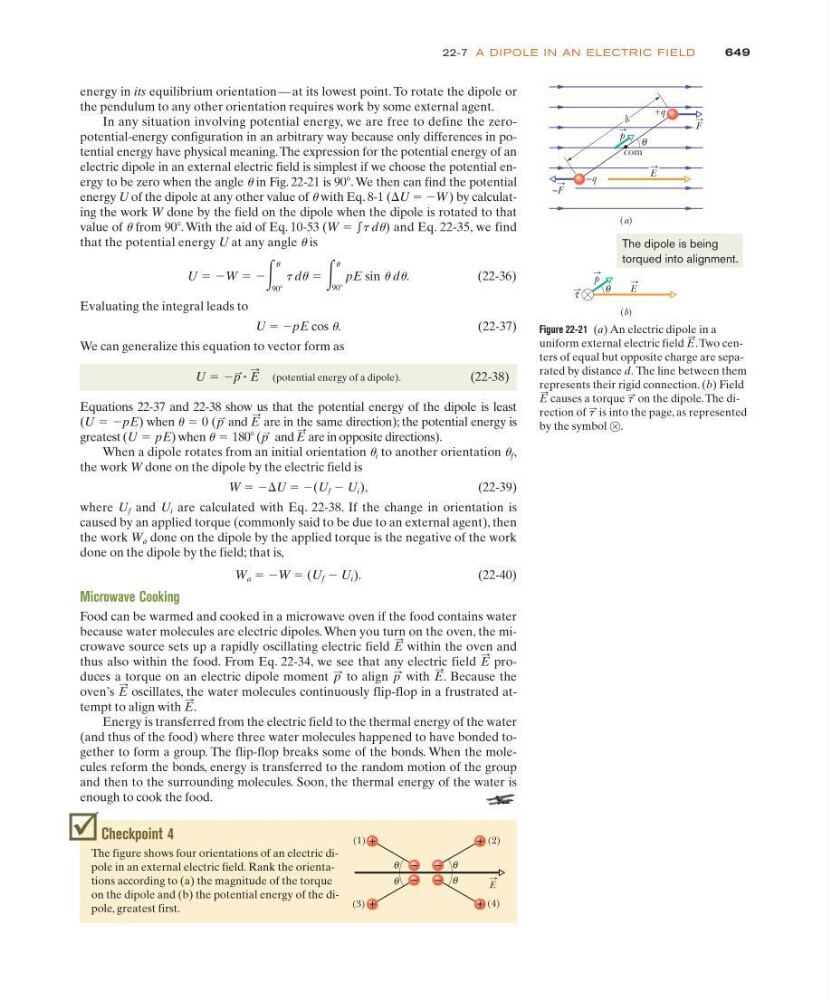
electric dipole in an external electric field is simplest if we choose the potential energy to be zero when the angle u in Fig. 22-21 is 90Њ. We then can find the potential
energy U of the dipole at any other value of u with Eq. 8-1 (⌬U ϭ ϪW) by calculating the work W done by the field on the dipole when the dipole is rotated to that
value of u from 90Њ. With the aid of Eq. 10-53 (W ϭ ͐t du) and Eq. 22-35, we find
that the potential energy U at any angle u is
(22-36)
Evaluating the integral leads to
U ϭ ϪpE cos u.
( 2 2 - 3 7 )
We can generalize this equation to vector form as
(potential energy of a dipole).
(22-38)
Equations 22-37 and 22-38 show us that the potential energy of the dipole is least
(
) w h e n
( a n d a r e i n t h e s a m e d i r e c t i o n ) ;t h e p o t e n t i a l e n e r g y i s
greatest (
) when
180 ( and are in opposite directions).
When a dipole rotates from an initial orientation u i to another orientation u f ,
the work W done on the dipole by the electric field is
W ϭ Ϫ⌬U ϭ Ϫ(U f Ϫ U i ),
(22-39)
where U f and U i are calculated with Eq. 22-38. If the change in orientation is
caused by an applied torque (commonly said to be due to an external agent), then
the work W a done on the dipole by the applied torque is the negative of the work
done on the dipole by the field; that is,
W a ϭ ϪW ϭ (U f Ϫ U i ).
(22-40)
Microwave Cooking
Food can be warmed and cooked in a microwave oven if the food contains water
because water molecules are electric dipoles. When you turn on the oven, the microwave source sets up a rapidly oscillating electric field within the oven and
thus also within the food. From Eq. 22-34, we see that any electric field produces a torque on an electric dipole moment to align with . Because the
oven’s oscillates, the water molecules continuously flip-flop in a frustrated attempt to align with .
Energy is transferred from the electric field to the thermal energy of the water
(and thus of the food) where three water molecules happened to have bonded together to form a group. The flip-flop breaks some of the bonds. When the molecules reform the bonds, energy is transferred to the random motion of the group
and then to the surrounding molecules. Soon, the thermal energy of the water is
enough to cook the food.
E
:
E
:
E
:
p
:
p
:
E
:
E
:
E
:
p
:
Њ
u ϭ
U ϭ pE
E
:
p
:
ϭ 0
U ϭ ϪpE
U ϭ Ϫp
: ؒ E
:
U ϭ ϪW ϭ Ϫ͵
u
90Њ
t du ϭ ͵
u
90Њ
pE sin u du.
Figure 22-21 (a) An electric dipole in a
uniform external electric field E
:
.Two centers of equal but opposite charge are separated by distance d. The line between them
represents their rigid connection. (b) Field
E
: causes a torque t
: on the dipole. The direction of t
: is into the page, as represented
by the symbol ᮏ.
The dipole is being
torqued into alignment.
(a)
(b)
p
d
θ
+q
–q
θ
τ
com
F
p
–F
E
E
Checkpoint 4
The figure shows four orientations of an electric dipole in an external electric field. Rank the orientations according to (a) the magnitude of the torque
on the dipole and (b) the potential energy of the dipole, greatest first.
E
θ
θ
(1)
(3)
(2)
(4)
+
+
+
+
θ
θ