

647
22-7 A DI POLE I N AN E LECTR IC FI E LD
magnitude QE acts upward on the charged drop. Thus, as the
drop travels parallel to the x axis at constant speed v x , it
accelerates upward with some constant acceleration a y .
Calculations: Applying Newton’s second law (F ϭ ma) for
components along the y axis, we find that
Sample Problem 22.04 Motion of a charged particle in an electric field
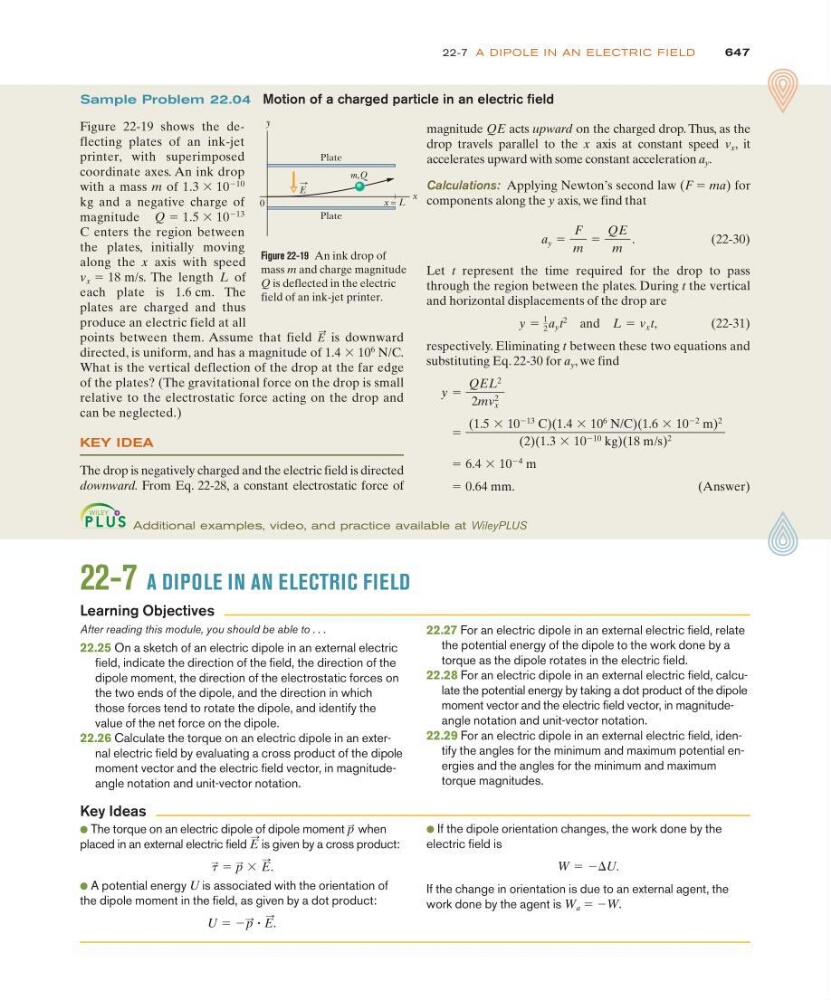
Figure 22-19 shows the deflecting plates of an ink-jet
printer, with superimposed
coordinate axes. An ink drop
with a mass m of 1.3 ϫ 10
Ϫ10
kg and a negative charge of
magnitude Q ϭ 1.5 ϫ 10
Ϫ13
C enters the region between
the plates, initially moving
along the x axis with speed
v x ϭ 18 m/s. The length L of
each plate is 1.6 cm. The
plates are charged and thus
produce an electric field at all
points between them. Assume that field
is downward
directed, is uniform, and has a magnitude of 1.4 ϫ 10
6
N/C.
What is the vertical deflection of the drop at the far edge
of the plates? (The gravitational force on the drop is small
relative to the electrostatic force acting on the drop and
can be neglected.)
KEY IDEA
The drop is negatively charged and the electric field is directed
downward. From Eq. 22-28, a constant electrostatic force of
E
:
Additional examples, video, and practice available at WileyPLUS
Figure 22-19 An ink drop of
mass m and charge magnitude
Q is deflected in the electric
field of an ink-jet printer.
22-7 A DIPOLE IN AN ELECTRIC FIELD
Learning Objectives
22.27 For an electric dipole in an external electric field, relate
the potential energy of the dipole to the work done by a
torque as the dipole rotates in the electric field.
22.28 For an electric dipole in an external electric field, calculate the potential energy by taking a dot product of the dipole
moment vector and the electric field vector, in magnitudeangle notation and unit-vector notation.
22.29 For an electric dipole in an external electric field, identify the angles for the minimum and maximum potential energies and the angles for the minimum and maximum
torque magnitudes.
● The torque on an electric dipole of dipole moment when
placed in an external electric field is given by a cross product:
● A potential energy U is associated with the orientation of
the dipole moment in the field, as given by a dot product:
U ϭ Ϫp
: ؒ E
:
.
t
: ϭ p
: ϫ E
: .
E
:
p
:
● If the dipole orientation changes, the work done by the
electric field is
If the change in orientation is due to an external agent, the
work done by the agent is W a ϭ ϪW.
W ϭ Ϫ⌬U.
After reading this module, you should be able to . . .
22.25 On a sketch of an electric dipole in an external electric
field, indicate the direction of the field, the direction of the
dipole moment, the direction of the electrostatic forces on
the two ends of the dipole, and the direction in which
those forces tend to rotate the dipole, and identify the
value of the net force on the dipole.
22.26 Calculate the torque on an electric dipole in an external electric field by evaluating a cross product of the dipole
moment vector and the electric field vector, in magnitudeangle notation and unit-vector notation.
Key Ideas
y
x
x = L
m,Q
0
E
Plate
Plate
(22-30)
Let t represent the time required for the drop to pass
through the region between the plates. During t the vertical
and horizontal displacements of the drop are
(22-31)
respectively. Eliminating t between these two equations and
substituting Eq. 22-30 for a y , we find
(Answer)
ϭ 0.64 mm.
ϭ 6.4 ϫ 10
Ϫ4
m
ϭ
(1.5 ϫ 10
Ϫ13
C)(1.4 ϫ 10
6
N/C)(1.6 ϫ 10
Ϫ2
m)
2
(2)(1.3 ϫ 10
Ϫ10
kg)(18 m/s)
2
y ϭ
QEL
2
2mv x
2
y ϭ
1
2 a y t
2
and L ϭ v x t,
a y ϭ
F
m
ϭ
QE
m
.