

Additional Problems
38
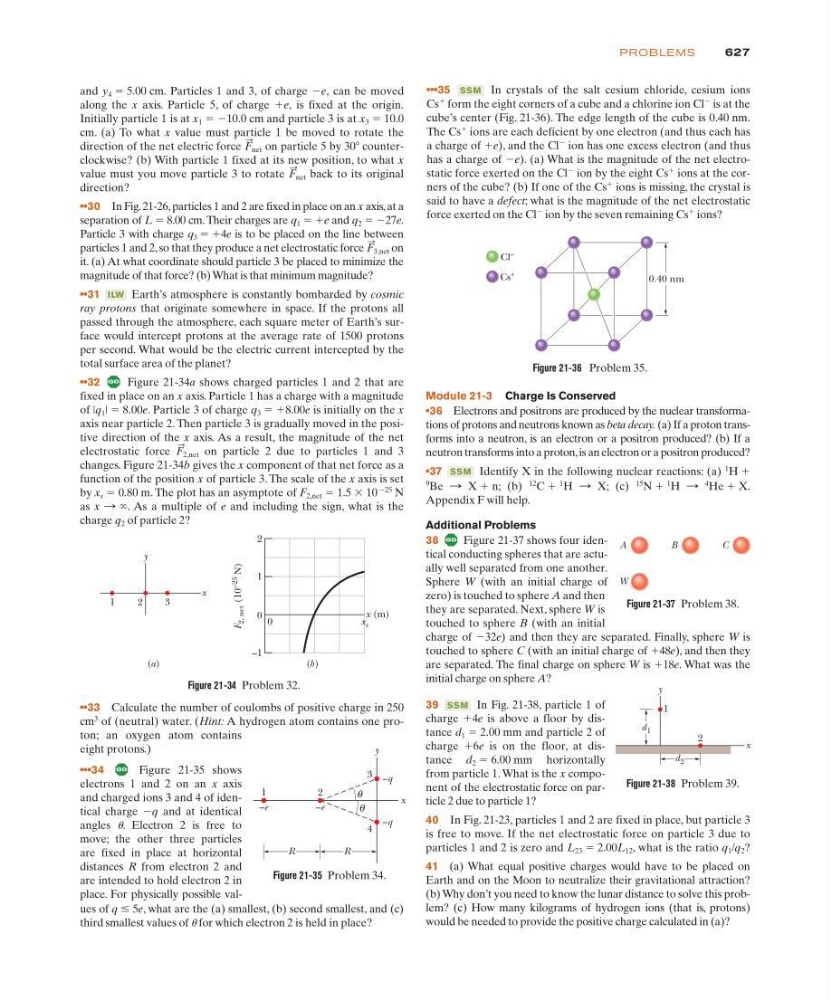
Figure 21-37 shows four identical conducting spheres that are actually well separated from one another.
Sphere W (with an initial charge of
zero) is touched to sphere A and then
they are separated. Next, sphere W is
touched to sphere B (with an initial
charge of Ϫ32e) and then they are separated. Finally, sphere W is
touched to sphere C (with an initial charge of ϩ48e), and then they
are separated. The final charge on sphere W is ϩ18e. What was the
initial charge on sphere A?
••33 Calculate the number of coulombs of positive charge in 250
cm
3
of (neutral) water. (Hint: A hydrogen atom contains one proton; an oxygen atom contains
eight protons.)
627
PROB LE M S
and y 4 ϭ 5.00 cm. Particles 1 and 3, of charge Ϫe, can be moved
along the x axis. Particle 5, of charge ϩe, is fixed at the origin.
Initially particle 1 is at x 1 ϭ Ϫ10.0 cm and particle 3 is at x 3 ϭ 10.0
cm. (a) To what x value must particle 1 be moved to rotate the
direction of the net electric force
on particle 5 by 30Њ counterclockwise? (b) With particle 1 fixed at its new position, to what x
value must you move particle 3 to rotate
back to its original
direction?
••30 In Fig. 21-26, particles 1 and 2 are fixed in place on an x axis, at a
separation of L ϭ 8.00 cm. Their charges are q 1 ϭ ϩe and q 2 ϭ Ϫ27e.
Particle 3 with charge q 3 ϭ ϩ4e is to be placed on the line between
particles 1 and 2, so that they produce a net electrostatic force
on
it. (a) At what coordinate should particle 3 be placed to minimize the
magnitude of that force? (b) What is that minimum magnitude?
••31
Earth’s atmosphere is constantly bombarded by cosmic
ray protons that originate somewhere in space. If the protons all
passed through the atmosphere, each square meter of Earth’s surface would intercept protons at the average rate of 1500 protons
per second. What would be the electric current intercepted by the
total surface area of the planet?
••32
Figure 21-34a shows charged particles 1 and 2 that are
fixed in place on an x axis. Particle 1 has a charge with a magnitude
of |q 1 | ϭ 8.00e. Particle 3 of charge q 3 ϭ ϩ8.00e is initially on the x
axis near particle 2. Then particle 3 is gradually moved in the positive direction of the x axis. As a result, the magnitude of the net
electrostatic force
on particle 2 due to particles 1 and 3
changes. Figure 21-34b gives the x component of that net force as a
function of the position x of particle 3. The scale of the x axis is set
by x s ϭ 0.80 m. The plot has an asymptote of F 2,net ϭ 1.5 ϫ 10
Ϫ25
N
as x : ϱ. As a multiple of e and including the sign, what is the
charge q 2 of particle 2?
F
:
2,net
ILW
F
:
3,net
F
:
net
F
:
net
•••35
In crystals of the salt cesium chloride, cesium ions
Cs
ϩ
form the eight corners of a cube and a chlorine ion Cl
Ϫ
is at the
cube’s center (Fig. 21-36). The edge length of the cube is 0.40 nm.
SSM
•••34
Figure 21-35 shows
electrons 1 and 2 on an x axis
and charged ions 3 and 4 of identical charge Ϫq and at identical
angles u. Electron 2 is free to
move; the other three particles
are fixed in place at horizontal
distances R from electron 2 and
are intended to hold electron 2 in
place. For physically possible valThe Cs
ϩ
ions are each deficient by one electron (and thus each has
a charge of ϩe), and the Cl
Ϫ
ion has one excess electron (and thus
has a charge of Ϫe). (a) What is the magnitude of the net electrostatic force exerted on the Cl
Ϫ
ion by the eight Cs
ϩ
ions at the corners of the cube? (b) If one of the Cs
ϩ
ions is missing, the crystal is
said to have a defect; what is the magnitude of the net electrostatic
force exerted on the Cl
Ϫ
ion by the seven remaining Cs
ϩ
ions?
2
1
0
–1
0
x (m)
F
2, net (10
–25
N)
x s
x
y
1
3
2
(a)
( b)
Figure 21-34 Problem 32.
Figure 21-35 Problem 34.
R
R
x
y
θ
θ
–q
–q
–e
–e
2
3
4
1
0.40 nm
Cs
+
Cl
–
Figure 21-36 Problem 35.
Module 21-3 Charge Is Conserved
•36 Electrons and positrons are produced by the nuclear transformations of protons and neutrons known as beta decay. (a) If a proton transforms into a neutron, is an electron or a positron produced? (b) If a
neutron transforms into a proton, is an electron or a positron produced?
•37
Identify X in the following nuclear reactions: (a)
1
H ϩ
SSM
9
Be : X ϩ n; (b)
12
C ϩ
1
H : X; (c)
15
N ϩ
1
H :
4
He ϩ X.
Appendix F will help.
A
W
B
C
Figure 21-37 Problem 38.
x
y
d 2
d 1
1
2
Figure 21-38 Problem 39.
39
In Fig. 21-38, particle 1 of
SSM
ticle 2 due to particle 1?
40 In Fig. 21-23, particles 1 and 2 are fixed in place, but particle 3
is free to move. If the net electrostatic force on particle 3 due to
particles 1 and 2 is zero and L 23 ϭ 2.00L 12 , what is the ratio q 1 /q 2 ?
41 (a) What equal positive charges would have to be placed on
Earth and on the Moon to neutralize their gravitational attraction?
(b) Why don’t you need to know the lunar distance to solve this problem? (c) How many kilograms of hydrogen ions (that is, protons)
would be needed to provide the positive charge calculated in (a)?
charge ϩ4e is above a floor by distance d 1 ϭ 2.00 mm and particle 2 of
charge ϩ6e is on the floor, at distance d 2 ϭ 6.00 mm horizontally
from particle 1. What is the x component of the electrostatic force on parues of q Յ 5e, what are the (a) smallest, (b) second smallest, and (c)
third smallest values of u for which electron 2 is held in place?