

625
PROB LE M S
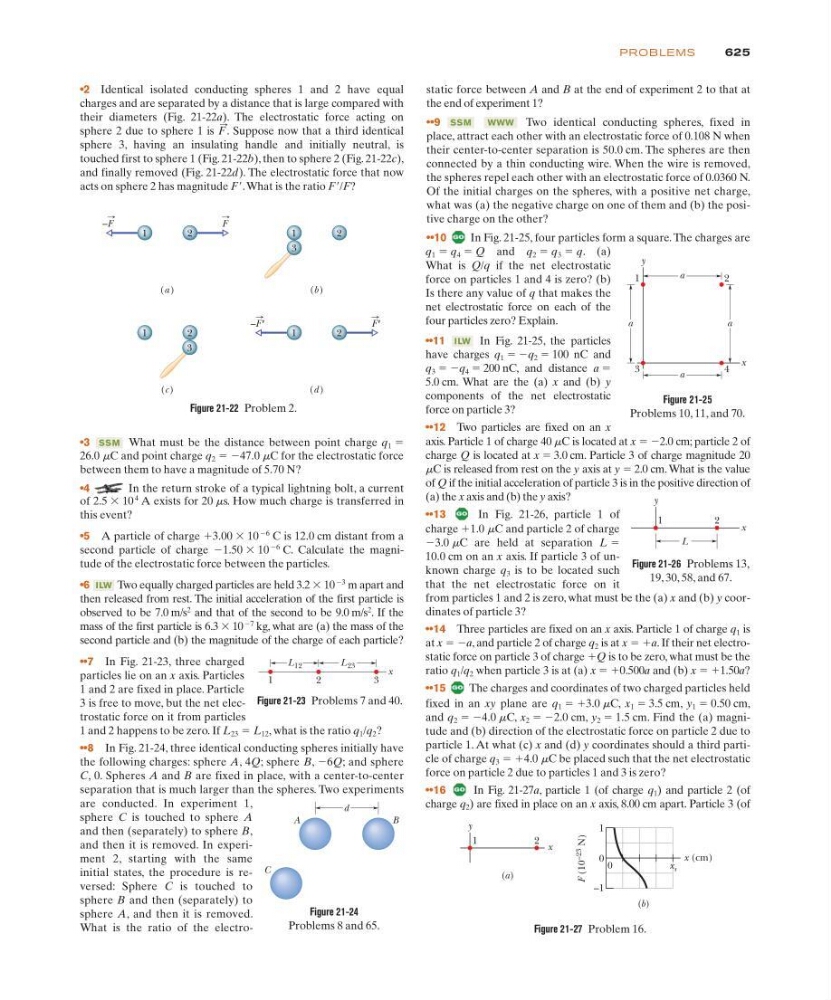
•2 Identical isolated conducting spheres 1 and 2 have equal
charges and are separated by a distance that is large compared with
their diameters (Fig. 21-22a). The electrostatic force acting on
sphere 2 due to sphere 1 is . Suppose now that a third identical
sphere 3, having an insulating handle and initially neutral, is
touched first to sphere 1 (Fig. 21-22b), then to sphere 2 (Fig. 21-22c),
and finally removed (Fig. 21-22d). The electrostatic force that now
acts on sphere 2 has magnitude FЈ.What is the ratio FЈ/F?
F
:
(a )
1
2
(b )
1
2
3
(c )
1
2
(d )
1
2
3
F
F'
–F
–F'
Figure 21-22 Problem 2.
•3
What must be the distance between point charge q 1 ϭ
SSM
static force between A and B at the end of experiment 2 to that at
the end of experiment 1?
••9
Two identical conducting spheres, fixed in
place, attract each other with an electrostatic force of 0.108 N when
their center-to-center separation is 50.0 cm. The spheres are then
connected by a thin conducting wire. When the wire is removed,
the spheres repel each other with an electrostatic force of 0.0360 N.
Of the initial charges on the spheres, with a positive net charge,
what was (a) the negative charge on one of them and (b) the positive charge on the other?
••10
In Fig. 21-25, four particles form a square. The charges are
WWW
SSM
26.0 mC and point charge q 2 ϭ Ϫ47.0 mC for the electrostatic force
between them to have a magnitude of 5.70 N?
•4
In the return stroke of a typical lightning bolt, a current
of 2.5 ϫ 10
4
A exists for 20 ms. How much charge is transferred in
this event?
•5 A particle of charge ϩ3.00 ϫ 10
Ϫ6
C is 12.0 cm distant from a
second particle of charge Ϫ1.50 ϫ 10
Ϫ6
C. Calculate the magnitude of the electrostatic force between the particles.
•6
Two equally charged particles are held 3.2 ϫ 10
Ϫ3
m apart and
then released from rest. The initial acceleration of the first particle is
observed to be 7.0 m/s
2
and that of the second to be 9.0 m/s
2
. If the
mass of the first particle is 6.3 ϫ 10
Ϫ7
kg, what are (a) the mass of the
second particle and (b) the magnitude of the charge of each particle?
••7 In Fig. 21-23, three charged
particles lie on an x axis. Particles
1 and 2 are fixed in place. Particle
3 is free to move, but the net electrostatic force on it from particles
1 and 2 happens to be zero. If L 23 ϭ L 12 , what is the ratio q 1 /q 2 ?
••8 In Fig. 21-24, three identical conducting spheres initially have
the following charges: sphere A, 4Q; sphere B, Ϫ6Q; and sphere
C, 0. Spheres A and B are fixed in place, with a center-to-center
separation that is much larger than the spheres. Two experiments
are conducted. In experiment 1,
sphere C is touched to sphere A
and then (separately) to sphere B,
and then it is removed. In experiment 2, starting with the same
initial states, the procedure is reversed: Sphere C is touched to
sphere B and then (separately) to
sphere A, and then it is removed.
What is the ratio of the electroILW
L 12
L 23
1
2
3
x
Figure 21-23 Problems 7 and 40.
Figure 21-24
Problems 8 and 65.
C
A
d
B
Figure 21-25
Problems 10, 11, and 70.
3
4
1
2
a
a
a
a
x
y
q 1 ϭ q 4 ϭ Q and q 2 ϭ q 3 ϭ q. (a)
What is Q/q if the net electrostatic
force on particles 1 and 4 is zero? (b)
Is there any value of q that makes the
net electrostatic force on each of the
four particles zero? Explain.
••11
In Fig. 21-25, the particles
ILW
have charges q 1 ϭ Ϫq 2 ϭ 100 nC and
q 3 ϭ Ϫq 4 ϭ 200 nC, and distance a ϭ
5.0 cm. What are the (a) x and (b) y
components of the net electrostatic
force on particle 3?
••12 Two particles are fixed on an x
axis. Particle 1 of charge 40 mC is located at x ϭ Ϫ2.0 cm; particle 2 of
charge Q is located at x ϭ 3.0 cm. Particle 3 of charge magnitude 20
mC is released from rest on the y axis at y ϭ 2.0 cm. What is the value
of Q if the initial acceleration of particle 3 is in the positive direction of
(a) the x axis and (b) the y axis?
••13
In Fig. 21-26, particle 1 of
x
y
1
2
L
Figure 21-26 Problems 13,
19, 30, 58, and 67.
charge ϩ1.0 mC and particle 2 of charge
Ϫ3.0 mC are held at separation L ϭ
10.0 cm on an x axis. If particle 3 of unknown charge q 3 is to be located such
that the net electrostatic force on it
from particles 1 and 2 is zero, what must be the (a) x and (b) y coordinates of particle 3?
••14 Three particles are fixed on an x axis. Particle 1 of charge q 1 is
at x ϭ Ϫa, and particle 2 of charge q 2 is at x ϭ ϩa. If their net electrostatic force on particle 3 of charge ϩQ is to be zero, what must be the
ratio q 1 /q 2 when particle 3 is at (a) x ϭ ϩ0.500a and (b) x ϭ ϩ1.50a?
••15
The charges and coordinates of two charged particles held
fixed in an xy plane are q 1 ϭ ϩ3.0 mC, x 1 ϭ 3.5 cm, y 1 ϭ 0.50 cm,
and q 2 ϭ Ϫ4.0 mC, x 2 ϭ Ϫ2.0 cm, y 2 ϭ 1.5 cm. Find the (a) magnitude and (b) direction of the electrostatic force on particle 2 due to
particle 1. At what (c) x and (d) y coordinates should a third particle of charge q 3 ϭ ϩ4.0 mC be placed such that the net electrostatic
force on particle 2 due to particles 1 and 3 is zero?
••16
In Fig. 21-27a, particle 1 (of charge q 1 ) and particle 2 (of
charge q 2 ) are fixed in place on an x axis, 8.00 cm apart. Particle 3 (of
F (10 –23
N)
–1
0
1
0
x s
x
x (cm)
y
(a)
(b)
1
2
Figure 21-27 Problem 16.