

623
QU ESTIONS
Questions
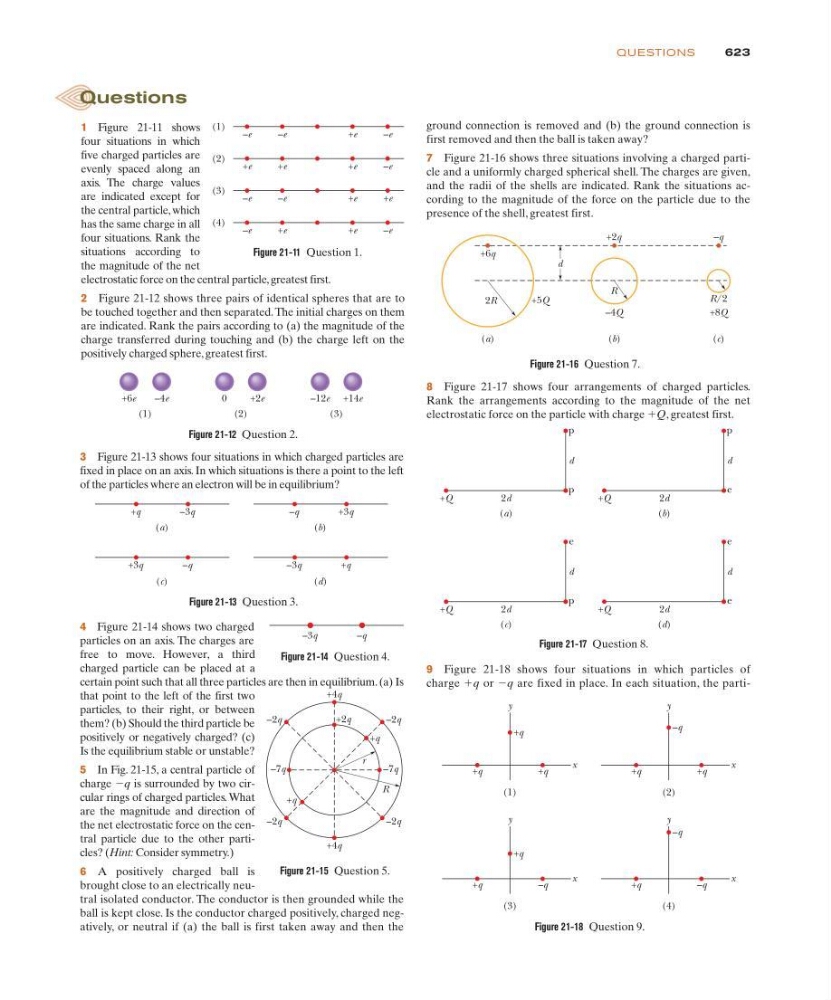
1 Figure 21-11 shows
four situations in which
five charged particles are
evenly spaced along an
axis. The charge values
are indicated except for
the central particle, which
has the same charge in all
four situations. Rank the
situations according to
the magnitude of the net
electrostatic force on the central particle, greatest first.
2 Figure 21-12 shows three pairs of identical spheres that are to
be touched together and then separated. The initial charges on them
are indicated. Rank the pairs according to (a) the magnitude of the
charge transferred during touching and (b) the charge left on the
positively charged sphere, greatest first.
4 Figure 21-14 shows two charged
particles on an axis. The charges are
free to move. However, a third
charged particle can be placed at a
certain point such that all three particles are then in equilibrium. (a) Is
that point to the left of the first two
particles, to their right, or between
them? (b) Should the third particle be
positively or negatively charged? (c)
Is the equilibrium stable or unstable?
5 In Fig. 21-15, a central particle of
charge Ϫq is surrounded by two circular rings of charged particles. What
are the magnitude and direction of
the net electrostatic force on the central particle due to the other particles? (Hint: Consider symmetry.)
6 A positively charged ball is
brought close to an electrically neutral isolated conductor. The conductor is then grounded while the
ball is kept close. Is the conductor charged positively, charged negatively, or neutral if (a) the ball is first taken away and then the
–e
–e
+e
–e
(1)
+e
+e
+e
–e
(2)
–e
–e
+e
+e
(3)
–e
+e
+e
–e
(4)
Figure 21-11 Question 1.
+6e
–4e
(1)
0
+2e
(2)
–12e +14e
(3)
Figure 21-12 Question 2.
3 Figure 21-13 shows four situations in which charged particles are
fixed in place on an axis. In which situations is there a point to the left
of the particles where an electron will be in equilibrium?
+q
(a)
–3q
+3q
(c)
–q
–3q
(d)
+q
(b)
–q
+3q
Figure 21-13 Question 3.
–3q
–q
Figure 21-14 Question 4.
+4q
+2q
+q
–2q
r
R
–2q
–7q
–7q
–2q
–2q
+4q
+q
Figure 21-15 Question 5.
ground connection is removed and (b) the ground connection is
first removed and then the ball is taken away?
7 Figure 21-16 shows three situations involving a charged particle and a uniformly charged spherical shell. The charges are given,
and the radii of the shells are indicated. Rank the situations according to the magnitude of the force on the particle due to the
presence of the shell, greatest first.
R
2R
R/2
+8Q
–q
+2q
+6q
–4Q
+5Q
(a)
( b)
( c)
d
Figure 21-16 Question 7.
8 Figure 21-17 shows four arrangements of charged particles.
Rank the arrangements according to the magnitude of the net
electrostatic force on the particle with charge ϩQ, greatest first.
+Q
p
p
d
2d
(a)
+Q
e
p
d
2d
(b)
+Q
p
e
d
2d
(c)
+Q
e
e
d
2d
(d)
Figure 21-17 Question 8.
9 Figure 21-18 shows four situations in which particles of
charge ϩq or Ϫq are fixed in place. In each situation, the partiFigure 21-18 Question 9.
x
y
+q
+q
+q
(1)
x
y
–q
+q
+q
(2)
x
y
+q
–q
+q
(3)
x
y
–q
–q
+q
(4)