

is 2220 J/kg иK; water’s heat of fusion is 333 kJ/kg. (Note that the
engine can operate only between 0ЊC and 800ЊC in this case. Energy
exhausted at Ϫ40ЊC cannot warm anything above Ϫ40ЊC.)
54 What is the entropy change for 3.20 mol of an ideal
monatomic gas undergoing a reversible increase in temperature
from 380 K to 425 K at constant volume?
55 A 600 g lump of copper at 80.0ЊC is placed in 70.0 g of water at
10.0 C in an insulated container. (See Table 18-3 for specific heats.)
(a) What is the equilibrium temperature of the copper –
water system? What entropy changes do (b) the copper, (c) the
water, and (d) the copper – water system undergo in reaching the
equilibrium temperature?
56
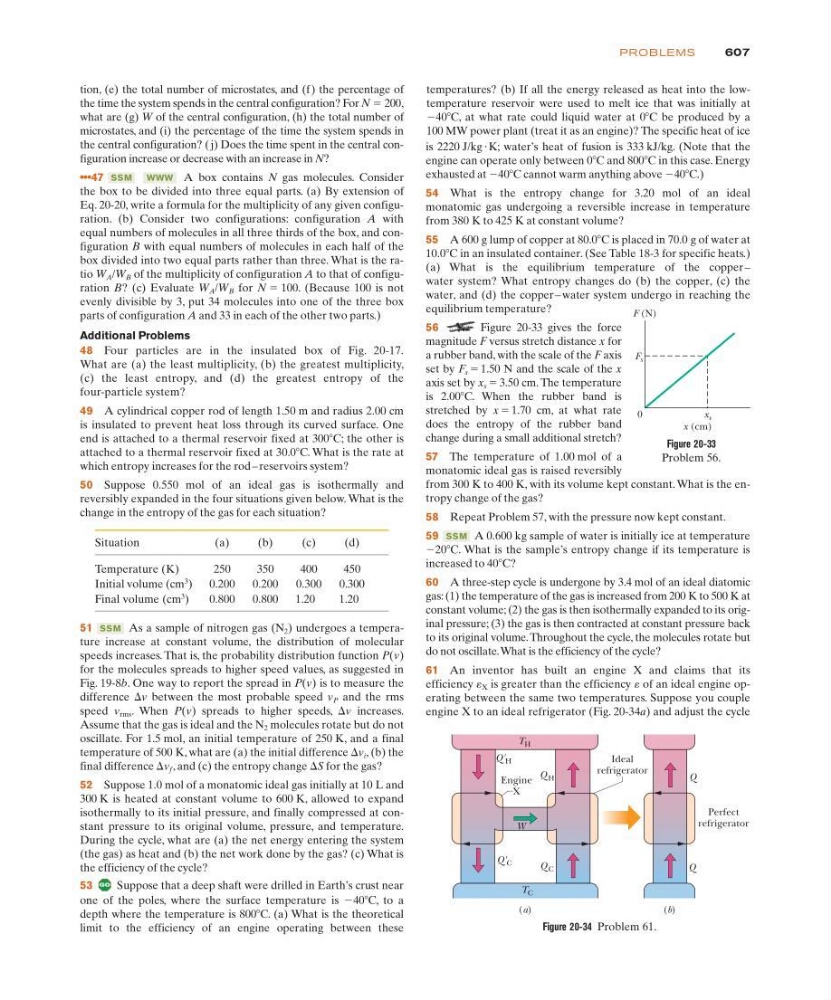
Figure 20-33 gives the force
magnitude F versus stretch distance x for
a rubber band, with the scale of the F axis
set by F s ϭ 1.50 N and the scale of the x
axis set by x s ϭ 3.50 cm. The temperature
is 2.00 C. When the rubber band is
stretched by x ϭ 1.70 cm, at what rate
does the entropy of the rubber band
change during a small additional stretch?
57 The temperature of 1.00 mol of a
monatomic ideal gas is raised reversibly
from 300 K to 400 K, with its volume kept constant. What is the entropy change of the gas?
58 Repeat Problem 57, with the pressure now kept constant.
59
A 0.600 kg sample of water is initially ice at temperature
. What is the sample’s entropy change if its temperature is
increased to 40 C?
60 A three-step cycle is undergone by 3.4 mol of an ideal diatomic
gas: (1) the temperature of the gas is increased from 200 K to 500 K at
constant volume; (2) the gas is then isothermally expanded to its original pressure; (3) the gas is then contracted at constant pressure back
to its original volume. Throughout the cycle, the molecules rotate but
do not oscillate.What is the efficiency of the cycle?
61 An inventor has built an engine X and claims that its
efficiency ´ X is greater than the efficiency ´ of an ideal engine operating between the same two temperatures. Suppose you couple
engine X to an ideal refrigerator (Fig. 20-34a) and adjust the cycle
Њ
Ϫ20ЊC
SSM
Њ
Њ
607
PROB LE M S
tion, (e) the total number of microstates, and (f) the percentage of
the time the system spends in the central configuration? For N ϭ 200,
what are (g) W of the central configuration, (h) the total number of
microstates, and (i) the percentage of the time the system spends in
the central configuration? ( j) Does the time spent in the central configuration increase or decrease with an increase in N?
•••47
A box contains N gas molecules. Consider
the box to be divided into three equal parts. (a) By extension of
Eq. 20-20, write a formula for the multiplicity of any given configuration. (b) Consider two configurations: configuration A with
equal numbers of molecules in all three thirds of the box, and configuration B with equal numbers of molecules in each half of the
box divided into two equal parts rather than three. What is the ratio W A /W B of the multiplicity of configuration A to that of configuration B? (c) Evaluate W A /W B for N ϭ 100. (Because 100 is not
evenly divisible by 3, put 34 molecules into one of the three box
parts of configuration A and 33 in each of the other two parts.)
Additional Problems
48 Four particles are in the insulated box of Fig. 20-17.
What are (a) the least multiplicity, (b) the greatest multiplicity,
(c) the least entropy, and (d) the greatest entropy of the
four-particle system?
49 A cylindrical copper rod of length 1.50 m and radius 2.00 cm
is insulated to prevent heat loss through its curved surface. One
end is attached to a thermal reservoir fixed at 300 C; the other is
attached to a thermal reservoir fixed at 30.0 C. What is the rate at
which entropy increases for the rod – reservoirs system?
50 Suppose 0.550 mol of an ideal gas is isothermally and
reversibly expanded in the four situations given below. What is the
change in the entropy of the gas for each situation?
Situation
(a)
(b)
(c)
(d)
Temperature (K)
250
350
400
450
Initial volume (cm
3
) 0.200
0.200
0.300
0.300
Final volume (cm
3
)
0.800
0.800
1.20
1.20
51
As a sample of nitrogen gas (N 2 ) undergoes a temperature increase at constant volume, the distribution of molecular
speeds increases. That is, the probability distribution function P(v)
for the molecules spreads to higher speed values, as suggested in
Fig. 19-8b. One way to report the spread in P(v) is to measure the
difference ⌬v between the most probable speed v P and the rms
speed v rms . When P(v) spreads to higher speeds, ⌬v increases.
Assume that the gas is ideal and the N 2 molecules rotate but do not
oscillate. For 1.5 mol, an initial temperature of 250 K, and a final
temperature of 500 K, what are (a) the initial difference ⌬v i , (b) the
final difference ⌬v f , and (c) the entropy change ⌬S for the gas?
52 Suppose 1.0 mol of a monatomic ideal gas initially at 10 L and
300 K is heated at constant volume to 600 K, allowed to expand
isothermally to its initial pressure, and finally compressed at constant pressure to its original volume, pressure, and temperature.
During the cycle, what are (a) the net energy entering the system
(the gas) as heat and (b) the net work done by the gas? (c) What is
the efficiency of the cycle?
53
Suppose that a deep shaft were drilled in Earth’s crust near
SSM
Њ
Њ
WWW
SSM
temperatures? (b) If all the energy released as heat into the lowtemperature reservoir were used to melt ice that was initially at
Ϫ40 C, at what rate could liquid water at 0ЊC be produced by a
100 MW power plant (treat it as an engine)? The specific heat of ice
Њ
F (N)
F s
0
x (cm)
x s
Figure 20-33
Problem 56.
Engine
X
T C
(a)
(b)
T H
Ideal
refrigerator
Perfect
refrigerator
W
Q H
Q' H
Q
Q C
Q
Q' C
Figure 20-34 Problem 61.
one of the poles, where the surface temperature is Ϫ40 C, to a
depth where the temperature is 800 C. (a) What is the theoretical
limit to the efficiency of an engine operating between these
Њ
Њ