

time t ϭ 0.At t ϭ 1.5 s it passes the top of a tall tower, and 1.0 s later
it reaches its maximum height.What is the height of the tower?
•••61
A steel ball is dropped from a building’s roof and passes
a window, taking 0.125 s to fall from the top to the bottom of the
window, a distance of 1.20 m. It then falls to a sidewalk and
bounces back past the window, moving from bottom to top in
0.125 s. Assume that the upward flight is an exact reverse of the
fall. The time the ball spends below the bottom of the window is
2.00 s. How tall is the building?
•••62
A basketball player grabbing a rebound jumps
76.0 cm vertically. How much total time (ascent and descent) does
the player spend (a) in the top 15.0 cm of this jump and (b) in the
bottom 15.0 cm? (The player seems to hang in the air at the top.)
•••63
A drowsy cat spots a flowerpot that sails first up and then
down past an open window. The pot is in view for a total of 0.50 s, and
the top-to-bottom height of the window is 2.00 m. How high above the
window top does the flowerpot go?
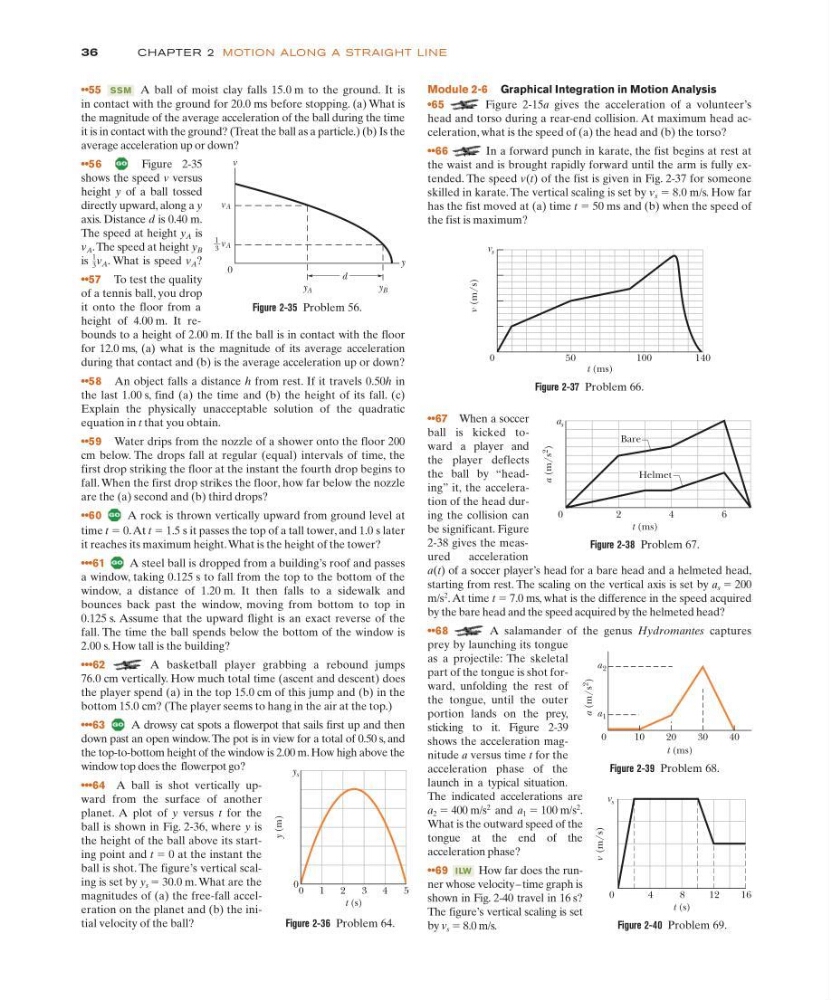
•••64 A ball is shot vertically upward from the surface of another
planet. A plot of y versus t for the
ball is shown in Fig. 2-36, where y is
the height of the ball above its starting point and t ϭ 0 at the instant the
ball is shot. The figure’s vertical scaling is set by y s ϭ 30.0 m. What are the
magnitudes of (a) the free-fall acceleration on the planet and (b) the initial velocity of the ball?
36
CHAPTE R 2 MOTION ALONG A STRAIGHT LINE
t (ms)
0
50
100
140
v s
v
(m/s)
Figure 2-37 Problem 66.
••55
A ball of moist clay falls 15.0 m to the ground. It is
in contact with the ground for 20.0 ms before stopping. (a) What is
the magnitude of the average acceleration of the ball during the time
it is in contact with the ground? (Treat the ball as a particle.) (b) Is the
average acceleration up or down?
••56
Figure 2-35
shows the speed v versus
height y of a ball tossed
directly upward, along a y
axis. Distance d is 0.40 m.
The speed at height y A is
v A .The speed at height y B
is v A . What is speed v A ?
••57 To test the quality
of a tennis ball, you drop
it onto the floor from a
height of 4.00 m. It rebounds to a height of 2.00 m. If the ball is in contact with the floor
for 12.0 ms, (a) what is the magnitude of its average acceleration
during that contact and (b) is the average acceleration up or down?
••58 An object falls a distance h from rest. If it travels 0.50h in
the last 1.00 s, find (a) the time and (b) the height of its fall. (c)
Explain the physically unacceptable solution of the quadratic
equation in t that you obtain.
••59 Water drips from the nozzle of a shower onto the floor 200
cm below. The drops fall at regular (equal) intervals of time, the
first drop striking the floor at the instant the fourth drop begins to
fall. When the first drop strikes the floor, how far below the nozzle
are the (a) second and (b) third drops?
••60
A rock is thrown vertically upward from ground level at
1
3
SSM
Module 2-6 Graphical Integration in Motion Analysis
•65
Figure 2-15a gives the acceleration of a volunteer’s
head and torso during a rear-end collision. At maximum head acceleration, what is the speed of (a) the head and (b) the torso?
••66
In a forward punch in karate, the fist begins at rest at
the waist and is brought rapidly forward until the arm is fully extended. The speed v(t) of the fist is given in Fig. 2-37 for someone
skilled in karate. The vertical scaling is set by v s ϭ 8.0 m/s. How far
has the fist moved at (a) time t ϭ 50 ms and (b) when the speed of
the fist is maximum?
••67 When a soccer
ball is kicked toward a player and
the player deflects
the ball by “heading” it, the acceleration of the head during the collision can
be significant. Figure
2-38 gives the measured
acceleration
a(t) of a soccer player’s head for a bare head and a helmeted head,
starting from rest. The scaling on the vertical axis is set by a s ϭ 200
m/s
2
. At time t ϭ 7.0 ms, what is the difference in the speed acquired
by the bare head and the speed acquired by the helmeted head?
••68
A salamander of the genus Hydromantes captures
prey by launching its tongue
as a projectile: The skeletal
part of the tongue is shot forward, unfolding the rest of
the tongue, until the outer
portion lands on the prey,
sticking to it. Figure 2-39
shows the acceleration magnitude a versus time t for the
acceleration phase of the
launch in a typical situation.
The indicated accelerations are
a 2 ϭ 400 m/s
2
and a 1 ϭ 100 m/s
2
.
What is the outward speed of the
tongue at the end of the
acceleration phase?
••69
How far does the runner whose velocity – time graph is
shown in Fig. 2-40 travel in 16 s?
The figure’s vertical scaling is set
by v s ϭ 8.0 m/s.
ILW
y
y A
y B
vA
vA
v
1
__
3
d
0
Figure 2-35 Problem 56.
y s
0
0
1
2
3
4
5
y (m)
t (s)
Figure 2-36 Problem 64.
a (m/s
2
)
a 2
a 1
0
t (ms)
10
20
30
40
Figure 2-39 Problem 68.
0
4
8
12
16
v s
v
(m/s)
t (s)
Figure 2-40 Problem 69.
Bare
Helmet
0
a s
2
4
6
a (m/s
2
)
t (ms)
Figure 2-38 Problem 67.
it reaches its maximum height.What is the height of the tower?
•••61
A steel ball is dropped from a building’s roof and passes
a window, taking 0.125 s to fall from the top to the bottom of the
window, a distance of 1.20 m. It then falls to a sidewalk and
bounces back past the window, moving from bottom to top in
0.125 s. Assume that the upward flight is an exact reverse of the
fall. The time the ball spends below the bottom of the window is
2.00 s. How tall is the building?
•••62
A basketball player grabbing a rebound jumps
76.0 cm vertically. How much total time (ascent and descent) does
the player spend (a) in the top 15.0 cm of this jump and (b) in the
bottom 15.0 cm? (The player seems to hang in the air at the top.)
•••63
A drowsy cat spots a flowerpot that sails first up and then
down past an open window. The pot is in view for a total of 0.50 s, and
the top-to-bottom height of the window is 2.00 m. How high above the
window top does the flowerpot go?
•••64 A ball is shot vertically upward from the surface of another
planet. A plot of y versus t for the
ball is shown in Fig. 2-36, where y is
the height of the ball above its starting point and t ϭ 0 at the instant the
ball is shot. The figure’s vertical scaling is set by y s ϭ 30.0 m. What are the
magnitudes of (a) the free-fall acceleration on the planet and (b) the initial velocity of the ball?
36
CHAPTE R 2 MOTION ALONG A STRAIGHT LINE
t (ms)
0
50
100
140
v s
v
(m/s)
Figure 2-37 Problem 66.
••55
A ball of moist clay falls 15.0 m to the ground. It is
in contact with the ground for 20.0 ms before stopping. (a) What is
the magnitude of the average acceleration of the ball during the time
it is in contact with the ground? (Treat the ball as a particle.) (b) Is the
average acceleration up or down?
••56
Figure 2-35
shows the speed v versus
height y of a ball tossed
directly upward, along a y
axis. Distance d is 0.40 m.
The speed at height y A is
v A .The speed at height y B
is v A . What is speed v A ?
••57 To test the quality
of a tennis ball, you drop
it onto the floor from a
height of 4.00 m. It rebounds to a height of 2.00 m. If the ball is in contact with the floor
for 12.0 ms, (a) what is the magnitude of its average acceleration
during that contact and (b) is the average acceleration up or down?
••58 An object falls a distance h from rest. If it travels 0.50h in
the last 1.00 s, find (a) the time and (b) the height of its fall. (c)
Explain the physically unacceptable solution of the quadratic
equation in t that you obtain.
••59 Water drips from the nozzle of a shower onto the floor 200
cm below. The drops fall at regular (equal) intervals of time, the
first drop striking the floor at the instant the fourth drop begins to
fall. When the first drop strikes the floor, how far below the nozzle
are the (a) second and (b) third drops?
••60
A rock is thrown vertically upward from ground level at
1
3
SSM
Module 2-6 Graphical Integration in Motion Analysis
•65
Figure 2-15a gives the acceleration of a volunteer’s
head and torso during a rear-end collision. At maximum head acceleration, what is the speed of (a) the head and (b) the torso?
••66
In a forward punch in karate, the fist begins at rest at
the waist and is brought rapidly forward until the arm is fully extended. The speed v(t) of the fist is given in Fig. 2-37 for someone
skilled in karate. The vertical scaling is set by v s ϭ 8.0 m/s. How far
has the fist moved at (a) time t ϭ 50 ms and (b) when the speed of
the fist is maximum?
••67 When a soccer
ball is kicked toward a player and
the player deflects
the ball by “heading” it, the acceleration of the head during the collision can
be significant. Figure
2-38 gives the measured
acceleration
a(t) of a soccer player’s head for a bare head and a helmeted head,
starting from rest. The scaling on the vertical axis is set by a s ϭ 200
m/s
2
. At time t ϭ 7.0 ms, what is the difference in the speed acquired
by the bare head and the speed acquired by the helmeted head?
••68
A salamander of the genus Hydromantes captures
prey by launching its tongue
as a projectile: The skeletal
part of the tongue is shot forward, unfolding the rest of
the tongue, until the outer
portion lands on the prey,
sticking to it. Figure 2-39
shows the acceleration magnitude a versus time t for the
acceleration phase of the
launch in a typical situation.
The indicated accelerations are
a 2 ϭ 400 m/s
2
and a 1 ϭ 100 m/s
2
.
What is the outward speed of the
tongue at the end of the
acceleration phase?
••69
How far does the runner whose velocity – time graph is
shown in Fig. 2-40 travel in 16 s?
The figure’s vertical scaling is set
by v s ϭ 8.0 m/s.
ILW
y
y A
y B
vA
vA
v
1
__
3
d
0
Figure 2-35 Problem 56.
y s
0
0
1
2
3
4
5
y (m)
t (s)
Figure 2-36 Problem 64.
a (m/s
2
)
a 2
a 1
0
t (ms)
10
20
30
40
Figure 2-39 Problem 68.
0
4
8
12
16
v s
v
(m/s)
t (s)
Figure 2-40 Problem 69.
Bare
Helmet
0
a s
2
4
6
a (m/s
2
)
t (ms)
Figure 2-38 Problem 67.