

and then
C p ϭ C V ϩ R.
(19-49)
This prediction of kinetic theory agrees well with experiment, not only for
monatomic gases but also for gases in general, as long as their density is low
enough so that we may treat them as ideal.
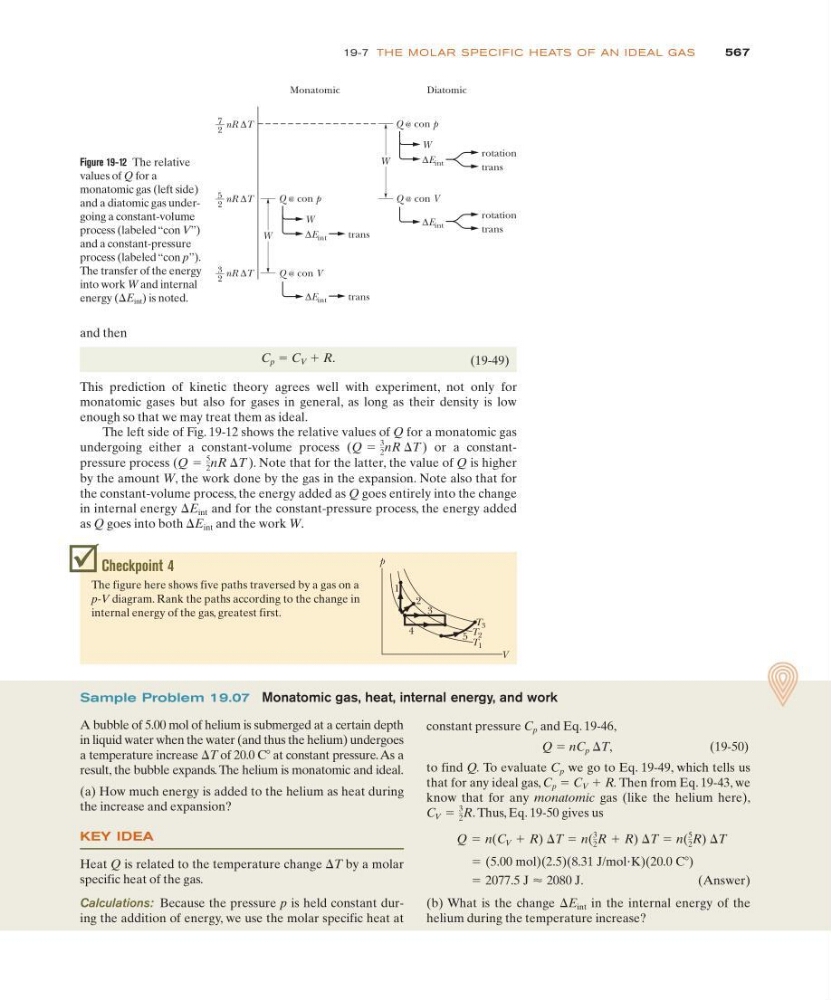
The left side of Fig. 19-12 shows the relative values of Q for a monatomic gas
undergoing either a constant-volume process
or a constant(Q ϭ
3
2 nR ⌬T )
567
19-7 TH E M OL AR SPECI FIC H EATS OF AN I DEAL GAS
Monatomic
Diatomic
nR ∆T
7
__
2
nR ∆T
5
__
2
nR ∆T
Q @ con V
Q @ con p
W
W
∆E int
trans
3
__
2
∆E int
trans
Q @ con V
Q @ con p
W
∆E int
trans
rotation
trans
rotation
∆E int
W
Figure 19-12 The relative
values of Q for a
monatomic gas (left side)
and a diatomic gas undergoing a constant-volume
process (labeled “con V”)
and a constant-pressure
process (labeled “con p”).
The transfer of the energy
into work W and internal
energy (⌬E int ) is noted.
Checkpoint 4
The figure here shows five paths traversed by a gas on a
p-V diagram. Rank the paths according to the change in
internal energy of the gas, greatest first.
p
V
T 1
T 2
T 3
4
3
2
1
5
constant pressure C p and Eq. 19-46,
Q ϭ nC p ⌬T,
( 1 9 - 5 0 )
to find Q. To evaluate C p we go to Eq. 19-49, which tells us
that for any ideal gas, C p ϭ C V ϩ R. Then from Eq. 19-43, we
know that for any monatomic gas (like the helium here),
Thus, Eq. 19-50 gives us
(Answer)
(b) What is the change ⌬E int in the internal energy of the
helium during the temperature increase?
ϭ 2077.5 J Ϸ 2080 J.
ϭ (5.00 mol)(2.5)(8.31 J/molиK)(20.0 CЊ)
Q ϭ n(C V ϩ R) ⌬T ϭ n(
3
2 R ϩ R) ⌬T ϭ n(
5
2 R) ⌬T
C V ϭ
3
2 R.
Sample Problem 19.07 Monatomic gas, heat, internal energy, and work
A bubble of 5.00 mol of helium is submerged at a certain depth
in liquid water when the water (and thus the helium) undergoes
a temperature increase ⌬T of 20.0 CЊ at constant pressure. As a
result, the bubble expands. The helium is monatomic and ideal.
(a) How much energy is added to the helium as heat during
the increase and expansion?
KEY IDEA
Heat Q is related to the temperature change ⌬T by a molar
specific heat of the gas.
Calculations: Because the pressure p is held constant during the addition of energy, we use the molar specific heat at
pressure process
. Note that for the latter, the value of Q is higher
(Q ϭ
5
2 nR ⌬T )
by the amount W, the work done by the gas in the expansion. Note also that for
the constant-volume process, the energy added as Q goes entirely into the change
in internal energy ⌬E int and for the constant-pressure process, the energy added
as Q goes into both ⌬E int and the work W.
C p ϭ C V ϩ R.
(19-49)
This prediction of kinetic theory agrees well with experiment, not only for
monatomic gases but also for gases in general, as long as their density is low
enough so that we may treat them as ideal.
The left side of Fig. 19-12 shows the relative values of Q for a monatomic gas
undergoing either a constant-volume process
or a constant(Q ϭ
3
2 nR ⌬T )
567
19-7 TH E M OL AR SPECI FIC H EATS OF AN I DEAL GAS
Monatomic
Diatomic
nR ∆T
7
__
2
nR ∆T
5
__
2
nR ∆T
Q @ con V
Q @ con p
W
W
∆E int
trans
3
__
2
∆E int
trans
Q @ con V
Q @ con p
W
∆E int
trans
rotation
trans
rotation
∆E int
W
Figure 19-12 The relative
values of Q for a
monatomic gas (left side)
and a diatomic gas undergoing a constant-volume
process (labeled “con V”)
and a constant-pressure
process (labeled “con p”).
The transfer of the energy
into work W and internal
energy (⌬E int ) is noted.
Checkpoint 4
The figure here shows five paths traversed by a gas on a
p-V diagram. Rank the paths according to the change in
internal energy of the gas, greatest first.
p
V
T 1
T 2
T 3
4
3
2
1
5
constant pressure C p and Eq. 19-46,
Q ϭ nC p ⌬T,
( 1 9 - 5 0 )
to find Q. To evaluate C p we go to Eq. 19-49, which tells us
that for any ideal gas, C p ϭ C V ϩ R. Then from Eq. 19-43, we
know that for any monatomic gas (like the helium here),
Thus, Eq. 19-50 gives us
(Answer)
(b) What is the change ⌬E int in the internal energy of the
helium during the temperature increase?
ϭ 2077.5 J Ϸ 2080 J.
ϭ (5.00 mol)(2.5)(8.31 J/molиK)(20.0 CЊ)
Q ϭ n(C V ϩ R) ⌬T ϭ n(
3
2 R ϩ R) ⌬T ϭ n(
5
2 R) ⌬T
C V ϭ
3
2 R.
Sample Problem 19.07 Monatomic gas, heat, internal energy, and work
A bubble of 5.00 mol of helium is submerged at a certain depth
in liquid water when the water (and thus the helium) undergoes
a temperature increase ⌬T of 20.0 CЊ at constant pressure. As a
result, the bubble expands. The helium is monatomic and ideal.
(a) How much energy is added to the helium as heat during
the increase and expansion?
KEY IDEA
Heat Q is related to the temperature change ⌬T by a molar
specific heat of the gas.
Calculations: Because the pressure p is held constant during the addition of energy, we use the molar specific heat at
pressure process
. Note that for the latter, the value of Q is higher
(Q ϭ
5
2 nR ⌬T )
by the amount W, the work done by the gas in the expansion. Note also that for
the constant-volume process, the energy added as Q goes entirely into the change
in internal energy ⌬E int and for the constant-pressure process, the energy added
as Q goes into both ⌬E int and the work W.