

565
19-7 TH E M OL AR SPECI FIC H EATS OF AN I DEAL GAS
The internal energy E int of an ideal gas is a function of the gas temperature only; it
does not depend on any other variable.
With Eq. 19-38 in hand, we are now able to derive an expression for the
molar specific heat of an ideal gas. Actually, we shall derive two expressions. One
is for the case in which the volume of the gas remains constant as energy is transferred to or from it as heat. The other is for the case in which the pressure of the
gas remains constant as energy is transferred to or from it as heat. The symbols
for these two molar specific heats are C V and C p , respectively. (By convention, the
capital letter C is used in both cases, even though C V and C p represent types of
specific heat and not heat capacities.)
Molar Specific Heat at Constant Volume
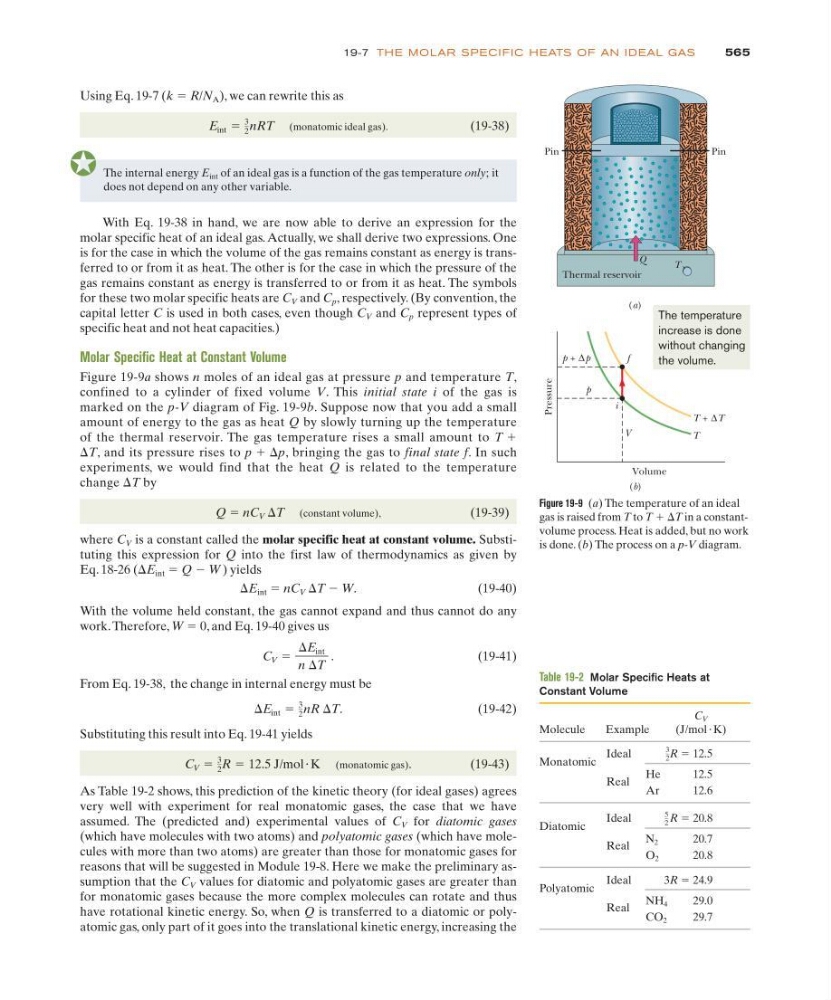
Figure 19-9a shows n moles of an ideal gas at pressure p and temperature T,
confined to a cylinder of fixed volume V. This initial state i of the gas is
marked on the p-V diagram of Fig. 19-9b. Suppose now that you add a small
amount of energy to the gas as heat Q by slowly turning up the temperature
of the thermal reservoir. The gas temperature rises a small amount to T ϩ
⌬T, and its pressure rises to p ϩ ⌬p, bringing the gas to final state f. In such
experiments, we would find that the heat Q is related to the temperature
change ⌬T by
Q ϭ nC V ⌬T (constant volume),
(19-39)
where C V is a constant called the molar specific heat at constant volume. Substituting this expression for Q into the first law of thermodynamics as given by
Eq. 18-26 (⌬E int ϭ Q Ϫ W ) yields
⌬E int ϭ nC V ⌬T Ϫ W.
( 1 9 - 4 0 )
With the volume held constant, the gas cannot expand and thus cannot do any
work. Therefore, W ϭ 0, and Eq. 19-40 gives us
(19-41)
From Eq. 19-38, the change in internal energy must be
(19-42)
Substituting this result into Eq. 19-41 yields
(monatomic gas).
( 1 9 - 4 3 )
As Table 19-2 shows, this prediction of the kinetic theory (for ideal gases) agrees
very well with experiment for real monatomic gases, the case that we have
assumed. The (predicted and) experimental values of C V for diatomic gases
(which have molecules with two atoms) and polyatomic gases (which have molecules with more than two atoms) are greater than those for monatomic gases for
reasons that will be suggested in Module 19-8. Here we make the preliminary assumption that the C V values for diatomic and polyatomic gases are greater than
for monatomic gases because the more complex molecules can rotate and thus
have rotational kinetic energy. So, when Q is transferred to a diatomic or polyatomic gas, only part of it goes into the translational kinetic energy, increasing the
C V ϭ
3
2 R ϭ 12.5 J/molиK
⌬E int ϭ
3
2 nR ⌬T.
C V ϭ
⌬E int
n ⌬T
.
Figure 19-9 (a) The temperature of an ideal
gas is raised from T to T ϩ ⌬T in a constantvolume process. Heat is added, but no work
is done. (b) The process on a p-V diagram.
T
Q
Pin
(a)
(b)
Pressure
Volume
V
i
p
f
p + p
∆
T + T
∆
T
Pin
Thermal reservoir
The temperature
increase is done
without changing
the volume.
Using Eq. 19-7 (k ϭ R/N A ), we can rewrite this as
(monatomic ideal gas).
(19-38)
E int ϭ
3
2 nRT
Table 19-2 Molar Specific Heats at
Constant Volume
C V
Molecule
Example
(J/mol иK)
Monatomic
Ideal
R ϭ 12.5
Real
He
12.5
Ar
12.6
Diatomic
Ideal
R ϭ 20.8
Real
N 2
20.7
O 2
20.8
Polyatomic
Ideal
3R ϭ 24.9
Real
NH 4
29.0
CO 2
29.7
5
2
3
2
19-7 TH E M OL AR SPECI FIC H EATS OF AN I DEAL GAS
The internal energy E int of an ideal gas is a function of the gas temperature only; it
does not depend on any other variable.
With Eq. 19-38 in hand, we are now able to derive an expression for the
molar specific heat of an ideal gas. Actually, we shall derive two expressions. One
is for the case in which the volume of the gas remains constant as energy is transferred to or from it as heat. The other is for the case in which the pressure of the
gas remains constant as energy is transferred to or from it as heat. The symbols
for these two molar specific heats are C V and C p , respectively. (By convention, the
capital letter C is used in both cases, even though C V and C p represent types of
specific heat and not heat capacities.)
Molar Specific Heat at Constant Volume
Figure 19-9a shows n moles of an ideal gas at pressure p and temperature T,
confined to a cylinder of fixed volume V. This initial state i of the gas is
marked on the p-V diagram of Fig. 19-9b. Suppose now that you add a small
amount of energy to the gas as heat Q by slowly turning up the temperature
of the thermal reservoir. The gas temperature rises a small amount to T ϩ
⌬T, and its pressure rises to p ϩ ⌬p, bringing the gas to final state f. In such
experiments, we would find that the heat Q is related to the temperature
change ⌬T by
Q ϭ nC V ⌬T (constant volume),
(19-39)
where C V is a constant called the molar specific heat at constant volume. Substituting this expression for Q into the first law of thermodynamics as given by
Eq. 18-26 (⌬E int ϭ Q Ϫ W ) yields
⌬E int ϭ nC V ⌬T Ϫ W.
( 1 9 - 4 0 )
With the volume held constant, the gas cannot expand and thus cannot do any
work. Therefore, W ϭ 0, and Eq. 19-40 gives us
(19-41)
From Eq. 19-38, the change in internal energy must be
(19-42)
Substituting this result into Eq. 19-41 yields
(monatomic gas).
( 1 9 - 4 3 )
As Table 19-2 shows, this prediction of the kinetic theory (for ideal gases) agrees
very well with experiment for real monatomic gases, the case that we have
assumed. The (predicted and) experimental values of C V for diatomic gases
(which have molecules with two atoms) and polyatomic gases (which have molecules with more than two atoms) are greater than those for monatomic gases for
reasons that will be suggested in Module 19-8. Here we make the preliminary assumption that the C V values for diatomic and polyatomic gases are greater than
for monatomic gases because the more complex molecules can rotate and thus
have rotational kinetic energy. So, when Q is transferred to a diatomic or polyatomic gas, only part of it goes into the translational kinetic energy, increasing the
C V ϭ
3
2 R ϭ 12.5 J/molиK
⌬E int ϭ
3
2 nR ⌬T.
C V ϭ
⌬E int
n ⌬T
.
Figure 19-9 (a) The temperature of an ideal
gas is raised from T to T ϩ ⌬T in a constantvolume process. Heat is added, but no work
is done. (b) The process on a p-V diagram.
T
Q
Pin
(a)
(b)
Pressure
Volume
V
i
p
f
p + p
∆
T + T
∆
T
Pin
Thermal reservoir
The temperature
increase is done
without changing
the volume.
Using Eq. 19-7 (k ϭ R/N A ), we can rewrite this as
(monatomic ideal gas).
(19-38)
E int ϭ
3
2 nRT
Table 19-2 Molar Specific Heats at
Constant Volume
C V
Molecule
Example
(J/mol иK)
Monatomic
Ideal
R ϭ 12.5
Real
He
12.5
Ar
12.6
Diatomic
Ideal
R ϭ 20.8
Real
N 2
20.7
O 2
20.8
Polyatomic
Ideal
3R ϭ 24.9
Real
NH 4
29.0
CO 2
29.7
5
2
3
2