

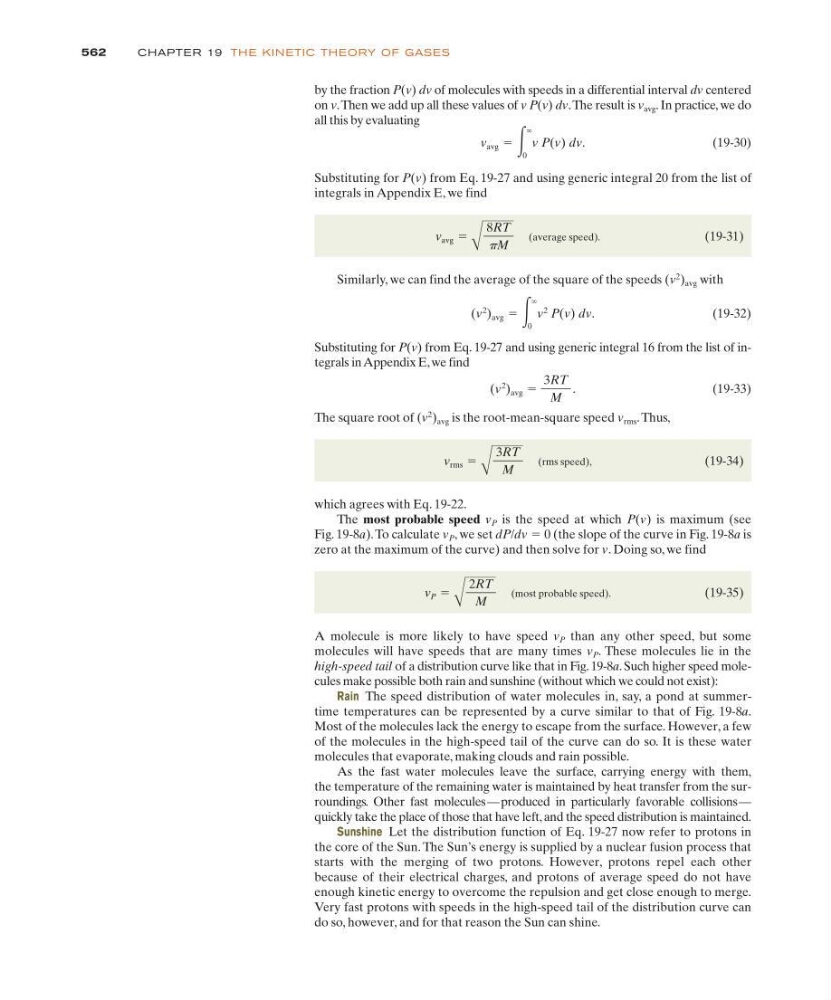
by the fraction P(v) dv of molecules with speeds in a differential interval dv centered
on v.Then we add up all these values of v P(v) dv.The result is v avg . In practice, we do
all this by evaluating
(19-30)
Substituting for P(v) from Eq. 19-27 and using generic integral 20 from the list of
integrals in Appendix E, we find
(average speed).
(19-31)
Similarly, we can find the average of the square of the speeds (v
2
) avg with
(19-32)
Substituting for P(v) from Eq. 19-27 and using generic integral 16 from the list of integrals in Appendix E, we find
(19-33)
The square root of (v
2
) avg is the root-mean-square speed v rms .Thus,
(rms speed),
(19-34)
which agrees with Eq. 19-22.
The most probable speed v P is the speed at which P(v) is maximum (see
Fig. 19-8a). To calculate v P , we set dP/dv ϭ 0 (the slope of the curve in Fig. 19-8a is
zero at the maximum of the curve) and then solve for v. Doing so, we find
(most probable speed).
(19-35)
A molecule is more likely to have speed v P than any other speed, but some
molecules will have speeds that are many times v P . These molecules lie in the
high-speed tail of a distribution curve like that in Fig. 19-8a. Such higher speed molecules make possible both rain and sunshine (without which we could not exist):
Rain The speed distribution of water molecules in, say, a pond at summertime temperatures can be represented by a curve similar to that of Fig. 19-8a.
Most of the molecules lack the energy to escape from the surface. However, a few
of the molecules in the high-speed tail of the curve can do so. It is these water
molecules that evaporate, making clouds and rain possible.
As the fast water molecules leave the surface, carrying energy with them,
the temperature of the remaining water is maintained by heat transfer from the surroundings. Other fast molecules—produced in particularly favorable collisions—
quickly take the place of those that have left, and the speed distribution is maintained.
Sunshine Let the distribution function of Eq. 19-27 now refer to protons in
the core of the Sun. The Sun’s energy is supplied by a nuclear fusion process that
starts with the merging of two protons. However, protons repel each other
because of their electrical charges, and protons of average speed do not have
enough kinetic energy to overcome the repulsion and get close enough to merge.
Very fast protons with speeds in the high-speed tail of the distribution curve can
do so, however, and for that reason the Sun can shine.
v P ϭ A
2RT
M
v rms ϭ A
3RT
M
(v
2
) avg ϭ
3RT
M
.
(v
2
) avg ϭ ͵
ϱ
0
v
2
P(v) dv.
v avg ϭ A
8RT
pM
v avg ϭ ͵
ϱ
0
v P(v) dv.
562
CHAPTE R 19 TH E KI N ETIC TH EORY OF GASES
on v.Then we add up all these values of v P(v) dv.The result is v avg . In practice, we do
all this by evaluating
(19-30)
Substituting for P(v) from Eq. 19-27 and using generic integral 20 from the list of
integrals in Appendix E, we find
(average speed).
(19-31)
Similarly, we can find the average of the square of the speeds (v
2
) avg with
(19-32)
Substituting for P(v) from Eq. 19-27 and using generic integral 16 from the list of integrals in Appendix E, we find
(19-33)
The square root of (v
2
) avg is the root-mean-square speed v rms .Thus,
(rms speed),
(19-34)
which agrees with Eq. 19-22.
The most probable speed v P is the speed at which P(v) is maximum (see
Fig. 19-8a). To calculate v P , we set dP/dv ϭ 0 (the slope of the curve in Fig. 19-8a is
zero at the maximum of the curve) and then solve for v. Doing so, we find
(most probable speed).
(19-35)
A molecule is more likely to have speed v P than any other speed, but some
molecules will have speeds that are many times v P . These molecules lie in the
high-speed tail of a distribution curve like that in Fig. 19-8a. Such higher speed molecules make possible both rain and sunshine (without which we could not exist):
Rain The speed distribution of water molecules in, say, a pond at summertime temperatures can be represented by a curve similar to that of Fig. 19-8a.
Most of the molecules lack the energy to escape from the surface. However, a few
of the molecules in the high-speed tail of the curve can do so. It is these water
molecules that evaporate, making clouds and rain possible.
As the fast water molecules leave the surface, carrying energy with them,
the temperature of the remaining water is maintained by heat transfer from the surroundings. Other fast molecules—produced in particularly favorable collisions—
quickly take the place of those that have left, and the speed distribution is maintained.
Sunshine Let the distribution function of Eq. 19-27 now refer to protons in
the core of the Sun. The Sun’s energy is supplied by a nuclear fusion process that
starts with the merging of two protons. However, protons repel each other
because of their electrical charges, and protons of average speed do not have
enough kinetic energy to overcome the repulsion and get close enough to merge.
Very fast protons with speeds in the high-speed tail of the distribution curve can
do so, however, and for that reason the Sun can shine.
v P ϭ A
2RT
M
v rms ϭ A
3RT
M
(v
2
) avg ϭ
3RT
M
.
(v
2
) avg ϭ ͵
ϱ
0
v
2
P(v) dv.
v avg ϭ A
8RT
pM
v avg ϭ ͵
ϱ
0
v P(v) dv.
562
CHAPTE R 19 TH E KI N ETIC TH EORY OF GASES