

543
PROB LE M S
point of Ϫ114 C, a heat of vaporization of 879 kJ/kg, a heat of fusion of 109 kJ/kg, and a specific heat of 2.43 kJ/kgиK. How much
energy must be removed from 0.510 kg of ethyl alcohol that is initially a gas at 78.0 C so that it becomes a solid at Ϫ114 C?
••40
Calculate the specific heat of a metal from the following
data. A container made of the metal has a mass of 3.6 kg and contains 14 kg of water. A 1.8 kg piece of the metal initially at a temperature of 180 C is dropped into the water. The container and
water initially have a temperature of 16.0 C, and the final temperature of the entire (insulated) system is 18.0 C.
•••41
(a) Two 50 g ice cubes are dropped into 200 g
of water in a thermally insulated container. If the water is initially
at 25 C, and the ice comes directly from a freezer at Ϫ15 C, what is
the final temperature at thermal equilibrium? (b) What is the final
temperature if only one ice cube is used?
Њ
Њ
WWW
SSM
Њ
Њ
Њ
Њ
Њ
Њ
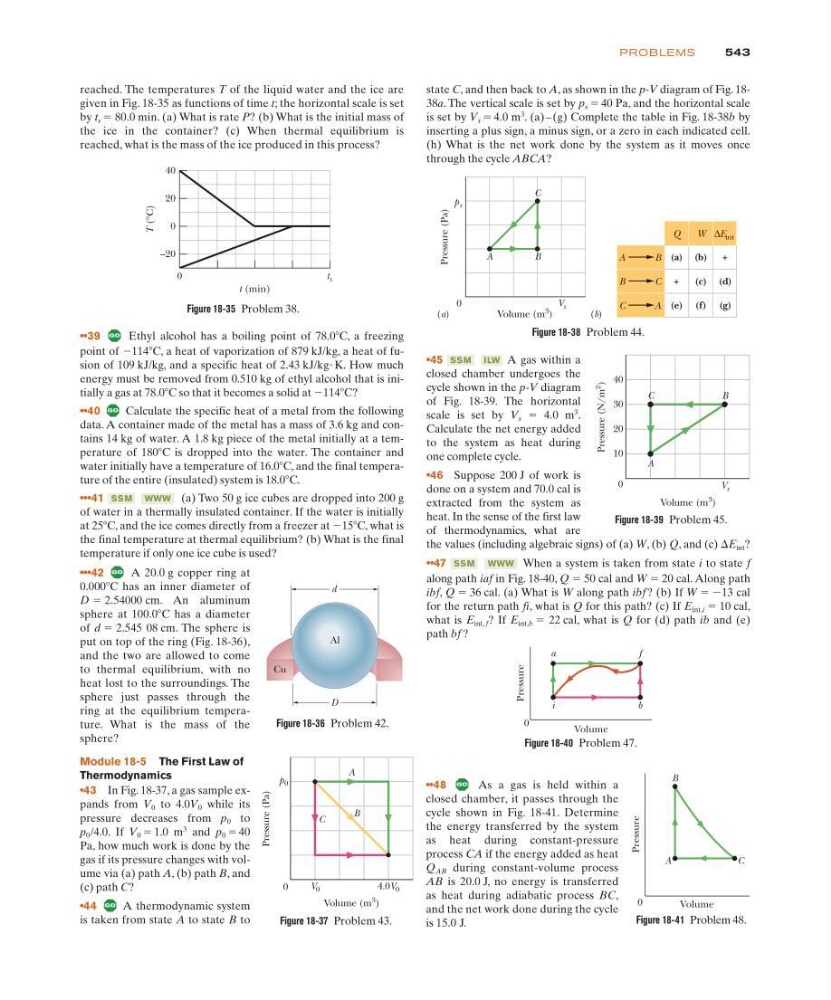
reached. The temperatures T of the liquid water and the ice are
given in Fig. 18-35 as functions of time t; the horizontal scale is set
by t s ϭ 80.0 min. (a) What is rate P? (b) What is the initial mass of
the ice in the container? (c) When thermal equilibrium is
reached, what is the mass of the ice produced in this process?
state C, and then back to A, as shown in the p-V diagram of Fig. 1838a. The vertical scale is set by p s ϭ 40 Pa, and the horizontal scale
is set by V s ϭ 4.0 m
3
. (a)–(g) Complete the table in Fig. 18-38b by
inserting a plus sign, a minus sign, or a zero in each indicated cell.
(h) What is the net work done by the system as it moves once
through the cycle ABCA?
Pressure (Pa)
p s
V s
C
B
A
Volume (m 3 )
0
B
A
C
B
A
C
Q
W ∆ E int
+
(e) (f)
(a) (b)
(g)
(c) (d)
+
(a)
( b)
Figure 18-36 Problem 42.
Al
d
D
Cu
Pressure (Pa)
p 0
V 0
4.0V 0
C
B
A
Volume (m
3
)
0
Figure 18-37 Problem 43.
Figure 18-38 Problem 44.
••39
Ethyl alcohol has a boiling point of 78.0 C, a freezing
Њ
•45
A gas within a
closed chamber undergoes the
cycle shown in the p-V diagram
of Fig. 18-39. The horizontal
scale is set by V s ϭ 4.0 m
3
.
Calculate the net energy added
to the system as heat during
one complete cycle.
•46 Suppose 200 J of work is
done on a system and 70.0 cal is
extracted from the system as
heat. In the sense of the first law
of thermodynamics, what are
the values (including algebraic signs) of (a) W, (b) Q, and (c) ⌬E int ?
••47
When a system is taken from state i to state f
WWW
SSM
ILW
SSM
along path iaf in Fig. 18-40, Q ϭ 50 cal and W ϭ 20 cal. Along path
ibf, Q ϭ 36 cal. (a) What is W along path ibf? (b) If W ϭ Ϫ13 cal
for the return path fi, what is Q for this path? (c) If E int,i ϭ 10 cal,
what is E int, f ? If E int,b ϭ 22 cal, what is Q for (d) path ib and (e)
path bf ?
40
20
0
–20
0
t (min)
t s
T (°C)
Figure 18-35 Problem 38.
•••42
A 20.0 g copper ring at
0.000 C has an inner diameter of
D ϭ 2.54000 cm. An aluminum
sphere at 100.0 C has a diameter
of d ϭ 2.545 08 cm. The sphere is
put on top of the ring (Fig. 18-36),
and the two are allowed to come
to thermal equilibrium, with no
heat lost to the surroundings. The
sphere just passes through the
ring at the equilibrium temperature. What is the mass of the
sphere?
Module 18-5 The First Law of
Thermodynamics
•43 In Fig. 18-37, a gas sample expands from V 0 to 4.0V 0 while its
pressure decreases from p 0 to
p 0 /4.0. If V 0 ϭ 1.0 m
3
and p 0 ϭ 40
Pa, how much work is done by the
gas if its pressure changes with volume via (a) path A, (b) path B, and
(c) path C?
•44
A thermodynamic system
is taken from state A to state B to
Њ
Њ
Pressure (N/m 2
)
40
30
20
10
V s
C
B
Volume (m 3 )
0
A
Figure 18-39 Problem 45.
a
i
f
b
Pressure
Volume
0
Figure 18-40 Problem 47.
••48
As a gas is held within a
closed chamber, it passes through the
cycle shown in Fig. 18-41. Determine
the energy transferred by the system
as heat during constant-pressure
process CA if the energy added as heat
Q AB during constant-volume process
AB is 20.0 J, no energy is transferred
as heat during adiabatic process BC,
and the net work done during the cycle
is 15.0 J.
A
C
B
0
Volume
Pressure
Figure 18-41 Problem 48.
PROB LE M S
point of Ϫ114 C, a heat of vaporization of 879 kJ/kg, a heat of fusion of 109 kJ/kg, and a specific heat of 2.43 kJ/kgиK. How much
energy must be removed from 0.510 kg of ethyl alcohol that is initially a gas at 78.0 C so that it becomes a solid at Ϫ114 C?
••40
Calculate the specific heat of a metal from the following
data. A container made of the metal has a mass of 3.6 kg and contains 14 kg of water. A 1.8 kg piece of the metal initially at a temperature of 180 C is dropped into the water. The container and
water initially have a temperature of 16.0 C, and the final temperature of the entire (insulated) system is 18.0 C.
•••41
(a) Two 50 g ice cubes are dropped into 200 g
of water in a thermally insulated container. If the water is initially
at 25 C, and the ice comes directly from a freezer at Ϫ15 C, what is
the final temperature at thermal equilibrium? (b) What is the final
temperature if only one ice cube is used?
Њ
Њ
WWW
SSM
Њ
Њ
Њ
Њ
Њ
Њ
reached. The temperatures T of the liquid water and the ice are
given in Fig. 18-35 as functions of time t; the horizontal scale is set
by t s ϭ 80.0 min. (a) What is rate P? (b) What is the initial mass of
the ice in the container? (c) When thermal equilibrium is
reached, what is the mass of the ice produced in this process?
state C, and then back to A, as shown in the p-V diagram of Fig. 1838a. The vertical scale is set by p s ϭ 40 Pa, and the horizontal scale
is set by V s ϭ 4.0 m
3
. (a)–(g) Complete the table in Fig. 18-38b by
inserting a plus sign, a minus sign, or a zero in each indicated cell.
(h) What is the net work done by the system as it moves once
through the cycle ABCA?
Pressure (Pa)
p s
V s
C
B
A
Volume (m 3 )
0
B
A
C
B
A
C
Q
W ∆ E int
+
(e) (f)
(a) (b)
(g)
(c) (d)
+
(a)
( b)
Figure 18-36 Problem 42.
Al
d
D
Cu
Pressure (Pa)
p 0
V 0
4.0V 0
C
B
A
Volume (m
3
)
0
Figure 18-37 Problem 43.
Figure 18-38 Problem 44.
••39
Ethyl alcohol has a boiling point of 78.0 C, a freezing
Њ
•45
A gas within a
closed chamber undergoes the
cycle shown in the p-V diagram
of Fig. 18-39. The horizontal
scale is set by V s ϭ 4.0 m
3
.
Calculate the net energy added
to the system as heat during
one complete cycle.
•46 Suppose 200 J of work is
done on a system and 70.0 cal is
extracted from the system as
heat. In the sense of the first law
of thermodynamics, what are
the values (including algebraic signs) of (a) W, (b) Q, and (c) ⌬E int ?
••47
When a system is taken from state i to state f
WWW
SSM
ILW
SSM
along path iaf in Fig. 18-40, Q ϭ 50 cal and W ϭ 20 cal. Along path
ibf, Q ϭ 36 cal. (a) What is W along path ibf? (b) If W ϭ Ϫ13 cal
for the return path fi, what is Q for this path? (c) If E int,i ϭ 10 cal,
what is E int, f ? If E int,b ϭ 22 cal, what is Q for (d) path ib and (e)
path bf ?
40
20
0
–20
0
t (min)
t s
T (°C)
Figure 18-35 Problem 38.
•••42
A 20.0 g copper ring at
0.000 C has an inner diameter of
D ϭ 2.54000 cm. An aluminum
sphere at 100.0 C has a diameter
of d ϭ 2.545 08 cm. The sphere is
put on top of the ring (Fig. 18-36),
and the two are allowed to come
to thermal equilibrium, with no
heat lost to the surroundings. The
sphere just passes through the
ring at the equilibrium temperature. What is the mass of the
sphere?
Module 18-5 The First Law of
Thermodynamics
•43 In Fig. 18-37, a gas sample expands from V 0 to 4.0V 0 while its
pressure decreases from p 0 to
p 0 /4.0. If V 0 ϭ 1.0 m
3
and p 0 ϭ 40
Pa, how much work is done by the
gas if its pressure changes with volume via (a) path A, (b) path B, and
(c) path C?
•44
A thermodynamic system
is taken from state A to state B to
Њ
Њ
Pressure (N/m 2
)
40
30
20
10
V s
C
B
Volume (m 3 )
0
A
Figure 18-39 Problem 45.
a
i
f
b
Pressure
Volume
0
Figure 18-40 Problem 47.
••48
As a gas is held within a
closed chamber, it passes through the
cycle shown in Fig. 18-41. Determine
the energy transferred by the system
as heat during constant-pressure
process CA if the energy added as heat
Q AB during constant-volume process
AB is 20.0 J, no energy is transferred
as heat during adiabatic process BC,
and the net work done during the cycle
is 15.0 J.
A
C
B
0
Volume
Pressure
Figure 18-41 Problem 48.