

537
18-6 HEAT TRANSFER M ECHANISMS
The rate P abs at which an object absorbs energy via thermal radiation from its
environment, which we take to be at uniform temperature T env (in kelvins), is
P abs ϭ s´AT
4
env .
( 1 8 - 3 9 )
The emissivity ´ in Eq. 18-39 is the same as that in Eq. 18-38.An idealized blackbody
radiator, with ´ ϭ 1, will absorb all the radiated energy it intercepts (rather than
sending a portion back away from itself through reflection or scattering).
Because an object both emits and absorbs thermal radiation, its net rate P net
of energy exchange due to thermal radiation is
P net ϭ P abs Ϫ P rad ϭ s´A(T
4
env Ϫ T
4
).
(18-40)
P net is positive if net energy is being absorbed via radiation and negative if it is
being lost via radiation.
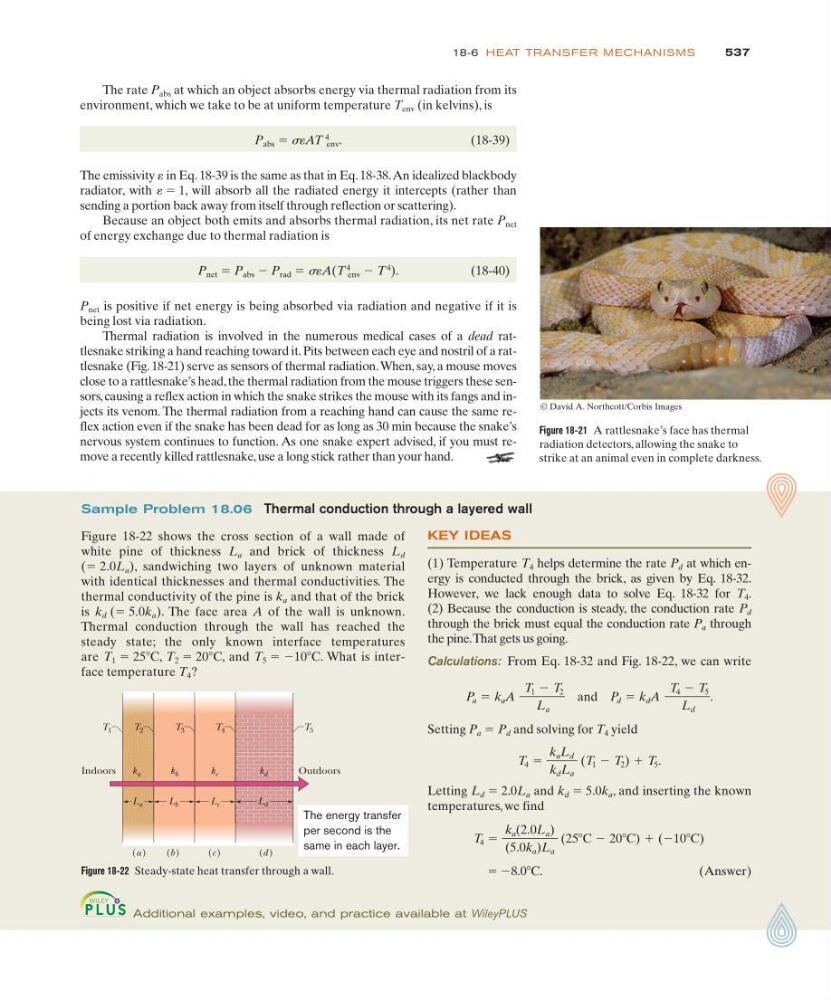
Thermal radiation is involved in the numerous medical cases of a dead rattlesnake striking a hand reaching toward it. Pits between each eye and nostril of a rattlesnake (Fig. 18-21) serve as sensors of thermal radiation.When, say, a mouse moves
close to a rattlesnake’s head, the thermal radiation from the mouse triggers these sensors, causing a reflex action in which the snake strikes the mouse with its fangs and injects its venom. The thermal radiation from a reaching hand can cause the same reflex action even if the snake has been dead for as long as 30 min because the snake’s
nervous system continues to function. As one snake expert advised, if you must remove a recently killed rattlesnake, use a long stick rather than your hand.
Figure 18-21 A rattlesnake’s face has thermal
radiation detectors, allowing the snake to
strike at an animal even in complete darkness.
© David A. Northcott/Corbis Images
Additional examples, video, and practice available at WileyPLUS
KEY IDEAS
(1) Temperature T 4 helps determine the rate P d at which energy is conducted through the brick, as given by Eq. 18-32.
However, we lack enough data to solve Eq. 18-32 for T 4 .
(2) Because the conduction is steady, the conduction rate P d
through the brick must equal the conduction rate P a through
the pine.That gets us going.
Calculations: From Eq. 18-32 and Fig. 18-22, we can write
Setting P a ϭ P d and solving for T 4 yield
Letting L d ϭ 2.0L a and k d ϭ 5.0k a , and inserting the known
temperatures, we find
ϭ Ϫ8.0ЊC.
(Answer)
T 4 ϭ
k a (2.0L a )
(5.0k a )L a
(25ЊC Ϫ 20ЊC) ϩ (Ϫ10ЊC)
T 4 ϭ
k a L d
k d L a
(T 1 Ϫ T 2 ) ϩ T 5 .
P a ϭ k a A
T 1 Ϫ T 2
L a
and P d ϭ k d A
T 4 Ϫ T 5
L d
.
Sample Problem 18.06 Thermal conduction through a layered wall
Figure 18-22 shows the cross section of a wall made of
white pine of thickness L a and brick of thickness L d
(ϭ 2.0L a ), sandwiching two layers of unknown material
with identical thicknesses and thermal conductivities. The
thermal conductivity of the pine is k a and that of the brick
is k d (ϭ 5.0k a ). The face area A of the wall is unknown.
Thermal conduction through the wall has reached the
steady state; the only known interface temperatures
are T 1 ϭ 25ЊC, T 2 ϭ 20ЊC, and T 5 ϭ Ϫ10ЊC. What is interface temperature T 4 ?
Figure 18-22 Steady-state heat transfer through a wall.
Indoors
Outdoors
(a )
(b )
( d )
(c )
L a
L b
L c
L d
k a
k b
k c
k d
T 1
T 2
T 3
T 4
T 5
The energy transfer
per second is the
same in each layer.
18-6 HEAT TRANSFER M ECHANISMS
The rate P abs at which an object absorbs energy via thermal radiation from its
environment, which we take to be at uniform temperature T env (in kelvins), is
P abs ϭ s´AT
4
env .
( 1 8 - 3 9 )
The emissivity ´ in Eq. 18-39 is the same as that in Eq. 18-38.An idealized blackbody
radiator, with ´ ϭ 1, will absorb all the radiated energy it intercepts (rather than
sending a portion back away from itself through reflection or scattering).
Because an object both emits and absorbs thermal radiation, its net rate P net
of energy exchange due to thermal radiation is
P net ϭ P abs Ϫ P rad ϭ s´A(T
4
env Ϫ T
4
).
(18-40)
P net is positive if net energy is being absorbed via radiation and negative if it is
being lost via radiation.
Thermal radiation is involved in the numerous medical cases of a dead rattlesnake striking a hand reaching toward it. Pits between each eye and nostril of a rattlesnake (Fig. 18-21) serve as sensors of thermal radiation.When, say, a mouse moves
close to a rattlesnake’s head, the thermal radiation from the mouse triggers these sensors, causing a reflex action in which the snake strikes the mouse with its fangs and injects its venom. The thermal radiation from a reaching hand can cause the same reflex action even if the snake has been dead for as long as 30 min because the snake’s
nervous system continues to function. As one snake expert advised, if you must remove a recently killed rattlesnake, use a long stick rather than your hand.
Figure 18-21 A rattlesnake’s face has thermal
radiation detectors, allowing the snake to
strike at an animal even in complete darkness.
© David A. Northcott/Corbis Images
Additional examples, video, and practice available at WileyPLUS
KEY IDEAS
(1) Temperature T 4 helps determine the rate P d at which energy is conducted through the brick, as given by Eq. 18-32.
However, we lack enough data to solve Eq. 18-32 for T 4 .
(2) Because the conduction is steady, the conduction rate P d
through the brick must equal the conduction rate P a through
the pine.That gets us going.
Calculations: From Eq. 18-32 and Fig. 18-22, we can write
Setting P a ϭ P d and solving for T 4 yield
Letting L d ϭ 2.0L a and k d ϭ 5.0k a , and inserting the known
temperatures, we find
ϭ Ϫ8.0ЊC.
(Answer)
T 4 ϭ
k a (2.0L a )
(5.0k a )L a
(25ЊC Ϫ 20ЊC) ϩ (Ϫ10ЊC)
T 4 ϭ
k a L d
k d L a
(T 1 Ϫ T 2 ) ϩ T 5 .
P a ϭ k a A
T 1 Ϫ T 2
L a
and P d ϭ k d A
T 4 Ϫ T 5
L d
.
Sample Problem 18.06 Thermal conduction through a layered wall
Figure 18-22 shows the cross section of a wall made of
white pine of thickness L a and brick of thickness L d
(ϭ 2.0L a ), sandwiching two layers of unknown material
with identical thicknesses and thermal conductivities. The
thermal conductivity of the pine is k a and that of the brick
is k d (ϭ 5.0k a ). The face area A of the wall is unknown.
Thermal conduction through the wall has reached the
steady state; the only known interface temperatures
are T 1 ϭ 25ЊC, T 2 ϭ 20ЊC, and T 5 ϭ Ϫ10ЊC. What is interface temperature T 4 ?
Figure 18-22 Steady-state heat transfer through a wall.
Indoors
Outdoors
(a )
(b )
( d )
(c )
L a
L b
L c
L d
k a
k b
k c
k d
T 1
T 2
T 3
T 4
T 5
The energy transfer
per second is the
same in each layer.