

535
18-6 HEAT TRANSFER M ECHANISMS
amount of energy transferred per unit time) is
(18-32)
in which k, called the thermal conductivity, is a constant that depends on the
material of which the slab is made. A material that readily transfers energy by
conduction is a good thermal conductor and has a high value of k.Table 18-6 gives
the thermal conductivities of some common metals, gases, and building materials.
Thermal Resistance to Conduction (R-Value)
If you are interested in insulating your house or in keeping cola cans cold on a
picnic, you are more concerned with poor heat conductors than with good ones.
For this reason, the concept of thermal resistance R has been introduced into
engineering practice. The R-value of a slab of thickness L is defined as
(18-33)
The lower the thermal conductivity of the material of which a slab is made, the
higher the R-value of the slab; so something that has a high R-value is a poor thermal conductor and thus a good thermal insulator.
Note that R is a property attributed to a slab of a specified thickness, not to a
material. The commonly used unit for R (which, in the United States at least, is
almost never stated) is the square foot – Fahrenheit degree – hour per British
thermal unit (ft
2 иFЊиh/Btu). (Now you know why the unit is rarely stated.)
Conduction Through a Composite Slab
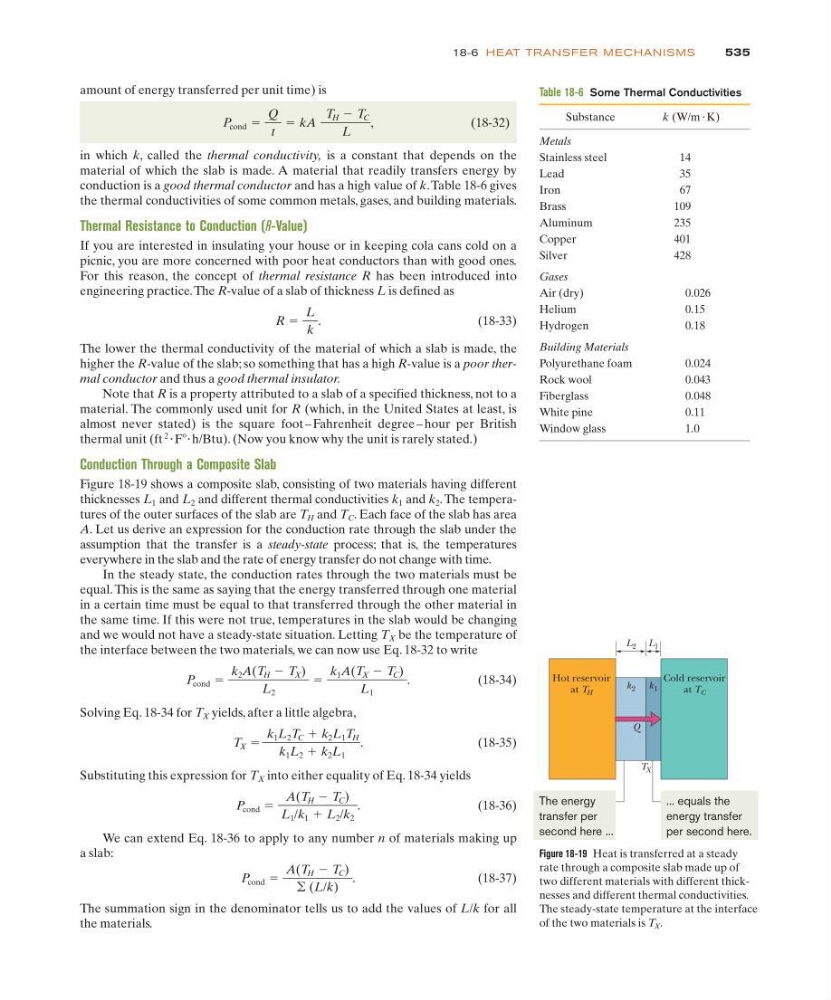
Figure 18-19 shows a composite slab, consisting of two materials having different
thicknesses L 1 and L 2 and different thermal conductivities k 1 and k 2 . The temperatures of the outer surfaces of the slab are T H and T C . Each face of the slab has area
A. Let us derive an expression for the conduction rate through the slab under the
assumption that the transfer is a steady-state process; that is, the temperatures
everywhere in the slab and the rate of energy transfer do not change with time.
In the steady state, the conduction rates through the two materials must be
equal. This is the same as saying that the energy transferred through one material
in a certain time must be equal to that transferred through the other material in
the same time. If this were not true, temperatures in the slab would be changing
and we would not have a steady-state situation. Letting T X be the temperature of
the interface between the two materials, we can now use Eq. 18-32 to write
(18-34)
Solving Eq. 18-34 for T X yields, after a little algebra,
(18-35)
Substituting this expression for T X into either equality of Eq. 18-34 yields
(18-36)
We can extend Eq. 18-36 to apply to any number n of materials making up
a slab:
(18-37)
The summation sign in the denominator tells us to add the values of L/k for all
the materials.
P cond ϭ
A(T H Ϫ T C )
͚ (L/k)
.
P cond ϭ
A(T H Ϫ T C )
L 1 /k 1 ϩ L 2 /k 2
.
T X ϭ
k 1 L 2 T C ϩ k 2 L 1 T H
k 1 L 2 ϩ k 2 L 1
.
P cond ϭ
k 2 A(T H Ϫ T X )
L 2
ϭ
k 1 A(T X Ϫ T C )
L 1
.
R ϭ
L
k
.
P cond ϭ
Q
t
ϭ kA
T H Ϫ T C
L
,
Table 18-6 Some Thermal Conductivities
Substance
k (W/m иK)
Metals
Stainless steel
14
Lead
35
Iron
67
Brass
109
Aluminum
235
Copper
401
Silver
428
Gases
Air (dry)
0.026
Helium
0.15
Hydrogen
0.18
Building Materials
Polyurethane foam
0.024
Rock wool
0.043
Fiberglass
0.048
White pine
0.11
Window glass
1.0
Figure 18-19 Heat is transferred at a steady
rate through a composite slab made up of
two different materials with different thicknesses and different thermal conductivities.
The steady-state temperature at the interface
of the two materials is T X .
Cold reservoir
at T C
Hot reservoir
at T H
k 1
L 1
Q
T X
k 2
L 2
The energy
transfer per
second here ...
... equals the
energy transfer
per second here.
18-6 HEAT TRANSFER M ECHANISMS
amount of energy transferred per unit time) is
(18-32)
in which k, called the thermal conductivity, is a constant that depends on the
material of which the slab is made. A material that readily transfers energy by
conduction is a good thermal conductor and has a high value of k.Table 18-6 gives
the thermal conductivities of some common metals, gases, and building materials.
Thermal Resistance to Conduction (R-Value)
If you are interested in insulating your house or in keeping cola cans cold on a
picnic, you are more concerned with poor heat conductors than with good ones.
For this reason, the concept of thermal resistance R has been introduced into
engineering practice. The R-value of a slab of thickness L is defined as
(18-33)
The lower the thermal conductivity of the material of which a slab is made, the
higher the R-value of the slab; so something that has a high R-value is a poor thermal conductor and thus a good thermal insulator.
Note that R is a property attributed to a slab of a specified thickness, not to a
material. The commonly used unit for R (which, in the United States at least, is
almost never stated) is the square foot – Fahrenheit degree – hour per British
thermal unit (ft
2 иFЊиh/Btu). (Now you know why the unit is rarely stated.)
Conduction Through a Composite Slab
Figure 18-19 shows a composite slab, consisting of two materials having different
thicknesses L 1 and L 2 and different thermal conductivities k 1 and k 2 . The temperatures of the outer surfaces of the slab are T H and T C . Each face of the slab has area
A. Let us derive an expression for the conduction rate through the slab under the
assumption that the transfer is a steady-state process; that is, the temperatures
everywhere in the slab and the rate of energy transfer do not change with time.
In the steady state, the conduction rates through the two materials must be
equal. This is the same as saying that the energy transferred through one material
in a certain time must be equal to that transferred through the other material in
the same time. If this were not true, temperatures in the slab would be changing
and we would not have a steady-state situation. Letting T X be the temperature of
the interface between the two materials, we can now use Eq. 18-32 to write
(18-34)
Solving Eq. 18-34 for T X yields, after a little algebra,
(18-35)
Substituting this expression for T X into either equality of Eq. 18-34 yields
(18-36)
We can extend Eq. 18-36 to apply to any number n of materials making up
a slab:
(18-37)
The summation sign in the denominator tells us to add the values of L/k for all
the materials.
P cond ϭ
A(T H Ϫ T C )
͚ (L/k)
.
P cond ϭ
A(T H Ϫ T C )
L 1 /k 1 ϩ L 2 /k 2
.
T X ϭ
k 1 L 2 T C ϩ k 2 L 1 T H
k 1 L 2 ϩ k 2 L 1
.
P cond ϭ
k 2 A(T H Ϫ T X )
L 2
ϭ
k 1 A(T X Ϫ T C )
L 1
.
R ϭ
L
k
.
P cond ϭ
Q
t
ϭ kA
T H Ϫ T C
L
,
Table 18-6 Some Thermal Conductivities
Substance
k (W/m иK)
Metals
Stainless steel
14
Lead
35
Iron
67
Brass
109
Aluminum
235
Copper
401
Silver
428
Gases
Air (dry)
0.026
Helium
0.15
Hydrogen
0.18
Building Materials
Polyurethane foam
0.024
Rock wool
0.043
Fiberglass
0.048
White pine
0.11
Window glass
1.0
Figure 18-19 Heat is transferred at a steady
rate through a composite slab made up of
two different materials with different thicknesses and different thermal conductivities.
The steady-state temperature at the interface
of the two materials is T X .
Cold reservoir
at T C
Hot reservoir
at T H
k 1
L 1
Q
T X
k 2
L 2
The energy
transfer per
second here ...
... equals the
energy transfer
per second here.