

532
CHAPTE R 18 TE M PE RATU R E, H EAT, AN D TH E FI RST L AW OF TH E R M ODYNAM ICS
Figure 18-16 The initial stage of a freeexpansion process. After the stopcock is
opened, the gas fills both chambers and
eventually reaches an equilibrium state.
Vacuum
Insulation
Stopcock
Some Special Cases of the First Law of Thermodynamics
Here are four thermodynamic processes as summarized in Table 18-5.
1. Adiabatic processes. An adiabatic process is one that occurs so rapidly or occurs in
a system that is so well insulated that no transfer of energy as heat occurs between
the system and its environment. Putting Q ϭ 0 in the first law (Eq. 18-26) yields
⌬E int ϭ ϪW
(adiabatic process).
(18-28)
This tells us that if work is done by the system (that is, if W is positive), the
internal energy of the system decreases by the amount of work. Conversely, if
work is done on the system (that is, if W is negative), the internal energy of the
system increases by that amount.
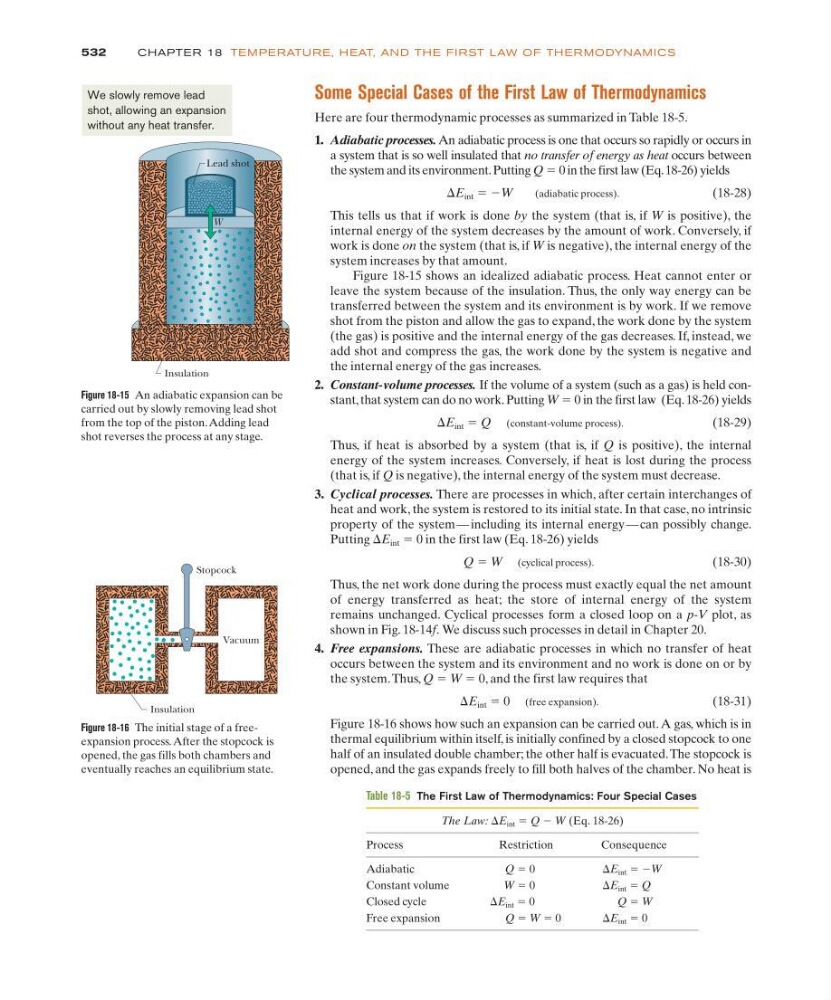
Figure 18-15 shows an idealized adiabatic process. Heat cannot enter or
leave the system because of the insulation. Thus, the only way energy can be
transferred between the system and its environment is by work. If we remove
shot from the piston and allow the gas to expand, the work done by the system
(the gas) is positive and the internal energy of the gas decreases. If, instead, we
add shot and compress the gas, the work done by the system is negative and
the internal energy of the gas increases.
2. Constant-volume processes. If the volume of a system (such as a gas) is held constant, that system can do no work. Putting W ϭ 0 in the first law (Eq. 18-26) yields
⌬E int ϭ Q (constant-volume process).
(18-29)
Thus, if heat is absorbed by a system (that is, if Q is positive), the internal
energy of the system increases. Conversely, if heat is lost during the process
(that is, if Q is negative), the internal energy of the system must decrease.
3. Cyclical processes. There are processes in which, after certain interchanges of
heat and work, the system is restored to its initial state. In that case, no intrinsic
property of the system — including its internal energy — can possibly change.
Putting ⌬E int ϭ 0 in the first law (Eq. 18-26) yields
Q ϭ W (cyclical process).
(18-30)
Thus, the net work done during the process must exactly equal the net amount
of energy transferred as heat; the store of internal energy of the system
remains unchanged. Cyclical processes form a closed loop on a p-V plot, as
shown in Fig. 18-14f. We discuss such processes in detail in Chapter 20.
4. Free expansions. These are adiabatic processes in which no transfer of heat
occurs between the system and its environment and no work is done on or by
the system. Thus, Q ϭ W ϭ 0, and the first law requires that
⌬E int ϭ 0 (free expansion).
(18-31)
Figure 18-16 shows how such an expansion can be carried out. A gas, which is in
thermal equilibrium within itself, is initially confined by a closed stopcock to one
half of an insulated double chamber; the other half is evacuated. The stopcock is
opened, and the gas expands freely to fill both halves of the chamber. No heat is
Table 18-5 The First Law of Thermodynamics: Four Special Cases
The Law: ⌬E int ϭ Q Ϫ W (Eq. 18-26)
Process
Restriction
Consequence
Adiabatic
Q ϭ 0
⌬E int ϭ ϪW
Constant volume
W ϭ 0
⌬E int ϭ Q
Closed cycle
⌬E int ϭ 0
Q ϭ W
Free expansion
Q ϭ W ϭ 0
⌬E int ϭ 0
Figure 18-15 An adiabatic expansion can be
carried out by slowly removing lead shot
from the top of the piston. Adding lead
shot reverses the process at any stage.
Lead shot
W
Insulation
We slowly remove lead
shot, allowing an expansion
without any heat transfer.
CHAPTE R 18 TE M PE RATU R E, H EAT, AN D TH E FI RST L AW OF TH E R M ODYNAM ICS
Figure 18-16 The initial stage of a freeexpansion process. After the stopcock is
opened, the gas fills both chambers and
eventually reaches an equilibrium state.
Vacuum
Insulation
Stopcock
Some Special Cases of the First Law of Thermodynamics
Here are four thermodynamic processes as summarized in Table 18-5.
1. Adiabatic processes. An adiabatic process is one that occurs so rapidly or occurs in
a system that is so well insulated that no transfer of energy as heat occurs between
the system and its environment. Putting Q ϭ 0 in the first law (Eq. 18-26) yields
⌬E int ϭ ϪW
(adiabatic process).
(18-28)
This tells us that if work is done by the system (that is, if W is positive), the
internal energy of the system decreases by the amount of work. Conversely, if
work is done on the system (that is, if W is negative), the internal energy of the
system increases by that amount.
Figure 18-15 shows an idealized adiabatic process. Heat cannot enter or
leave the system because of the insulation. Thus, the only way energy can be
transferred between the system and its environment is by work. If we remove
shot from the piston and allow the gas to expand, the work done by the system
(the gas) is positive and the internal energy of the gas decreases. If, instead, we
add shot and compress the gas, the work done by the system is negative and
the internal energy of the gas increases.
2. Constant-volume processes. If the volume of a system (such as a gas) is held constant, that system can do no work. Putting W ϭ 0 in the first law (Eq. 18-26) yields
⌬E int ϭ Q (constant-volume process).
(18-29)
Thus, if heat is absorbed by a system (that is, if Q is positive), the internal
energy of the system increases. Conversely, if heat is lost during the process
(that is, if Q is negative), the internal energy of the system must decrease.
3. Cyclical processes. There are processes in which, after certain interchanges of
heat and work, the system is restored to its initial state. In that case, no intrinsic
property of the system — including its internal energy — can possibly change.
Putting ⌬E int ϭ 0 in the first law (Eq. 18-26) yields
Q ϭ W (cyclical process).
(18-30)
Thus, the net work done during the process must exactly equal the net amount
of energy transferred as heat; the store of internal energy of the system
remains unchanged. Cyclical processes form a closed loop on a p-V plot, as
shown in Fig. 18-14f. We discuss such processes in detail in Chapter 20.
4. Free expansions. These are adiabatic processes in which no transfer of heat
occurs between the system and its environment and no work is done on or by
the system. Thus, Q ϭ W ϭ 0, and the first law requires that
⌬E int ϭ 0 (free expansion).
(18-31)
Figure 18-16 shows how such an expansion can be carried out. A gas, which is in
thermal equilibrium within itself, is initially confined by a closed stopcock to one
half of an insulated double chamber; the other half is evacuated. The stopcock is
opened, and the gas expands freely to fill both halves of the chamber. No heat is
Table 18-5 The First Law of Thermodynamics: Four Special Cases
The Law: ⌬E int ϭ Q Ϫ W (Eq. 18-26)
Process
Restriction
Consequence
Adiabatic
Q ϭ 0
⌬E int ϭ ϪW
Constant volume
W ϭ 0
⌬E int ϭ Q
Closed cycle
⌬E int ϭ 0
Q ϭ W
Free expansion
Q ϭ W ϭ 0
⌬E int ϭ 0
Figure 18-15 An adiabatic expansion can be
carried out by slowly removing lead shot
from the top of the piston. Adding lead
shot reverses the process at any stage.
Lead shot
W
Insulation
We slowly remove lead
shot, allowing an expansion
without any heat transfer.