

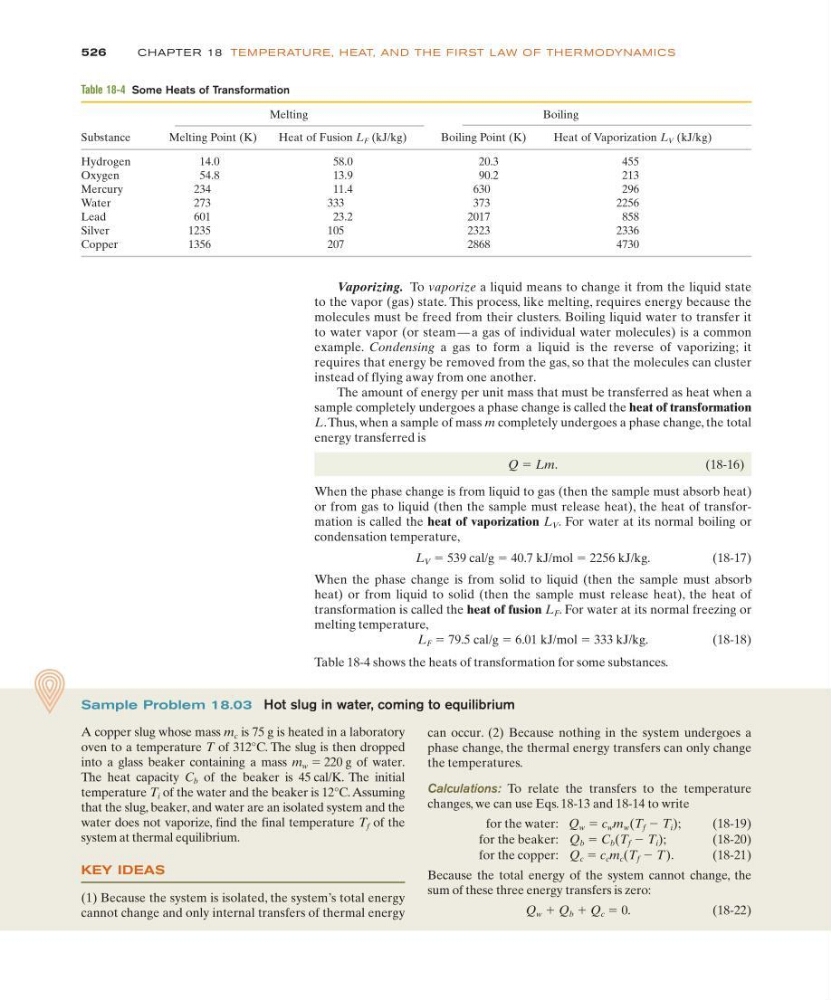
Table 18-4 Some Heats of Transformation
Melting
Boiling
Substance
Melting Point (K)
Heat of Fusion L F (kJ/kg)
Boiling Point (K)
Heat of Vaporization L V (kJ/kg)
Hydrogen
14.0
58.0
20.3
455
Oxygen
54.8
13.9
90.2
213
Mercury
234
11.4
630
296
Water
273
333
373
2256
Lead
601
23.2
2017
858
Silver
1235
105
2323
2336
Copper
1356
207
2868
4730
Vaporizing. To vaporize a liquid means to change it from the liquid state
to the vapor (gas) state. This process, like melting, requires energy because the
molecules must be freed from their clusters. Boiling liquid water to transfer it
to water vapor (or steam — a gas of individual water molecules) is a common
example. Condensing a gas to form a liquid is the reverse of vaporizing; it
requires that energy be removed from the gas, so that the molecules can cluster
instead of flying away from one another.
The amount of energy per unit mass that must be transferred as heat when a
sample completely undergoes a phase change is called the heat of transformation
L. Thus, when a sample of mass m completely undergoes a phase change, the total
energy transferred is
Q ϭ Lm.
( 1 8 - 1 6 )
When the phase change is from liquid to gas (then the sample must absorb heat)
or from gas to liquid (then the sample must release heat), the heat of transformation is called the heat of vaporization L V . For water at its normal boiling or
condensation temperature,
L V ϭ 539 cal/g ϭ 40.7 kJ/mol ϭ 2256 kJ/kg.
(18-17)
When the phase change is from solid to liquid (then the sample must absorb
heat) or from liquid to solid (then the sample must release heat), the heat of
transformation is called the heat of fusion L F . For water at its normal freezing or
melting temperature,
L F ϭ 79.5 cal/g ϭ 6.01 kJ/mol ϭ 333 kJ/kg.
(18-18)
Table 18-4 shows the heats of transformation for some substances.
526
CHAPTE R 18 TE M PE RATU R E, H EAT, AN D TH E FI RST L AW OF TH E R M ODYNAM ICS
can occur. (2) Because nothing in the system undergoes a
phase change, the thermal energy transfers can only change
the temperatures.
Calculations: To relate the transfers to the temperature
changes, we can use Eqs. 18-13 and 18-14 to write
for the water: Q w ϭ c w m w (T f Ϫ T i );
(18-19)
for the beaker: Q b ϭ C b (T f Ϫ T i );
(18-20)
for the copper: Q c ϭ c c m c (T f Ϫ T ).
(18-21)
Because the total energy of the system cannot change, the
sum of these three energy transfers is zero:
Q w ϩ Q b ϩ Q c ϭ 0.
(18-22)
Sample Problem 18.03 Hot slug in water, coming to equilibrium
A copper slug whose mass m c is 75 g is heated in a laboratory
oven to a temperature T of 312°C. The slug is then dropped
into a glass beaker containing a mass m w ϭ 220 g of water.
The heat capacity C b of the beaker is 45 cal/K. The initial
temperature T i of the water and the beaker is 12°C. Assuming
that the slug, beaker, and water are an isolated system and the
water does not vaporize, find the final temperature T f of the
system at thermal equilibrium.
KEY IDEAS
(1) Because the system is isolated, the system’s total energy
cannot change and only internal transfers of thermal energy
Melting
Boiling
Substance
Melting Point (K)
Heat of Fusion L F (kJ/kg)
Boiling Point (K)
Heat of Vaporization L V (kJ/kg)
Hydrogen
14.0
58.0
20.3
455
Oxygen
54.8
13.9
90.2
213
Mercury
234
11.4
630
296
Water
273
333
373
2256
Lead
601
23.2
2017
858
Silver
1235
105
2323
2336
Copper
1356
207
2868
4730
Vaporizing. To vaporize a liquid means to change it from the liquid state
to the vapor (gas) state. This process, like melting, requires energy because the
molecules must be freed from their clusters. Boiling liquid water to transfer it
to water vapor (or steam — a gas of individual water molecules) is a common
example. Condensing a gas to form a liquid is the reverse of vaporizing; it
requires that energy be removed from the gas, so that the molecules can cluster
instead of flying away from one another.
The amount of energy per unit mass that must be transferred as heat when a
sample completely undergoes a phase change is called the heat of transformation
L. Thus, when a sample of mass m completely undergoes a phase change, the total
energy transferred is
Q ϭ Lm.
( 1 8 - 1 6 )
When the phase change is from liquid to gas (then the sample must absorb heat)
or from gas to liquid (then the sample must release heat), the heat of transformation is called the heat of vaporization L V . For water at its normal boiling or
condensation temperature,
L V ϭ 539 cal/g ϭ 40.7 kJ/mol ϭ 2256 kJ/kg.
(18-17)
When the phase change is from solid to liquid (then the sample must absorb
heat) or from liquid to solid (then the sample must release heat), the heat of
transformation is called the heat of fusion L F . For water at its normal freezing or
melting temperature,
L F ϭ 79.5 cal/g ϭ 6.01 kJ/mol ϭ 333 kJ/kg.
(18-18)
Table 18-4 shows the heats of transformation for some substances.
526
CHAPTE R 18 TE M PE RATU R E, H EAT, AN D TH E FI RST L AW OF TH E R M ODYNAM ICS
can occur. (2) Because nothing in the system undergoes a
phase change, the thermal energy transfers can only change
the temperatures.
Calculations: To relate the transfers to the temperature
changes, we can use Eqs. 18-13 and 18-14 to write
for the water: Q w ϭ c w m w (T f Ϫ T i );
(18-19)
for the beaker: Q b ϭ C b (T f Ϫ T i );
(18-20)
for the copper: Q c ϭ c c m c (T f Ϫ T ).
(18-21)
Because the total energy of the system cannot change, the
sum of these three energy transfers is zero:
Q w ϩ Q b ϩ Q c ϭ 0.
(18-22)
Sample Problem 18.03 Hot slug in water, coming to equilibrium
A copper slug whose mass m c is 75 g is heated in a laboratory
oven to a temperature T of 312°C. The slug is then dropped
into a glass beaker containing a mass m w ϭ 220 g of water.
The heat capacity C b of the beaker is 45 cal/K. The initial
temperature T i of the water and the beaker is 12°C. Assuming
that the slug, beaker, and water are an isolated system and the
water does not vaporize, find the final temperature T f of the
system at thermal equilibrium.
KEY IDEAS
(1) Because the system is isolated, the system’s total energy
cannot change and only internal transfers of thermal energy