

519
18-2 TH E CE LSI US AN D FAH R E N H E IT SCALES
We use the letters C and F to distinguish measurements and degrees on the
two scales. Thus,
0ЊC ϭ 32ЊF
means that 0Њ on the Celsius scale measures the same temperature as 32Њ on the
Fahrenheit scale, whereas
5 CЊ ϭ 9 FЊ
means that a temperature difference of 5 Celsius degrees (note the degree symbol appears after C) is equivalent to a temperature difference of 9 Fahrenheit
degrees.
Checkpoint 1
The figure here shows three
linear temperature scales
with the freezing and boiling
points of water indicated.
(a) Rank the degrees on
these scales by size, greatest
first. (b) Rank the following
temperatures, highest first:
50ЊX, 50ЊW, and 50ЊY.
70°X
–20°X
120°W
30°W
90°Y
0°Y
Boiling point
Freezing point
corresponding temperatures on the Fahrenheit scale. On the
Z scale, the difference between the boiling and freezing
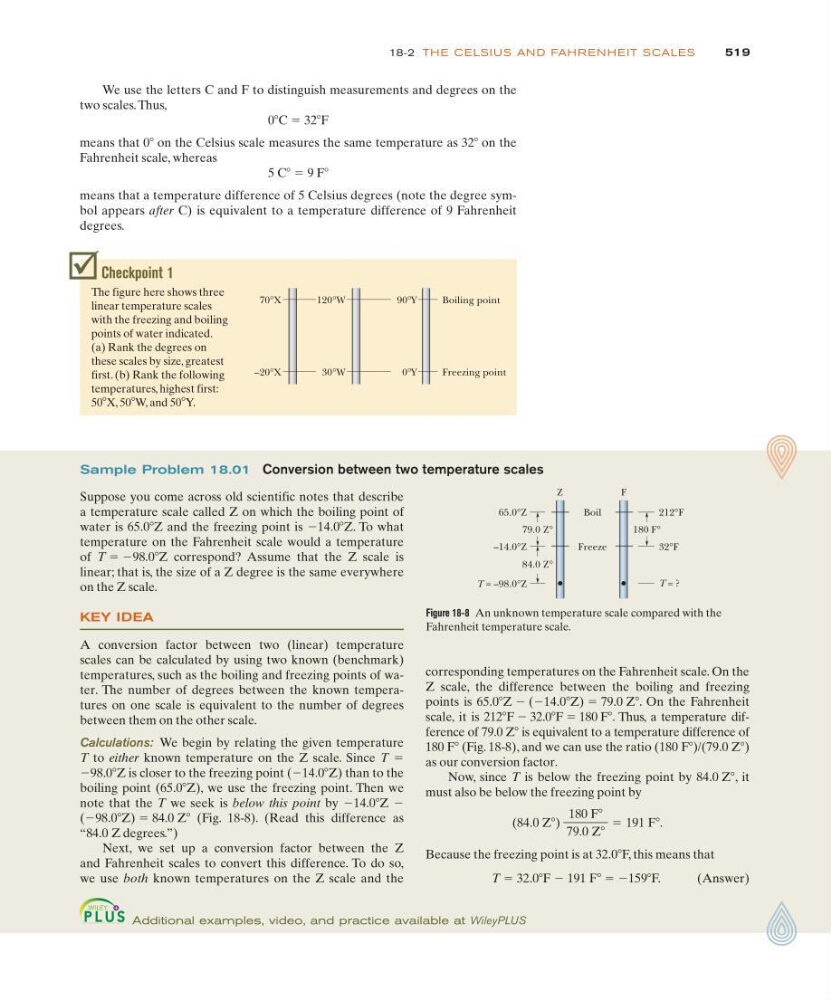
points is 65.0ЊZ Ϫ (Ϫ14.0ЊZ) ϭ 79.0 ZЊ. On the Fahrenheit
scale, it is 212ЊF Ϫ 32.0ЊF ϭ 180 FЊ. Thus, a temperature difference of 79.0 ZЊ is equivalent to a temperature difference of
180 FЊ (Fig. 18-8), and we can use the ratio (180 FЊ)/(79.0 ZЊ)
as our conversion factor.
Now, since T is below the freezing point by 84.0 ZЊ, it
must also be below the freezing point by
Because the freezing point is at 32.0ЊF, this means that
T ϭ 32.0ЊF Ϫ 191 FЊ ϭ Ϫ159ЊF.
(Answer)
(84.0 ZЊ)
180 FЊ
79.0 ZЊ
ϭ 191 FЊ.
Sample Problem 18.01 Conversion between two temperature scales
Suppose you come across old scientific notes that describe
a temperature scale called Z on which the boiling point of
water is 65.0ЊZ and the freezing point is Ϫ14.0ЊZ. To what
temperature on the Fahrenheit scale would a temperature
of T ϭ Ϫ98.0ЊZ correspond? Assume that the Z scale is
linear; that is, the size of a Z degree is the same everywhere
on the Z scale.
KEY IDEA
A conversion factor between two (linear) temperature
scales can be calculated by using two known (benchmark)
temperatures, such as the boiling and freezing points of water. The number of degrees between the known temperatures on one scale is equivalent to the number of degrees
between them on the other scale.
Calculations: We begin by relating the given temperature
T to either known temperature on the Z scale. Since T ϭ
Ϫ98.0ЊZ is closer to the freezing point (Ϫ14.0ЊZ) than to the
boiling point (65.0ЊZ), we use the freezing point. Then we
note that the T we seek is below this point by Ϫ14.0ЊZ Ϫ
(Ϫ98.0ЊZ) ϭ 84.0 ZЊ (Fig. 18-8). (Read this difference as
“84.0 Z degrees.”)
Next, we set up a conversion factor between the Z
and Fahrenheit scales to convert this difference. To do so,
we use both known temperatures on the Z scale and the
Additional examples, video, and practice available at WileyPLUS
Figure 18-8 An unknown temperature scale compared with the
Fahrenheit temperature scale.
65.0°Z
–14.0°Z
T = –98.0°Z
79.0 Z°
84.0 Z°
Boil
Freeze
212°F
F
Z
32°F
T = ?
180 F°
18-2 TH E CE LSI US AN D FAH R E N H E IT SCALES
We use the letters C and F to distinguish measurements and degrees on the
two scales. Thus,
0ЊC ϭ 32ЊF
means that 0Њ on the Celsius scale measures the same temperature as 32Њ on the
Fahrenheit scale, whereas
5 CЊ ϭ 9 FЊ
means that a temperature difference of 5 Celsius degrees (note the degree symbol appears after C) is equivalent to a temperature difference of 9 Fahrenheit
degrees.
Checkpoint 1
The figure here shows three
linear temperature scales
with the freezing and boiling
points of water indicated.
(a) Rank the degrees on
these scales by size, greatest
first. (b) Rank the following
temperatures, highest first:
50ЊX, 50ЊW, and 50ЊY.
70°X
–20°X
120°W
30°W
90°Y
0°Y
Boiling point
Freezing point
corresponding temperatures on the Fahrenheit scale. On the
Z scale, the difference between the boiling and freezing
points is 65.0ЊZ Ϫ (Ϫ14.0ЊZ) ϭ 79.0 ZЊ. On the Fahrenheit
scale, it is 212ЊF Ϫ 32.0ЊF ϭ 180 FЊ. Thus, a temperature difference of 79.0 ZЊ is equivalent to a temperature difference of
180 FЊ (Fig. 18-8), and we can use the ratio (180 FЊ)/(79.0 ZЊ)
as our conversion factor.
Now, since T is below the freezing point by 84.0 ZЊ, it
must also be below the freezing point by
Because the freezing point is at 32.0ЊF, this means that
T ϭ 32.0ЊF Ϫ 191 FЊ ϭ Ϫ159ЊF.
(Answer)
(84.0 ZЊ)
180 FЊ
79.0 ZЊ
ϭ 191 FЊ.
Sample Problem 18.01 Conversion between two temperature scales
Suppose you come across old scientific notes that describe
a temperature scale called Z on which the boiling point of
water is 65.0ЊZ and the freezing point is Ϫ14.0ЊZ. To what
temperature on the Fahrenheit scale would a temperature
of T ϭ Ϫ98.0ЊZ correspond? Assume that the Z scale is
linear; that is, the size of a Z degree is the same everywhere
on the Z scale.
KEY IDEA
A conversion factor between two (linear) temperature
scales can be calculated by using two known (benchmark)
temperatures, such as the boiling and freezing points of water. The number of degrees between the known temperatures on one scale is equivalent to the number of degrees
between them on the other scale.
Calculations: We begin by relating the given temperature
T to either known temperature on the Z scale. Since T ϭ
Ϫ98.0ЊZ is closer to the freezing point (Ϫ14.0ЊZ) than to the
boiling point (65.0ЊZ), we use the freezing point. Then we
note that the T we seek is below this point by Ϫ14.0ЊZ Ϫ
(Ϫ98.0ЊZ) ϭ 84.0 ZЊ (Fig. 18-8). (Read this difference as
“84.0 Z degrees.”)
Next, we set up a conversion factor between the Z
and Fahrenheit scales to convert this difference. To do so,
we use both known temperatures on the Z scale and the
Additional examples, video, and practice available at WileyPLUS
Figure 18-8 An unknown temperature scale compared with the
Fahrenheit temperature scale.
65.0°Z
–14.0°Z
T = –98.0°Z
79.0 Z°
84.0 Z°
Boil
Freeze
212°F
F
Z
32°F
T = ?
180 F°