

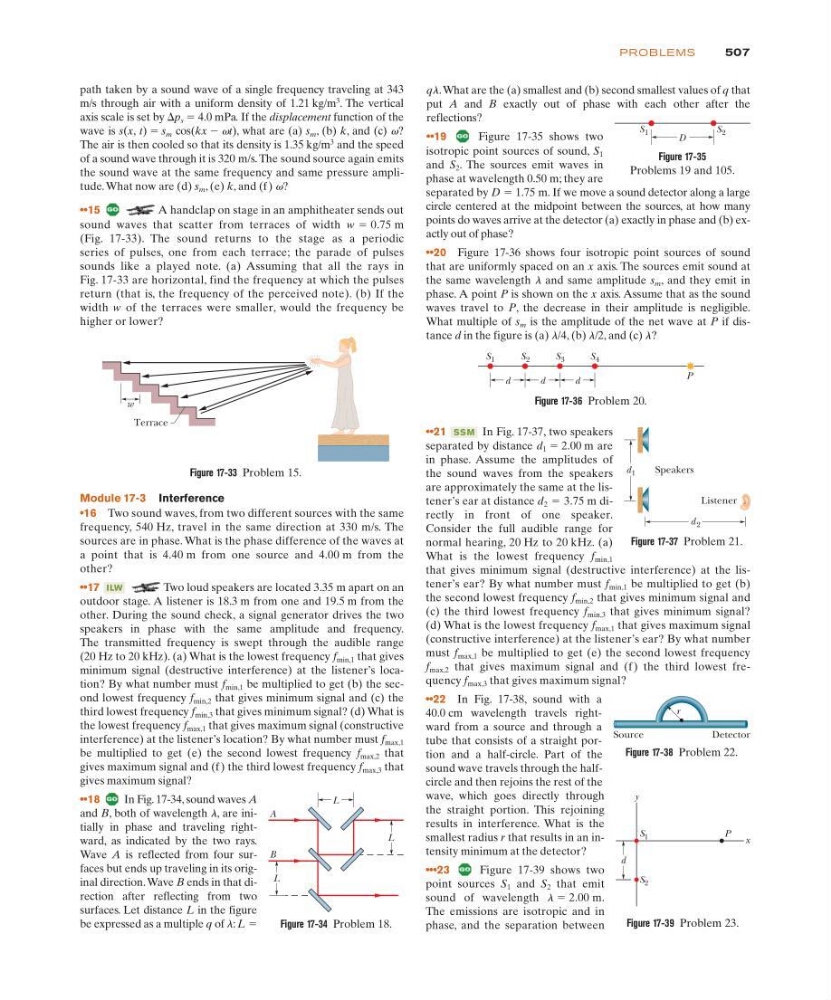
separated by distance d 1 ϭ 2.00 m are
in phase. Assume the amplitudes of
the sound waves from the speakers
are approximately the same at the listener’s ear at distance d 2 3.75 m directly in front of one speaker.
Consider the full audible range for
normal hearing, 20 Hz to 20 kHz. (a)
What is the lowest frequency f min,1
that gives minimum signal (destructive interference) at the listener’s ear? By what number must f min,1 be multiplied to get (b)
the second lowest frequency f min,2 that gives minimum signal and
(c) the third lowest frequency f min,3 that gives minimum signal?
(d) What is the lowest frequency f max,1 that gives maximum signal
(constructive interference) at the listener’s ear? By what number
must f max,1 be multiplied to get (e) the second lowest frequency
f max,2 that gives maximum signal and (f ) the third lowest frequency f max,3 that gives maximum signal?
••22 In Fig. 17-38, sound with a
40.0 cm wavelength travels rightward from a source and through a
tube that consists of a straight portion and a half-circle. Part of the
sound wave travels through the halfcircle and then rejoins the rest of the
wave, which goes directly through
the straight portion. This rejoining
results in interference. What is the
smallest radius r that results in an intensity minimum at the detector?
•••23
Figure 17-39 shows two
point sources S 1 and S 2 that emit
sound of wavelength l ϭ 2.00 m.
The emissions are isotropic and in
phase, and the separation between
ϭ
507
PROB LE M S
path taken by a sound wave of a single frequency traveling at 343
m/s through air with a uniform density of 1.21 kg/m
3
. The vertical
axis scale is set by ⌬p s ϭ 4.0 mPa. If the displacement function of the
wave is s(x, t) ϭ s m cos(kx Ϫ vt), what are (a) s m , (b) k, and (c) v?
The air is then cooled so that its density is 1.35 kg/m
3
and the speed
of a sound wave through it is 320 m/s. The sound source again emits
the sound wave at the same frequency and same pressure amplitude. What now are (d) s m , (e) k, and (f) v?
••15
A handclap on stage in an amphitheater sends out
ql.What are the (a) smallest and (b) second smallest values of q that
put A and B exactly out of phase with each other after the
reflections?
••19
Figure 17-35 shows two
Figure 17-33 Problem 15.
w
Terrace
isotropic point sources of sound, S 1
and S 2 . The sources emit waves in
phase at wavelength 0.50 m; they are
separated by D ϭ 1.75 m. If we move a sound detector along a large
circle centered at the midpoint between the sources, at how many
points do waves arrive at the detector (a) exactly in phase and (b) exactly out of phase?
••20 Figure 17-36 shows four isotropic point sources of sound
that are uniformly spaced on an x axis. The sources emit sound at
the same wavelength l and same amplitude s m , and they emit in
phase. A point P is shown on the x axis. Assume that as the sound
waves travel to P, the decrease in their amplitude is negligible.
What multiple of s m is the amplitude of the net wave at P if distance d in the figure is (a) l/4, (b) l/2, and (c) l?
••21
In Fig. 17-37, two speakers
SSM
sound waves that scatter from terraces of width w ϭ 0.75 m
(Fig. 17-33). The sound returns to the stage as a periodic
series of pulses, one from each terrace; the parade of pulses
sounds like a played note. (a) Assuming that all the rays in
Fig. 17-33 are horizontal, find the frequency at which the pulses
return (that is, the frequency of the perceived note). (b) If the
width w of the terraces were smaller, would the frequency be
higher or lower?
Module 17-3 Interference
•16 Two sound waves, from two different sources with the same
frequency, 540 Hz, travel in the same direction at 330 m/s. The
sources are in phase. What is the phase difference of the waves at
a point that is 4.40 m from one source and 4.00 m from the
other?
••17
Two loud speakers are located 3.35 m apart on an
outdoor stage. A listener is 18.3 m from one and 19.5 m from the
other. During the sound check, a signal generator drives the two
speakers in phase with the same amplitude and frequency.
The transmitted frequency is swept through the audible range
(20 Hz to 20 kHz). (a) What is the lowest frequency f min,1 that gives
minimum signal (destructive interference) at the listener’s location? By what number must f min,1 be multiplied to get (b) the second lowest frequency f min,2 that gives minimum signal and (c) the
third lowest frequency f min,3 that gives minimum signal? (d) What is
the lowest frequency f max,1 that gives maximum signal (constructive
interference) at the listener’s location? By what number must f max,1
be multiplied to get (e) the second lowest frequency f max,2 that
gives maximum signal and (f) the third lowest frequency f max,3 that
gives maximum signal?
••18
In Fig. 17-34, sound waves A
and B, both of wavelength l, are initially in phase and traveling rightward, as indicated by the two rays.
Wave A is reflected from four surfaces but ends up traveling in its original direction.Wave B ends in that direction after reflecting from two
surfaces. Let distance L in the figure
be expressed as a multiple q of l: L ϭ
ILW
d
d
d
S 1
S 2
S 3
S 4
P
Figure 17-36 Problem 20.
D
S 1
S 2
Figure 17-35
Problems 19 and 105.
L
L
L
A
B
Figure 17-34 Problem 18.
Speakers
Listener
d 1
d 2
Figure 17-37 Problem 21.
Source
Detector
r
Figure 17-38 Problem 22.
S 1
P
S 2
x
y
d
Figure 17-39 Problem 23.
in phase. Assume the amplitudes of
the sound waves from the speakers
are approximately the same at the listener’s ear at distance d 2 3.75 m directly in front of one speaker.
Consider the full audible range for
normal hearing, 20 Hz to 20 kHz. (a)
What is the lowest frequency f min,1
that gives minimum signal (destructive interference) at the listener’s ear? By what number must f min,1 be multiplied to get (b)
the second lowest frequency f min,2 that gives minimum signal and
(c) the third lowest frequency f min,3 that gives minimum signal?
(d) What is the lowest frequency f max,1 that gives maximum signal
(constructive interference) at the listener’s ear? By what number
must f max,1 be multiplied to get (e) the second lowest frequency
f max,2 that gives maximum signal and (f ) the third lowest frequency f max,3 that gives maximum signal?
••22 In Fig. 17-38, sound with a
40.0 cm wavelength travels rightward from a source and through a
tube that consists of a straight portion and a half-circle. Part of the
sound wave travels through the halfcircle and then rejoins the rest of the
wave, which goes directly through
the straight portion. This rejoining
results in interference. What is the
smallest radius r that results in an intensity minimum at the detector?
•••23
Figure 17-39 shows two
point sources S 1 and S 2 that emit
sound of wavelength l ϭ 2.00 m.
The emissions are isotropic and in
phase, and the separation between
ϭ
507
PROB LE M S
path taken by a sound wave of a single frequency traveling at 343
m/s through air with a uniform density of 1.21 kg/m
3
. The vertical
axis scale is set by ⌬p s ϭ 4.0 mPa. If the displacement function of the
wave is s(x, t) ϭ s m cos(kx Ϫ vt), what are (a) s m , (b) k, and (c) v?
The air is then cooled so that its density is 1.35 kg/m
3
and the speed
of a sound wave through it is 320 m/s. The sound source again emits
the sound wave at the same frequency and same pressure amplitude. What now are (d) s m , (e) k, and (f) v?
••15
A handclap on stage in an amphitheater sends out
ql.What are the (a) smallest and (b) second smallest values of q that
put A and B exactly out of phase with each other after the
reflections?
••19
Figure 17-35 shows two
Figure 17-33 Problem 15.
w
Terrace
isotropic point sources of sound, S 1
and S 2 . The sources emit waves in
phase at wavelength 0.50 m; they are
separated by D ϭ 1.75 m. If we move a sound detector along a large
circle centered at the midpoint between the sources, at how many
points do waves arrive at the detector (a) exactly in phase and (b) exactly out of phase?
••20 Figure 17-36 shows four isotropic point sources of sound
that are uniformly spaced on an x axis. The sources emit sound at
the same wavelength l and same amplitude s m , and they emit in
phase. A point P is shown on the x axis. Assume that as the sound
waves travel to P, the decrease in their amplitude is negligible.
What multiple of s m is the amplitude of the net wave at P if distance d in the figure is (a) l/4, (b) l/2, and (c) l?
••21
In Fig. 17-37, two speakers
SSM
sound waves that scatter from terraces of width w ϭ 0.75 m
(Fig. 17-33). The sound returns to the stage as a periodic
series of pulses, one from each terrace; the parade of pulses
sounds like a played note. (a) Assuming that all the rays in
Fig. 17-33 are horizontal, find the frequency at which the pulses
return (that is, the frequency of the perceived note). (b) If the
width w of the terraces were smaller, would the frequency be
higher or lower?
Module 17-3 Interference
•16 Two sound waves, from two different sources with the same
frequency, 540 Hz, travel in the same direction at 330 m/s. The
sources are in phase. What is the phase difference of the waves at
a point that is 4.40 m from one source and 4.00 m from the
other?
••17
Two loud speakers are located 3.35 m apart on an
outdoor stage. A listener is 18.3 m from one and 19.5 m from the
other. During the sound check, a signal generator drives the two
speakers in phase with the same amplitude and frequency.
The transmitted frequency is swept through the audible range
(20 Hz to 20 kHz). (a) What is the lowest frequency f min,1 that gives
minimum signal (destructive interference) at the listener’s location? By what number must f min,1 be multiplied to get (b) the second lowest frequency f min,2 that gives minimum signal and (c) the
third lowest frequency f min,3 that gives minimum signal? (d) What is
the lowest frequency f max,1 that gives maximum signal (constructive
interference) at the listener’s location? By what number must f max,1
be multiplied to get (e) the second lowest frequency f max,2 that
gives maximum signal and (f) the third lowest frequency f max,3 that
gives maximum signal?
••18
In Fig. 17-34, sound waves A
and B, both of wavelength l, are initially in phase and traveling rightward, as indicated by the two rays.
Wave A is reflected from four surfaces but ends up traveling in its original direction.Wave B ends in that direction after reflecting from two
surfaces. Let distance L in the figure
be expressed as a multiple q of l: L ϭ
ILW
d
d
d
S 1
S 2
S 3
S 4
P
Figure 17-36 Problem 20.
D
S 1
S 2
Figure 17-35
Problems 19 and 105.
L
L
L
A
B
Figure 17-34 Problem 18.
Speakers
Listener
d 1
d 2
Figure 17-37 Problem 21.
Source
Detector
r
Figure 17-38 Problem 22.
S 1
P
S 2
x
y
d
Figure 17-39 Problem 23.