

27
2-5 FR E E-FALL ACCE LE RATION
Next, we substitute for v with Eq. 2-11:
Since v 0 is a constant, as is the acceleration a, this can be rewritten as
Integration now yields
(2-26)
where CЈ is another constant of integration. At time t ϭ 0, we have x ϭ x 0 .
Substituting these values in Eq. 2-26 yields x 0 ϭ CЈ. Replacing CЈ with x 0 in Eq.
2-26 gives us Eq. 2-15.
x ϭ v 0 t ϩ
1
2 at
2 ϩ CЈ,
͵dx ϭ v 0͵ dt ϩ a͵t dt.
͵dx ϭ ͵(v0 ϩ at) dt.
2-5 FREE-FALL ACCELERATION
After reading this module, you should be able to . . .
2.16 Identify that if a particle is in free flight (whether
upward or downward) and if we can neglect the
effects of air on its motion, the particle has a constant
downward acceleration with a magnitude g that we take to
be 9.8 m/s
2
.
2.17 Apply the constant-acceleration equations (Table 2-1) to
free-fall motion.
● An important example of straight-line motion with constant
acceleration is that of an object rising or falling freely near
Earth’s surface. The constant acceleration equations describe this motion, but we make two changes in notation:
(1) we refer the motion to the vertical y axis with ϩy vertically
up; (2) we replace a with Ϫg, where g is the magnitude of the
free-fall acceleration. Near Earth’s surface,
g ϭ 9.8 m/s
2 ϭ 32 ft/s
2
.
Learning Objectives
Key Ideas
Free-Fall Acceleration
If you tossed an object either up or down and could somehow eliminate the
effects of air on its flight, you would find that the object accelerates downward at
a certain constant rate. That rate is called the free-fall acceleration, and its magnitude is represented by g. The acceleration is independent of the object’s characteristics, such as mass, density, or shape; it is the same for all objects.
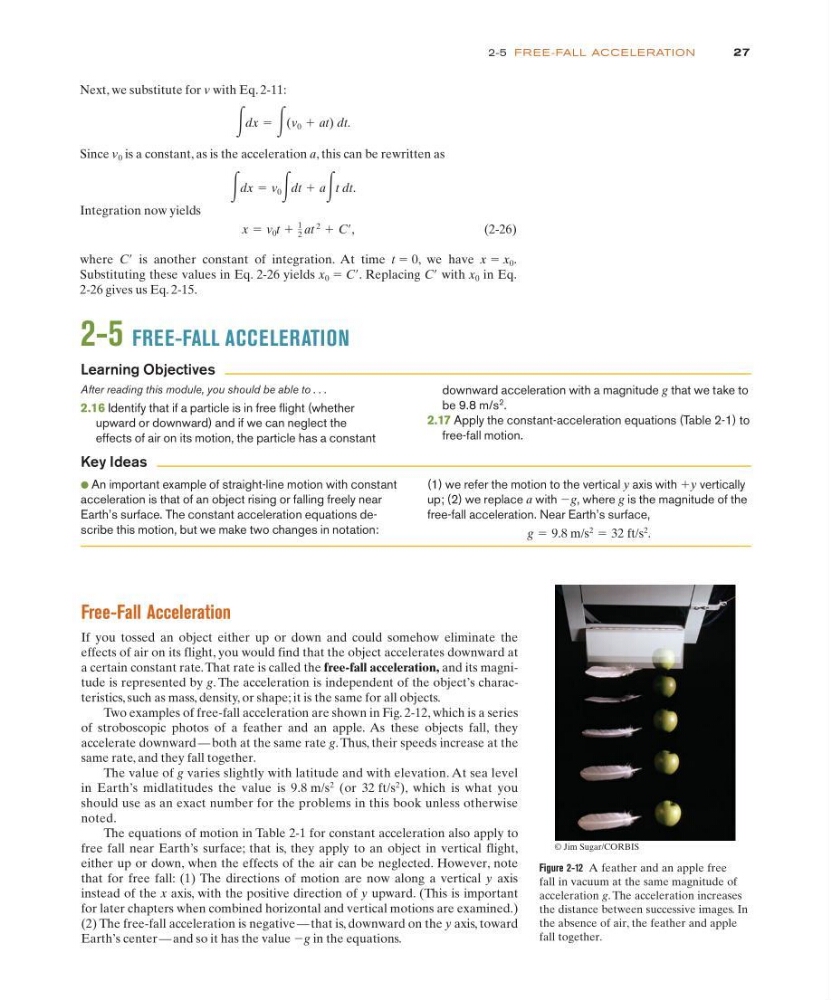
Two examples of free-fall acceleration are shown in Fig. 2-12, which is a series
of stroboscopic photos of a feather and an apple. As these objects fall, they
accelerate downward — both at the same rate g. Thus, their speeds increase at the
same rate, and they fall together.
The value of g varies slightly with latitude and with elevation. At sea level
in Earth’s midlatitudes the value is 9.8 m/s
2
(or 32 ft/s
2
), which is what you
should use as an exact number for the problems in this book unless otherwise
noted.
The equations of motion in Table 2-1 for constant acceleration also apply to
free fall near Earth’s surface; that is, they apply to an object in vertical flight,
either up or down, when the effects of the air can be neglected. However, note
that for free fall: (1) The directions of motion are now along a vertical y axis
instead of the x axis, with the positive direction of y upward. (This is important
for later chapters when combined horizontal and vertical motions are examined.)
(2) The free-fall acceleration is negative — that is, downward on the y axis, toward
Earth’s center — and so it has the value Ϫg in the equations.
Figure 2-12 A feather and an apple free
fall in vacuum at the same magnitude of
acceleration g. The acceleration increases
the distance between successive images. In
the absence of air, the feather and apple
fall together.
© Jim Sugar/CORBIS
2-5 FR E E-FALL ACCE LE RATION
Next, we substitute for v with Eq. 2-11:
Since v 0 is a constant, as is the acceleration a, this can be rewritten as
Integration now yields
(2-26)
where CЈ is another constant of integration. At time t ϭ 0, we have x ϭ x 0 .
Substituting these values in Eq. 2-26 yields x 0 ϭ CЈ. Replacing CЈ with x 0 in Eq.
2-26 gives us Eq. 2-15.
x ϭ v 0 t ϩ
1
2 at
2 ϩ CЈ,
͵dx ϭ v 0͵ dt ϩ a͵t dt.
͵dx ϭ ͵(v0 ϩ at) dt.
2-5 FREE-FALL ACCELERATION
After reading this module, you should be able to . . .
2.16 Identify that if a particle is in free flight (whether
upward or downward) and if we can neglect the
effects of air on its motion, the particle has a constant
downward acceleration with a magnitude g that we take to
be 9.8 m/s
2
.
2.17 Apply the constant-acceleration equations (Table 2-1) to
free-fall motion.
● An important example of straight-line motion with constant
acceleration is that of an object rising or falling freely near
Earth’s surface. The constant acceleration equations describe this motion, but we make two changes in notation:
(1) we refer the motion to the vertical y axis with ϩy vertically
up; (2) we replace a with Ϫg, where g is the magnitude of the
free-fall acceleration. Near Earth’s surface,
g ϭ 9.8 m/s
2 ϭ 32 ft/s
2
.
Learning Objectives
Key Ideas
Free-Fall Acceleration
If you tossed an object either up or down and could somehow eliminate the
effects of air on its flight, you would find that the object accelerates downward at
a certain constant rate. That rate is called the free-fall acceleration, and its magnitude is represented by g. The acceleration is independent of the object’s characteristics, such as mass, density, or shape; it is the same for all objects.
Two examples of free-fall acceleration are shown in Fig. 2-12, which is a series
of stroboscopic photos of a feather and an apple. As these objects fall, they
accelerate downward — both at the same rate g. Thus, their speeds increase at the
same rate, and they fall together.
The value of g varies slightly with latitude and with elevation. At sea level
in Earth’s midlatitudes the value is 9.8 m/s
2
(or 32 ft/s
2
), which is what you
should use as an exact number for the problems in this book unless otherwise
noted.
The equations of motion in Table 2-1 for constant acceleration also apply to
free fall near Earth’s surface; that is, they apply to an object in vertical flight,
either up or down, when the effects of the air can be neglected. However, note
that for free fall: (1) The directions of motion are now along a vertical y axis
instead of the x axis, with the positive direction of y upward. (This is important
for later chapters when combined horizontal and vertical motions are examined.)
(2) The free-fall acceleration is negative — that is, downward on the y axis, toward
Earth’s center — and so it has the value Ϫg in the equations.
Figure 2-12 A feather and an apple free
fall in vacuum at the same magnitude of
acceleration g. The acceleration increases
the distance between successive images. In
the absence of air, the feather and apple
fall together.
© Jim Sugar/CORBIS