

25
2-4 CONSTANT ACCE LE RATION
Checkpoint 4
The following equations give the position x(t) of a particle in four situations: (1) x ϭ
3t Ϫ 4; (2) x ϭ Ϫ5t
3 ϩ 4t
2 ϩ 6; (3) x ϭ 2/t
2 Ϫ 4/t; (4) x ϭ 5t
2 Ϫ 3. To which of these
situations do the equations of Table 2-1 apply?
choose any initial numbers because we are looking for the
elapsed time, not a particular time in, say, the afternoon, but
let’s stick with these easy numbers.) We want the car to pass
the motorcycle, but what does that mean mathematically?
It means that at some time t, the side-by-side vehicles
are at the same coordinate: x c for the car and the sum x m1 ϩ
x m2 for the motorcycle. We can write this statement mathematically as
(2-19)
(Writing this first step is the hardest part of the problem.
That is true of most physics problems. How do you go from
the problem statement (in words) to a mathematical expression? One purpose of this book is for you to build up that
ability of writing the first step — it takes lots of practice just
as in learning, say, tae-kwon-do.)
Now let’s fill out both sides of Eq. 2-19, left side first. To
reach the passing point at x c , the car accelerates from rest. From
Eq. 2-15
, with x 0 and v 0 ϭ 0, we have
(2-20)
To write an expression for x m1 for the motorcycle, we
first find the time t m it takes to reach its maximum speed v m ,
using Eq. 2-11 (v ϭ v 0 ϩ at). Substituting v 0 ϭ 0, v ϭ v m ϭ
58.8 m/s, and a ϭ a m ϭ 8.40 m/s
2
, that time is
(2-21)
To get the distance x m1 traveled by the motorcycle during
the first stage, we again use Eq. 2-15 with x 0 ϭ 0 and v 0 ϭ 0,
but we also substitute from Eq. 2-21 for the time. We find
(2-22)
For the remaining time of
, the motorcycle travels
at its maximum speed with zero acceleration. To get the
distance, we use Eq. 2-15 for this second stage of the motion,
but now the initial velocity is
(the speed at the end
v 0 ϭ v m
t Ϫ t m
x m1 ϭ
1
2 a m t m
2 ϭ
1
2 a m
v m
a m
2
ϭ
1
2
v m
2
a m
.
ϭ
58.8 m/s
8.40 m/s
2
ϭ 7.00 s.
t m ϭ
v m
a m
x c ϭ
1
2 a c t
2
.
(x Ϫ x 0 ϭ v 0 t ϩ
1
2 at
2
)
x c ϭ x m1 ϩ x m2 .
Sample Problem 2.04 Drag race of car and motorcycle
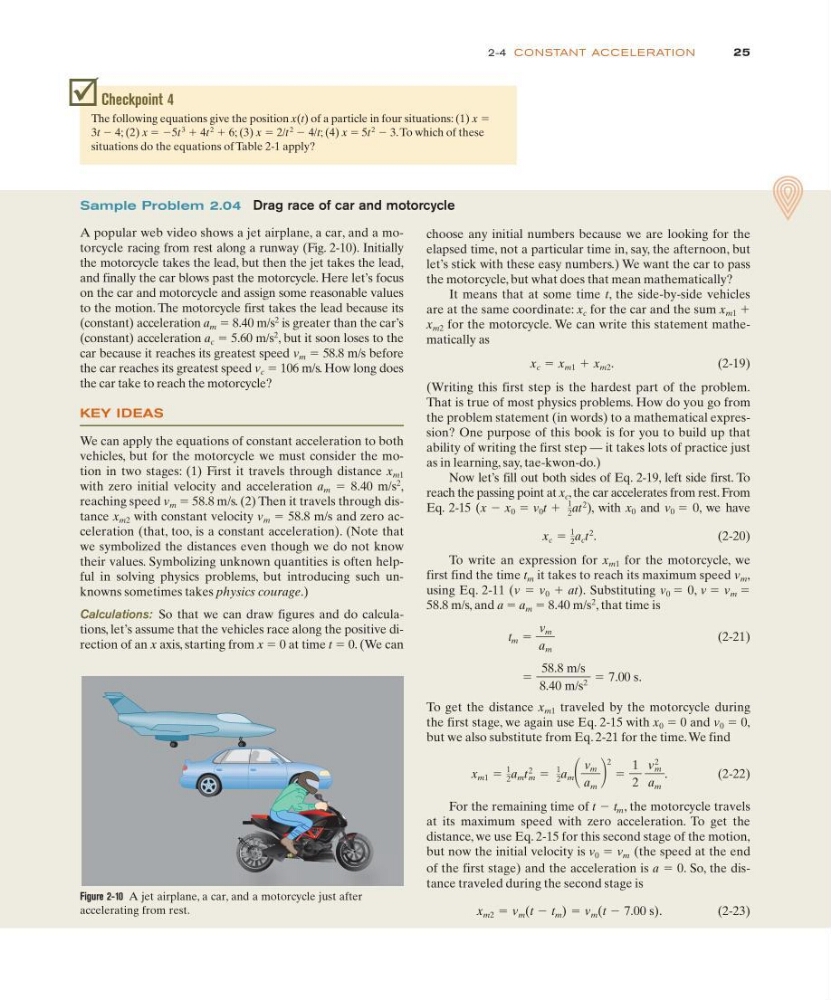
A popular web video shows a jet airplane, a car, and a motorcycle racing from rest along a runway (Fig. 2-10). Initially
the motorcycle takes the lead, but then the jet takes the lead,
and finally the car blows past the motorcycle. Here let’s focus
on the car and motorcycle and assign some reasonable values
to the motion. The motorcycle first takes the lead because its
(constant) acceleration a m ϭ 8.40 m/s
2
is greater than the car’s
(constant) acceleration a c ϭ 5.60 m/s
2
, but it soon loses to the
car because it reaches its greatest speed v m ϭ 58.8 m/s before
the car reaches its greatest speed v c ϭ 106 m/s. How long does
the car take to reach the motorcycle?
KEY IDEAS
We can apply the equations of constant acceleration to both
vehicles, but for the motorcycle we must consider the motion in two stages: (1) First it travels through distance x m1
with zero initial velocity and acceleration a m ϭ 8.40 m/s
2
,
reaching speed v m ϭ 58.8 m/s. (2) Then it travels through distance x m2 with constant velocity v m ϭ 58.8 m/s and zero acceleration (that, too, is a constant acceleration). (Note that
we symbolized the distances even though we do not know
their values. Symbolizing unknown quantities is often helpful in solving physics problems, but introducing such unknowns sometimes takes physics courage.)
Calculations: So that we can draw figures and do calculations, let’s assume that the vehicles race along the positive direction of an x axis, starting from x ϭ 0 at time t ϭ 0. (We can
Figure 2-10 A jet airplane, a car, and a motorcycle just after
accelerating from rest.
of the first stage) and the acceleration is a ϭ 0. So, the distance traveled during the second stage is
(2-23)
x m2 ϭ v m (t Ϫ t m ) ϭ v m (t Ϫ 7.00 s).
2-4 CONSTANT ACCE LE RATION
Checkpoint 4
The following equations give the position x(t) of a particle in four situations: (1) x ϭ
3t Ϫ 4; (2) x ϭ Ϫ5t
3 ϩ 4t
2 ϩ 6; (3) x ϭ 2/t
2 Ϫ 4/t; (4) x ϭ 5t
2 Ϫ 3. To which of these
situations do the equations of Table 2-1 apply?
choose any initial numbers because we are looking for the
elapsed time, not a particular time in, say, the afternoon, but
let’s stick with these easy numbers.) We want the car to pass
the motorcycle, but what does that mean mathematically?
It means that at some time t, the side-by-side vehicles
are at the same coordinate: x c for the car and the sum x m1 ϩ
x m2 for the motorcycle. We can write this statement mathematically as
(2-19)
(Writing this first step is the hardest part of the problem.
That is true of most physics problems. How do you go from
the problem statement (in words) to a mathematical expression? One purpose of this book is for you to build up that
ability of writing the first step — it takes lots of practice just
as in learning, say, tae-kwon-do.)
Now let’s fill out both sides of Eq. 2-19, left side first. To
reach the passing point at x c , the car accelerates from rest. From
Eq. 2-15
, with x 0 and v 0 ϭ 0, we have
(2-20)
To write an expression for x m1 for the motorcycle, we
first find the time t m it takes to reach its maximum speed v m ,
using Eq. 2-11 (v ϭ v 0 ϩ at). Substituting v 0 ϭ 0, v ϭ v m ϭ
58.8 m/s, and a ϭ a m ϭ 8.40 m/s
2
, that time is
(2-21)
To get the distance x m1 traveled by the motorcycle during
the first stage, we again use Eq. 2-15 with x 0 ϭ 0 and v 0 ϭ 0,
but we also substitute from Eq. 2-21 for the time. We find
(2-22)
For the remaining time of
, the motorcycle travels
at its maximum speed with zero acceleration. To get the
distance, we use Eq. 2-15 for this second stage of the motion,
but now the initial velocity is
(the speed at the end
v 0 ϭ v m
t Ϫ t m
x m1 ϭ
1
2 a m t m
2 ϭ
1
2 a m
v m
a m
2
ϭ
1
2
v m
2
a m
.
ϭ
58.8 m/s
8.40 m/s
2
ϭ 7.00 s.
t m ϭ
v m
a m
x c ϭ
1
2 a c t
2
.
(x Ϫ x 0 ϭ v 0 t ϩ
1
2 at
2
)
x c ϭ x m1 ϩ x m2 .
Sample Problem 2.04 Drag race of car and motorcycle
A popular web video shows a jet airplane, a car, and a motorcycle racing from rest along a runway (Fig. 2-10). Initially
the motorcycle takes the lead, but then the jet takes the lead,
and finally the car blows past the motorcycle. Here let’s focus
on the car and motorcycle and assign some reasonable values
to the motion. The motorcycle first takes the lead because its
(constant) acceleration a m ϭ 8.40 m/s
2
is greater than the car’s
(constant) acceleration a c ϭ 5.60 m/s
2
, but it soon loses to the
car because it reaches its greatest speed v m ϭ 58.8 m/s before
the car reaches its greatest speed v c ϭ 106 m/s. How long does
the car take to reach the motorcycle?
KEY IDEAS
We can apply the equations of constant acceleration to both
vehicles, but for the motorcycle we must consider the motion in two stages: (1) First it travels through distance x m1
with zero initial velocity and acceleration a m ϭ 8.40 m/s
2
,
reaching speed v m ϭ 58.8 m/s. (2) Then it travels through distance x m2 with constant velocity v m ϭ 58.8 m/s and zero acceleration (that, too, is a constant acceleration). (Note that
we symbolized the distances even though we do not know
their values. Symbolizing unknown quantities is often helpful in solving physics problems, but introducing such unknowns sometimes takes physics courage.)
Calculations: So that we can draw figures and do calculations, let’s assume that the vehicles race along the positive direction of an x axis, starting from x ϭ 0 at time t ϭ 0. (We can
Figure 2-10 A jet airplane, a car, and a motorcycle just after
accelerating from rest.
of the first stage) and the acceleration is a ϭ 0. So, the distance traveled during the second stage is
(2-23)
x m2 ϭ v m (t Ϫ t m ) ϭ v m (t Ϫ 7.00 s).