

483
17-2 TRAVE LI NG SOU N D WAVES
the tube (as in Fig. 16-2). The piston’s rightward motion moves the element of
air next to the piston face and compresses that air; the piston’s leftward motion
allows the element of air to move back to the left and the pressure to decrease.
As each element of air pushes on the next element in turn, the right – left motion
of the air and the change in its pressure travel along the tube as a sound wave.
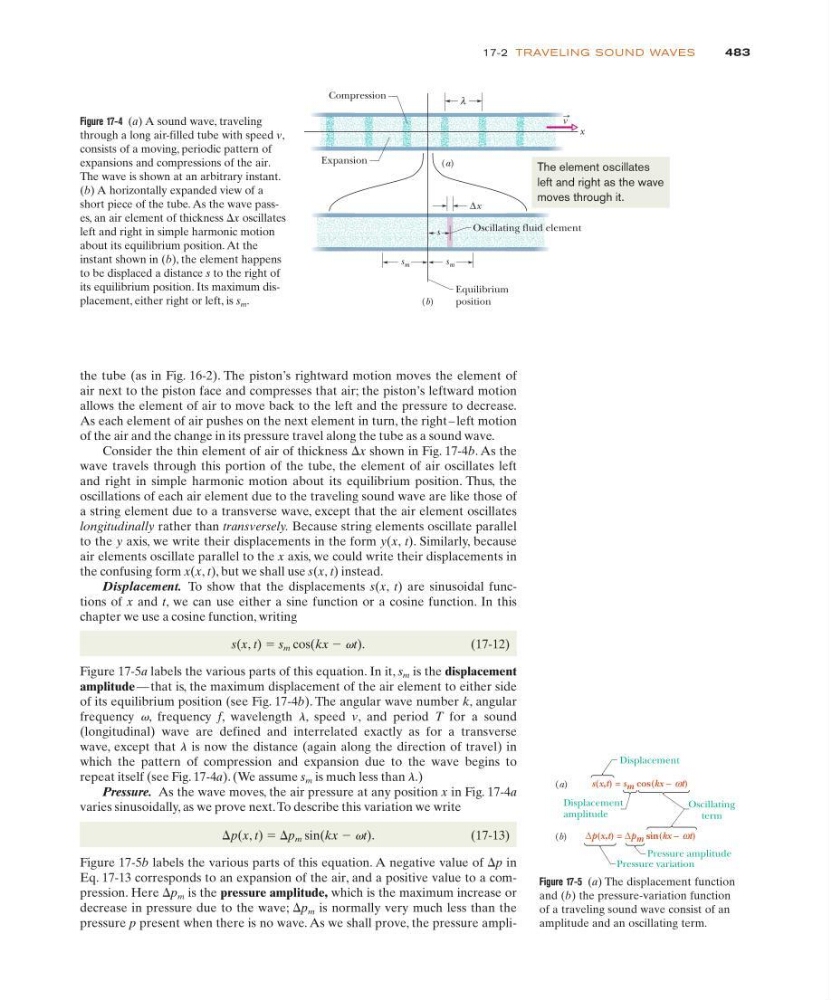
Consider the thin element of air of thickness ⌬x shown in Fig. 17-4b. As the
wave travels through this portion of the tube, the element of air oscillates left
and right in simple harmonic motion about its equilibrium position. Thus, the
oscillations of each air element due to the traveling sound wave are like those of
a string element due to a transverse wave, except that the air element oscillates
longitudinally rather than transversely. Because string elements oscillate parallel
to the y axis, we write their displacements in the form y(x, t). Similarly, because
air elements oscillate parallel to the x axis, we could write their displacements in
the confusing form x(x, t), but we shall use s(x, t) instead.
Displacement. To show that the displacements s(x, t) are sinusoidal functions of x and t, we can use either a sine function or a cosine function. In this
chapter we use a cosine function, writing
s(x, t) ϭ s m cos(kx Ϫ vt).
(17-12)
Figure 17-5a labels the various parts of this equation. In it, s m is the displacement
amplitude — that is, the maximum displacement of the air element to either side
of its equilibrium position (see Fig. 17-4b). The angular wave number k, angular
frequency v, frequency f, wavelength l, speed v, and period T for a sound
(longitudinal) wave are defined and interrelated exactly as for a transverse
wave, except that l is now the distance (again along the direction of travel) in
which the pattern of compression and expansion due to the wave begins to
repeat itself (see Fig. 17-4a). (We assume s m is much less than l.)
Pressure. As the wave moves, the air pressure at any position x in Fig. 17-4a
varies sinusoidally, as we prove next. To describe this variation we write
⌬p(x, t) ϭ ⌬p m sin(kx Ϫ vt).
(17-13)
Figure 17-5b labels the various parts of this equation. A negative value of ⌬p in
Eq. 17-13 corresponds to an expansion of the air, and a positive value to a compression. Here ⌬p m is the pressure amplitude, which is the maximum increase or
decrease in pressure due to the wave; ⌬p m is normally very much less than the
pressure p present when there is no wave. As we shall prove, the pressure ampliCompression
(a)
∆ x
Expansion
λ
Equilibrium
position
s
s m
s m
(b)
x
Oscillating fluid element
v
The element oscillates
left and right as the wave
moves through it.
Figure 17-4 (a) A sound wave, traveling
through a long air-filled tube with speed v,
consists of a moving, periodic pattern of
expansions and compressions of the air.
The wave is shown at an arbitrary instant.
(b) A horizontally expanded view of a
short piece of the tube. As the wave passes, an air element of thickness ⌬x oscillates
left and right in simple harmonic motion
about its equilibrium position. At the
instant shown in (b), the element happens
to be displaced a distance s to the right of
its equilibrium position. Its maximum displacement, either right or left, is s m .
Displacement
Pressure variation
Pressure amplitude
Displacement
amplitude
ω ω
Oscillating
term
(a)
ω ω
(b)
s(x,t) = s m cos(kx – t)
∆p(x,t) = ∆p m sin(kx – t)
Figure 17-5 (a) The displacement function
and (b) the pressure-variation function
of a traveling sound wave consist of an
amplitude and an oscillating term.
17-2 TRAVE LI NG SOU N D WAVES
the tube (as in Fig. 16-2). The piston’s rightward motion moves the element of
air next to the piston face and compresses that air; the piston’s leftward motion
allows the element of air to move back to the left and the pressure to decrease.
As each element of air pushes on the next element in turn, the right – left motion
of the air and the change in its pressure travel along the tube as a sound wave.
Consider the thin element of air of thickness ⌬x shown in Fig. 17-4b. As the
wave travels through this portion of the tube, the element of air oscillates left
and right in simple harmonic motion about its equilibrium position. Thus, the
oscillations of each air element due to the traveling sound wave are like those of
a string element due to a transverse wave, except that the air element oscillates
longitudinally rather than transversely. Because string elements oscillate parallel
to the y axis, we write their displacements in the form y(x, t). Similarly, because
air elements oscillate parallel to the x axis, we could write their displacements in
the confusing form x(x, t), but we shall use s(x, t) instead.
Displacement. To show that the displacements s(x, t) are sinusoidal functions of x and t, we can use either a sine function or a cosine function. In this
chapter we use a cosine function, writing
s(x, t) ϭ s m cos(kx Ϫ vt).
(17-12)
Figure 17-5a labels the various parts of this equation. In it, s m is the displacement
amplitude — that is, the maximum displacement of the air element to either side
of its equilibrium position (see Fig. 17-4b). The angular wave number k, angular
frequency v, frequency f, wavelength l, speed v, and period T for a sound
(longitudinal) wave are defined and interrelated exactly as for a transverse
wave, except that l is now the distance (again along the direction of travel) in
which the pattern of compression and expansion due to the wave begins to
repeat itself (see Fig. 17-4a). (We assume s m is much less than l.)
Pressure. As the wave moves, the air pressure at any position x in Fig. 17-4a
varies sinusoidally, as we prove next. To describe this variation we write
⌬p(x, t) ϭ ⌬p m sin(kx Ϫ vt).
(17-13)
Figure 17-5b labels the various parts of this equation. A negative value of ⌬p in
Eq. 17-13 corresponds to an expansion of the air, and a positive value to a compression. Here ⌬p m is the pressure amplitude, which is the maximum increase or
decrease in pressure due to the wave; ⌬p m is normally very much less than the
pressure p present when there is no wave. As we shall prove, the pressure ampliCompression
(a)
∆ x
Expansion
λ
Equilibrium
position
s
s m
s m
(b)
x
Oscillating fluid element
v
The element oscillates
left and right as the wave
moves through it.
Figure 17-4 (a) A sound wave, traveling
through a long air-filled tube with speed v,
consists of a moving, periodic pattern of
expansions and compressions of the air.
The wave is shown at an arbitrary instant.
(b) A horizontally expanded view of a
short piece of the tube. As the wave passes, an air element of thickness ⌬x oscillates
left and right in simple harmonic motion
about its equilibrium position. At the
instant shown in (b), the element happens
to be displaced a distance s to the right of
its equilibrium position. Its maximum displacement, either right or left, is s m .
Displacement
Pressure variation
Pressure amplitude
Displacement
amplitude
ω ω
Oscillating
term
(a)
ω ω
(b)
s(x,t) = s m cos(kx – t)
∆p(x,t) = ∆p m sin(kx – t)
Figure 17-5 (a) The displacement function
and (b) the pressure-variation function
of a traveling sound wave consist of an
amplitude and an oscillating term.