

480
CHAPTE R 17 WAVES—I I
carry sound-ranging gear (sonar) to detect underwater obstacles. Submarines
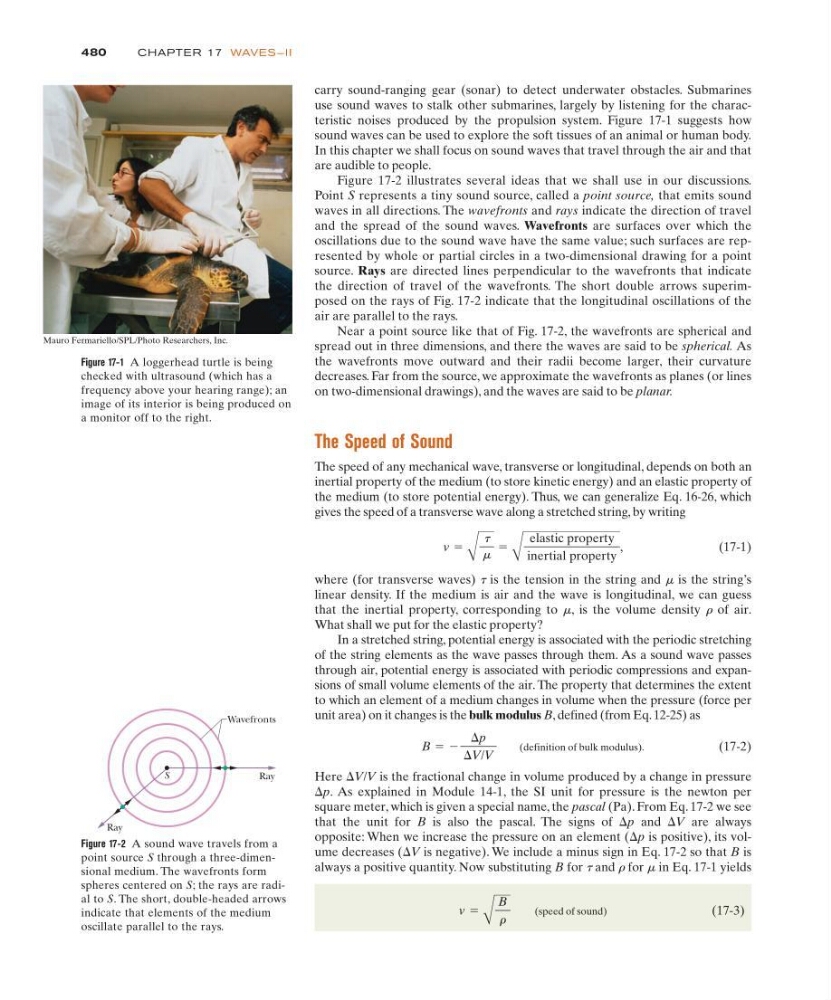
use sound waves to stalk other submarines, largely by listening for the characteristic noises produced by the propulsion system. Figure 17-1 suggests how
sound waves can be used to explore the soft tissues of an animal or human body.
In this chapter we shall focus on sound waves that travel through the air and that
are audible to people.
Figure 17-2 illustrates several ideas that we shall use in our discussions.
Point S represents a tiny sound source, called a point source, that emits sound
waves in all directions. The wavefronts and rays indicate the direction of travel
and the spread of the sound waves. Wavefronts are surfaces over which the
oscillations due to the sound wave have the same value; such surfaces are represented by whole or partial circles in a two-dimensional drawing for a point
source. Rays are directed lines perpendicular to the wavefronts that indicate
the direction of travel of the wavefronts. The short double arrows superimposed on the rays of Fig. 17-2 indicate that the longitudinal oscillations of the
air are parallel to the rays.
Near a point source like that of Fig. 17-2, the wavefronts are spherical and
spread out in three dimensions, and there the waves are said to be spherical. As
the wavefronts move outward and their radii become larger, their curvature
decreases. Far from the source, we approximate the wavefronts as planes (or lines
on two-dimensional drawings), and the waves are said to be planar.
The Speed of Sound
The speed of any mechanical wave, transverse or longitudinal, depends on both an
inertial property of the medium (to store kinetic energy) and an elastic property of
the medium (to store potential energy). Thus, we can generalize Eq. 16-26, which
gives the speed of a transverse wave along a stretched string, by writing
(17-1)
where (for transverse waves) t is the tension in the string and m is the string’s
linear density. If the medium is air and the wave is longitudinal, we can guess
that the inertial property, corresponding to m, is the volume density r of air.
What shall we put for the elastic property?
In a stretched string, potential energy is associated with the periodic stretching
of the string elements as the wave passes through them. As a sound wave passes
through air, potential energy is associated with periodic compressions and expansions of small volume elements of the air. The property that determines the extent
to which an element of a medium changes in volume when the pressure (force per
unit area) on it changes is the bulk modulus B, defined (from Eq. 12-25) as
(definition of bulk modulus).
(17-2)
Here ⌬V/V is the fractional change in volume produced by a change in pressure
⌬p. As explained in Module 14-1, the SI unit for pressure is the newton per
square meter, which is given a special name, the pascal (Pa). From Eq. 17-2 we see
that the unit for B is also the pascal. The signs of ⌬p and ⌬V are always
opposite: When we increase the pressure on an element (⌬p is positive), its volume decreases (⌬V is negative). We include a minus sign in Eq. 17-2 so that B is
always a positive quantity. Now substituting B for t and r for m in Eq. 17-1 yields
(speed of sound)
(17-3)
v ϭ A
B
B ϭ Ϫ
⌬p
⌬V/V
v ϭ A
t
m
ϭ A
elastic property
inertial property
,
Mauro Fermariello/SPL/Photo Researchers, Inc.
Figure 17-1 A loggerhead turtle is being
checked with ultrasound (which has a
frequency above your hearing range); an
image of its interior is being produced on
a monitor off to the right.
Ray
Ray
S
Wavefronts
Figure 17-2 A sound wave travels from a
point source S through a three-dimensional medium. The wavefronts form
spheres centered on S; the rays are radial to S. The short, double-headed arrows
indicate that elements of the medium
oscillate parallel to the rays.
CHAPTE R 17 WAVES—I I
carry sound-ranging gear (sonar) to detect underwater obstacles. Submarines
use sound waves to stalk other submarines, largely by listening for the characteristic noises produced by the propulsion system. Figure 17-1 suggests how
sound waves can be used to explore the soft tissues of an animal or human body.
In this chapter we shall focus on sound waves that travel through the air and that
are audible to people.
Figure 17-2 illustrates several ideas that we shall use in our discussions.
Point S represents a tiny sound source, called a point source, that emits sound
waves in all directions. The wavefronts and rays indicate the direction of travel
and the spread of the sound waves. Wavefronts are surfaces over which the
oscillations due to the sound wave have the same value; such surfaces are represented by whole or partial circles in a two-dimensional drawing for a point
source. Rays are directed lines perpendicular to the wavefronts that indicate
the direction of travel of the wavefronts. The short double arrows superimposed on the rays of Fig. 17-2 indicate that the longitudinal oscillations of the
air are parallel to the rays.
Near a point source like that of Fig. 17-2, the wavefronts are spherical and
spread out in three dimensions, and there the waves are said to be spherical. As
the wavefronts move outward and their radii become larger, their curvature
decreases. Far from the source, we approximate the wavefronts as planes (or lines
on two-dimensional drawings), and the waves are said to be planar.
The Speed of Sound
The speed of any mechanical wave, transverse or longitudinal, depends on both an
inertial property of the medium (to store kinetic energy) and an elastic property of
the medium (to store potential energy). Thus, we can generalize Eq. 16-26, which
gives the speed of a transverse wave along a stretched string, by writing
(17-1)
where (for transverse waves) t is the tension in the string and m is the string’s
linear density. If the medium is air and the wave is longitudinal, we can guess
that the inertial property, corresponding to m, is the volume density r of air.
What shall we put for the elastic property?
In a stretched string, potential energy is associated with the periodic stretching
of the string elements as the wave passes through them. As a sound wave passes
through air, potential energy is associated with periodic compressions and expansions of small volume elements of the air. The property that determines the extent
to which an element of a medium changes in volume when the pressure (force per
unit area) on it changes is the bulk modulus B, defined (from Eq. 12-25) as
(definition of bulk modulus).
(17-2)
Here ⌬V/V is the fractional change in volume produced by a change in pressure
⌬p. As explained in Module 14-1, the SI unit for pressure is the newton per
square meter, which is given a special name, the pascal (Pa). From Eq. 17-2 we see
that the unit for B is also the pascal. The signs of ⌬p and ⌬V are always
opposite: When we increase the pressure on an element (⌬p is positive), its volume decreases (⌬V is negative). We include a minus sign in Eq. 17-2 so that B is
always a positive quantity. Now substituting B for t and r for m in Eq. 17-1 yields
(speed of sound)
(17-3)
v ϭ A
B
B ϭ Ϫ
⌬p
⌬V/V
v ϭ A
t
m
ϭ A
elastic property
inertial property
,
Mauro Fermariello/SPL/Photo Researchers, Inc.
Figure 17-1 A loggerhead turtle is being
checked with ultrasound (which has a
frequency above your hearing range); an
image of its interior is being produced on
a monitor off to the right.
Ray
Ray
S
Wavefronts
Figure 17-2 A sound wave travels from a
point source S through a three-dimensional medium. The wavefronts form
spheres centered on S; the rays are radial to S. The short, double-headed arrows
indicate that elements of the medium
oscillate parallel to the rays.