

472
CHAPTE R 16 WAVES—I
Tutoring problem available (at instructor’s discretion) in WileyPLUS and WebAssign
SSM Worked-out solution available in Student Solutions Manual
• – ••• Number of dots indicates level of problem difficulty
Additional information available in The Flying Circus of Physics and at flyingcircusofphysics.com
WWW Worked-out solution is at
ILW Interactive solution is at
http://www.wiley.com/college/halliday
Problems
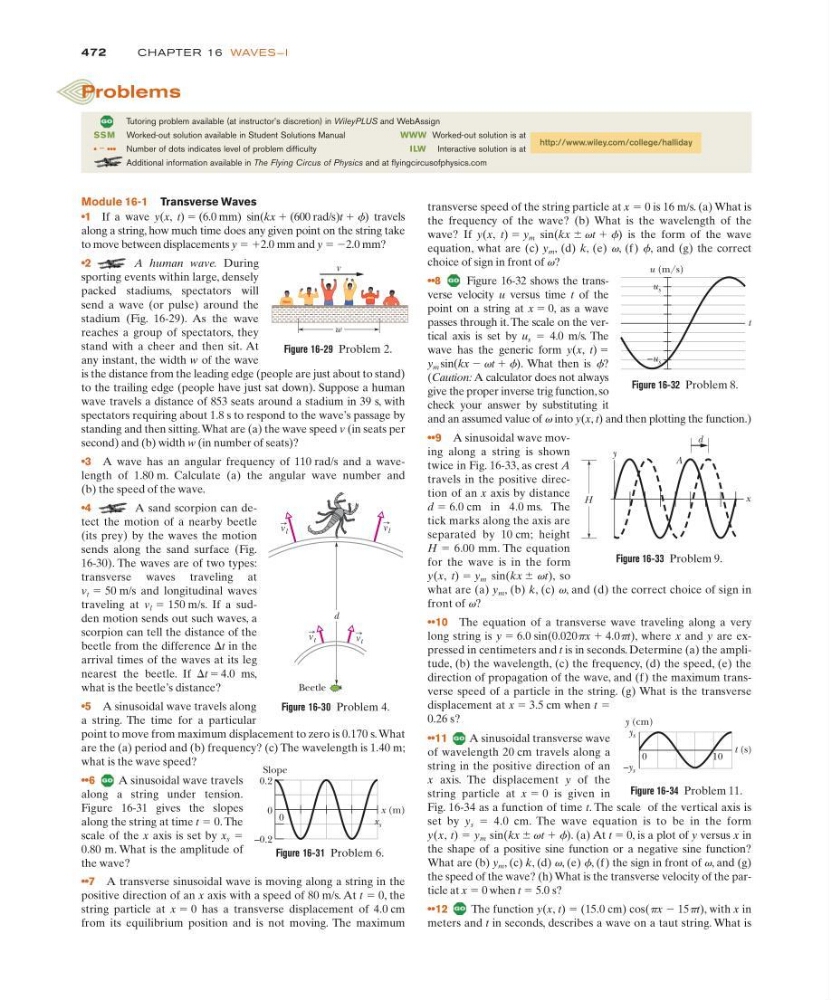
Module 16-1 Transverse Waves
•1 If a wave y(x, t) ϭ (6.0 mm) sin(kx ϩ (600 rad/s)t ϩ f) travels
along a string, how much time does any given point on the string take
to move between displacements y ϭ ϩ2.0 mm and y ϭ Ϫ2.0 mm?
•2
A human wave. During
sporting events within large, densely
packed stadiums, spectators will
send a wave (or pulse) around the
stadium (Fig. 16-29). As the wave
reaches a group of spectators, they
stand with a cheer and then sit. At
any instant, the width w of the wave
is the distance from the leading edge (people are just about to stand)
to the trailing edge (people have just sat down). Suppose a human
wave travels a distance of 853 seats around a stadium in 39 s, with
spectators requiring about 1.8 s to respond to the wave’s passage by
standing and then sitting.What are (a) the wave speed v (in seats per
second) and (b) width w (in number of seats)?
•3 A wave has an angular frequency of 110 rad/s and a wavelength of 1.80 m. Calculate (a) the angular wave number and
(b) the speed of the wave.
•4
A sand scorpion can detect the motion of a nearby beetle
(its prey) by the waves the motion
sends along the sand surface (Fig.
16-30). The waves are of two types:
transverse waves traveling at
and longitudinal waves
traveling at
. If a sudden motion sends out such waves, a
scorpion can tell the distance of the
beetle from the difference ⌬t in the
arrival times of the waves at its leg
nearest the beetle. If ⌬t ϭ 4.0 ms,
what is the beetle’s distance?
•5 A sinusoidal wave travels along
a string. The time for a particular
point to move from maximum displacement to zero is 0.170 s. What
are the (a) period and (b) frequency? (c) The wavelength is 1.40 m;
what is the wave speed?
••6
A sinusoidal wave travels
along a string under tension.
Figure 16-31 gives the slopes
along the string at time t ϭ 0. The
scale of the x axis is set by x s ϭ
0.80 m. What is the amplitude of
the wave?
••7 A transverse sinusoidal wave is moving along a string in the
positive direction of an x axis with a speed of 80 m/s. At t ϭ 0, the
string particle at x ϭ 0 has a transverse displacement of 4.0 cm
from its equilibrium position and is not moving. The maximum
v l ϭ 150 m/s
v t ϭ 50 m/s
transverse speed of the string particle at x ϭ 0 is 16 m/s. (a) What is
the frequency of the wave? (b) What is the wavelength of the
wave? If y(x, t) ϭ y m sin(kx Ϯ vt ϩ f) is the form of the wave
equation, what are (c) y m , (d) k, (e) v, (f) f, and (g) the correct
choice of sign in front of v?
••8
Figure 16-32 shows the transverse velocity u versus time t of the
point on a string at x ϭ 0, as a wave
passes through it. The scale on the vertical axis is set by u s ϭ 4.0 m/s. The
wave has the generic form y(x, t) ϭ
y m sin(kx Ϫ vt ϩ f). What then is f?
(Caution: A calculator does not always
give the proper inverse trig function, so
check your answer by substituting it
and an assumed value of v into y(x, t) and then plotting the function.)
••9 A sinusoidal wave moving along a string is shown
twice in Fig. 16-33, as crest A
travels in the positive direction of an x axis by distance
d ϭ 6.0 cm in 4.0 ms. The
tick marks along the axis are
separated by 10 cm; height
H ϭ 6.00 mm. The equation
for the wave is in the form
y(x, t) ϭ y m sin(kx Ϯ vt), so
what are (a) y m , (b) k, (c) v, and (d) the correct choice of sign in
front of v?
••10 The equation of a transverse wave traveling along a very
long string is y ϭ 6.0 sin(0.020px ϩ 4.0pt), where x and y are expressed in centimeters and t is in seconds. Determine (a) the amplitude, (b) the wavelength, (c) the frequency, (d) the speed, (e) the
direction of propagation of the wave, and (f) the maximum transverse speed of a particle in the string. (g) What is the transverse
displacement at x ϭ 3.5 cm when t ϭ
0.26 s?
••11
A sinusoidal transverse wave
of wavelength 20 cm travels along a
string in the positive direction of an
x axis. The displacement y of the
string particle at x ϭ 0 is given in
Fig. 16-34 as a function of time t. The scale of the vertical axis is
set by y s ϭ 4.0 cm. The wave equation is to be in the form
y(x, t) ϭ y m sin(kx Ϯ vt ϩ f). (a) At t ϭ 0, is a plot of y versus x in
the shape of a positive sine function or a negative sine function?
What are (b) y m , (c) k, (d) v, (e) f, (f) the sign in front of v, and (g)
the speed of the wave? (h) What is the transverse velocity of the particle at x ϭ 0 when t ϭ 5.0 s?
••12
The function y(x, t) ϭ (15.0 cm) cos(px Ϫ 15pt), with x in
meters and t in seconds, describes a wave on a taut string. What is
w
v
Figure 16-29 Problem 2.
Figure 16-30 Problem 4.
d
v l
v l
v t
v t
Beetle
Figure 16-31 Problem 6.
0 0
–0.2
0.2
Slope
x (m)
x s
u s
–u s
u (m/s)
t
Figure 16-32 Problem 8.
H
x
A
y
d
Figure 16-33 Problem 9.
y (cm)
y s
–y s
t (s)
10
0
Figure 16-34 Problem 11.
CHAPTE R 16 WAVES—I
Tutoring problem available (at instructor’s discretion) in WileyPLUS and WebAssign
SSM Worked-out solution available in Student Solutions Manual
• – ••• Number of dots indicates level of problem difficulty
Additional information available in The Flying Circus of Physics and at flyingcircusofphysics.com
WWW Worked-out solution is at
ILW Interactive solution is at
http://www.wiley.com/college/halliday
Problems
Module 16-1 Transverse Waves
•1 If a wave y(x, t) ϭ (6.0 mm) sin(kx ϩ (600 rad/s)t ϩ f) travels
along a string, how much time does any given point on the string take
to move between displacements y ϭ ϩ2.0 mm and y ϭ Ϫ2.0 mm?
•2
A human wave. During
sporting events within large, densely
packed stadiums, spectators will
send a wave (or pulse) around the
stadium (Fig. 16-29). As the wave
reaches a group of spectators, they
stand with a cheer and then sit. At
any instant, the width w of the wave
is the distance from the leading edge (people are just about to stand)
to the trailing edge (people have just sat down). Suppose a human
wave travels a distance of 853 seats around a stadium in 39 s, with
spectators requiring about 1.8 s to respond to the wave’s passage by
standing and then sitting.What are (a) the wave speed v (in seats per
second) and (b) width w (in number of seats)?
•3 A wave has an angular frequency of 110 rad/s and a wavelength of 1.80 m. Calculate (a) the angular wave number and
(b) the speed of the wave.
•4
A sand scorpion can detect the motion of a nearby beetle
(its prey) by the waves the motion
sends along the sand surface (Fig.
16-30). The waves are of two types:
transverse waves traveling at
and longitudinal waves
traveling at
. If a sudden motion sends out such waves, a
scorpion can tell the distance of the
beetle from the difference ⌬t in the
arrival times of the waves at its leg
nearest the beetle. If ⌬t ϭ 4.0 ms,
what is the beetle’s distance?
•5 A sinusoidal wave travels along
a string. The time for a particular
point to move from maximum displacement to zero is 0.170 s. What
are the (a) period and (b) frequency? (c) The wavelength is 1.40 m;
what is the wave speed?
••6
A sinusoidal wave travels
along a string under tension.
Figure 16-31 gives the slopes
along the string at time t ϭ 0. The
scale of the x axis is set by x s ϭ
0.80 m. What is the amplitude of
the wave?
••7 A transverse sinusoidal wave is moving along a string in the
positive direction of an x axis with a speed of 80 m/s. At t ϭ 0, the
string particle at x ϭ 0 has a transverse displacement of 4.0 cm
from its equilibrium position and is not moving. The maximum
v l ϭ 150 m/s
v t ϭ 50 m/s
transverse speed of the string particle at x ϭ 0 is 16 m/s. (a) What is
the frequency of the wave? (b) What is the wavelength of the
wave? If y(x, t) ϭ y m sin(kx Ϯ vt ϩ f) is the form of the wave
equation, what are (c) y m , (d) k, (e) v, (f) f, and (g) the correct
choice of sign in front of v?
••8
Figure 16-32 shows the transverse velocity u versus time t of the
point on a string at x ϭ 0, as a wave
passes through it. The scale on the vertical axis is set by u s ϭ 4.0 m/s. The
wave has the generic form y(x, t) ϭ
y m sin(kx Ϫ vt ϩ f). What then is f?
(Caution: A calculator does not always
give the proper inverse trig function, so
check your answer by substituting it
and an assumed value of v into y(x, t) and then plotting the function.)
••9 A sinusoidal wave moving along a string is shown
twice in Fig. 16-33, as crest A
travels in the positive direction of an x axis by distance
d ϭ 6.0 cm in 4.0 ms. The
tick marks along the axis are
separated by 10 cm; height
H ϭ 6.00 mm. The equation
for the wave is in the form
y(x, t) ϭ y m sin(kx Ϯ vt), so
what are (a) y m , (b) k, (c) v, and (d) the correct choice of sign in
front of v?
••10 The equation of a transverse wave traveling along a very
long string is y ϭ 6.0 sin(0.020px ϩ 4.0pt), where x and y are expressed in centimeters and t is in seconds. Determine (a) the amplitude, (b) the wavelength, (c) the frequency, (d) the speed, (e) the
direction of propagation of the wave, and (f) the maximum transverse speed of a particle in the string. (g) What is the transverse
displacement at x ϭ 3.5 cm when t ϭ
0.26 s?
••11
A sinusoidal transverse wave
of wavelength 20 cm travels along a
string in the positive direction of an
x axis. The displacement y of the
string particle at x ϭ 0 is given in
Fig. 16-34 as a function of time t. The scale of the vertical axis is
set by y s ϭ 4.0 cm. The wave equation is to be in the form
y(x, t) ϭ y m sin(kx Ϯ vt ϩ f). (a) At t ϭ 0, is a plot of y versus x in
the shape of a positive sine function or a negative sine function?
What are (b) y m , (c) k, (d) v, (e) f, (f) the sign in front of v, and (g)
the speed of the wave? (h) What is the transverse velocity of the particle at x ϭ 0 when t ϭ 5.0 s?
••12
The function y(x, t) ϭ (15.0 cm) cos(px Ϫ 15pt), with x in
meters and t in seconds, describes a wave on a taut string. What is
w
v
Figure 16-29 Problem 2.
Figure 16-30 Problem 4.
d
v l
v l
v t
v t
Beetle
Figure 16-31 Problem 6.
0 0
–0.2
0.2
Slope
x (m)
x s
u s
–u s
u (m/s)
t
Figure 16-32 Problem 8.
H
x
A
y
d
Figure 16-33 Problem 9.
y (cm)
y s
–y s
t (s)
10
0
Figure 16-34 Problem 11.