

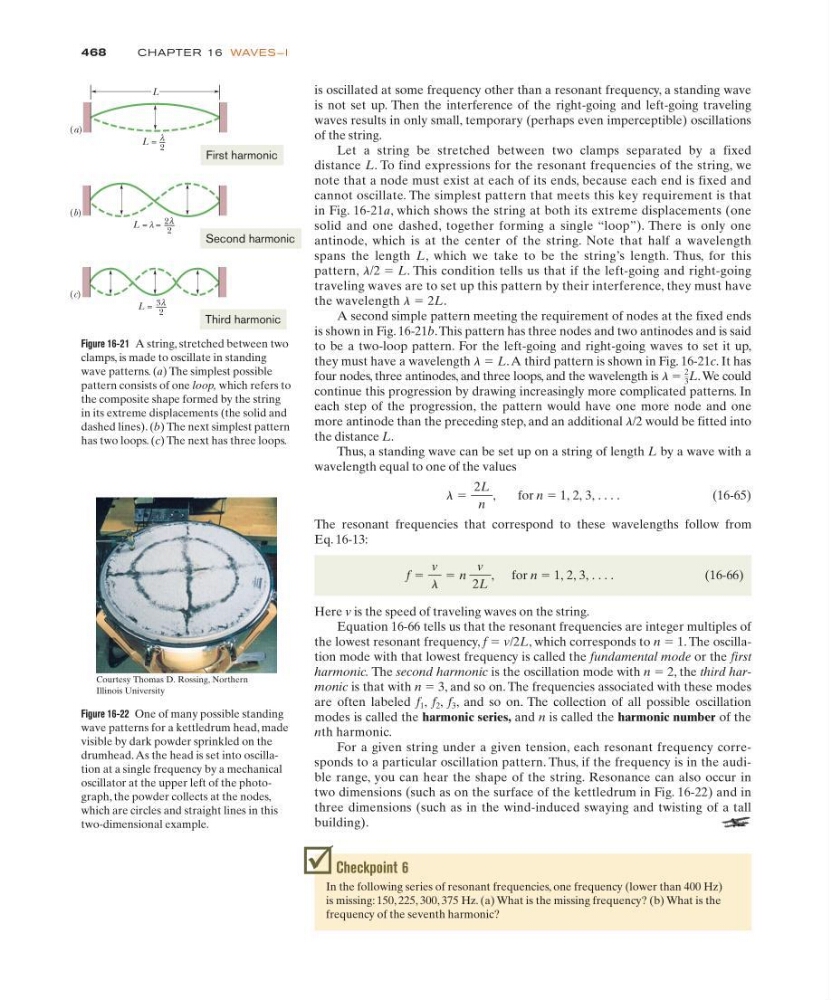
Courtesy Thomas D. Rossing, Northern
Illinois University
Figure 16-22 One of many possible standing
wave patterns for a kettledrum head, made
visible by dark powder sprinkled on the
drumhead. As the head is set into oscillation at a single frequency by a mechanical
oscillator at the upper left of the photograph, the powder collects at the nodes,
which are circles and straight lines in this
two-dimensional example.
Checkpoint 6
In the following series of resonant frequencies, one frequency (lower than 400 Hz)
is missing: 150, 225, 300, 375 Hz. (a) What is the missing frequency? (b) What is the
frequency of the seventh harmonic?
468
CHAPTE R 16 WAVES—I
Figure 16-21 A string, stretched between two
clamps, is made to oscillate in standing
wave patterns. (a) The simplest possible
pattern consists of one loop, which refers to
the composite shape formed by the string
in its extreme displacements (the solid and
dashed lines). (b) The next simplest pattern
has two loops. (c) The next has three loops.
L
L = λ
2
(a)
First harmonic
L =
λ
2
(b)
2
λ =
Second harmonic
L = λ
2
(c)
3
Third harmonic
is oscillated at some frequency other than a resonant frequency, a standing wave
is not set up. Then the interference of the right-going and left-going traveling
waves results in only small, temporary (perhaps even imperceptible) oscillations
of the string.
Let a string be stretched between two clamps separated by a fixed
distance L. To find expressions for the resonant frequencies of the string, we
note that a node must exist at each of its ends, because each end is fixed and
cannot oscillate. The simplest pattern that meets this key requirement is that
in Fig. 16-21a, which shows the string at both its extreme displacements (one
solid and one dashed, together forming a single “loop”). There is only one
antinode, which is at the center of the string. Note that half a wavelength
spans the length L, which we take to be the string’s length. Thus, for this
pattern, l/2 ϭ L. This condition tells us that if the left-going and right-going
traveling waves are to set up this pattern by their interference, they must have
the wavelength l ϭ 2L.
A second simple pattern meeting the requirement of nodes at the fixed ends
is shown in Fig. 16-21b.This pattern has three nodes and two antinodes and is said
to be a two-loop pattern. For the left-going and right-going waves to set it up,
they must have a wavelength l ϭ L. A third pattern is shown in Fig. 16-21c. It has
four nodes, three antinodes, and three loops, and the wavelength is l ϭ L.We could
continue this progression by drawing increasingly more complicated patterns. In
each step of the progression, the pattern would have one more node and one
more antinode than the preceding step, and an additional l/2 would be fitted into
the distance L.
Thus, a standing wave can be set up on a string of length L by a wave with a
wavelength equal to one of the values
for n ϭ 1, 2, 3, . . . .
(16-65)
The resonant frequencies that correspond to these wavelengths follow from
Eq. 16-13:
for n ϭ 1, 2, 3, . . . .
(16-66)
Here v is the speed of traveling waves on the string.
Equation 16-66 tells us that the resonant frequencies are integer multiples of
the lowest resonant frequency, f ϭ v/2L, which corresponds to n ϭ 1. The oscillation mode with that lowest frequency is called the fundamental mode or the first
harmonic. The second harmonic is the oscillation mode with n ϭ 2, the third harmonic is that with n ϭ 3, and so on. The frequencies associated with these modes
are often labeled f 1 , f 2 , f 3 , and so on. The collection of all possible oscillation
modes is called the harmonic series, and n is called the harmonic number of the
nth harmonic.
For a given string under a given tension, each resonant frequency corresponds to a particular oscillation pattern. Thus, if the frequency is in the audible range, you can hear the shape of the string. Resonance can also occur in
two dimensions (such as on the surface of the kettledrum in Fig. 16-22) and in
three dimensions (such as in the wind-induced swaying and twisting of a tall
building).
f ϭ
v
ϭ n
v
2L
,
ϭ
2L
n
,
2
3
Illinois University
Figure 16-22 One of many possible standing
wave patterns for a kettledrum head, made
visible by dark powder sprinkled on the
drumhead. As the head is set into oscillation at a single frequency by a mechanical
oscillator at the upper left of the photograph, the powder collects at the nodes,
which are circles and straight lines in this
two-dimensional example.
Checkpoint 6
In the following series of resonant frequencies, one frequency (lower than 400 Hz)
is missing: 150, 225, 300, 375 Hz. (a) What is the missing frequency? (b) What is the
frequency of the seventh harmonic?
468
CHAPTE R 16 WAVES—I
Figure 16-21 A string, stretched between two
clamps, is made to oscillate in standing
wave patterns. (a) The simplest possible
pattern consists of one loop, which refers to
the composite shape formed by the string
in its extreme displacements (the solid and
dashed lines). (b) The next simplest pattern
has two loops. (c) The next has three loops.
L
L = λ
2
(a)
First harmonic
L =
λ
2
(b)
2
λ =
Second harmonic
L = λ
2
(c)
3
Third harmonic
is oscillated at some frequency other than a resonant frequency, a standing wave
is not set up. Then the interference of the right-going and left-going traveling
waves results in only small, temporary (perhaps even imperceptible) oscillations
of the string.
Let a string be stretched between two clamps separated by a fixed
distance L. To find expressions for the resonant frequencies of the string, we
note that a node must exist at each of its ends, because each end is fixed and
cannot oscillate. The simplest pattern that meets this key requirement is that
in Fig. 16-21a, which shows the string at both its extreme displacements (one
solid and one dashed, together forming a single “loop”). There is only one
antinode, which is at the center of the string. Note that half a wavelength
spans the length L, which we take to be the string’s length. Thus, for this
pattern, l/2 ϭ L. This condition tells us that if the left-going and right-going
traveling waves are to set up this pattern by their interference, they must have
the wavelength l ϭ 2L.
A second simple pattern meeting the requirement of nodes at the fixed ends
is shown in Fig. 16-21b.This pattern has three nodes and two antinodes and is said
to be a two-loop pattern. For the left-going and right-going waves to set it up,
they must have a wavelength l ϭ L. A third pattern is shown in Fig. 16-21c. It has
four nodes, three antinodes, and three loops, and the wavelength is l ϭ L.We could
continue this progression by drawing increasingly more complicated patterns. In
each step of the progression, the pattern would have one more node and one
more antinode than the preceding step, and an additional l/2 would be fitted into
the distance L.
Thus, a standing wave can be set up on a string of length L by a wave with a
wavelength equal to one of the values
for n ϭ 1, 2, 3, . . . .
(16-65)
The resonant frequencies that correspond to these wavelengths follow from
Eq. 16-13:
for n ϭ 1, 2, 3, . . . .
(16-66)
Here v is the speed of traveling waves on the string.
Equation 16-66 tells us that the resonant frequencies are integer multiples of
the lowest resonant frequency, f ϭ v/2L, which corresponds to n ϭ 1. The oscillation mode with that lowest frequency is called the fundamental mode or the first
harmonic. The second harmonic is the oscillation mode with n ϭ 2, the third harmonic is that with n ϭ 3, and so on. The frequencies associated with these modes
are often labeled f 1 , f 2 , f 3 , and so on. The collection of all possible oscillation
modes is called the harmonic series, and n is called the harmonic number of the
nth harmonic.
For a given string under a given tension, each resonant frequency corresponds to a particular oscillation pattern. Thus, if the frequency is in the audible range, you can hear the shape of the string. Resonance can also occur in
two dimensions (such as on the surface of the kettledrum in Fig. 16-22) and in
three dimensions (such as in the wind-induced swaying and twisting of a tall
building).
f ϭ
v
ϭ n
v
2L
,
ϭ
2L
n
,
2
3