

461
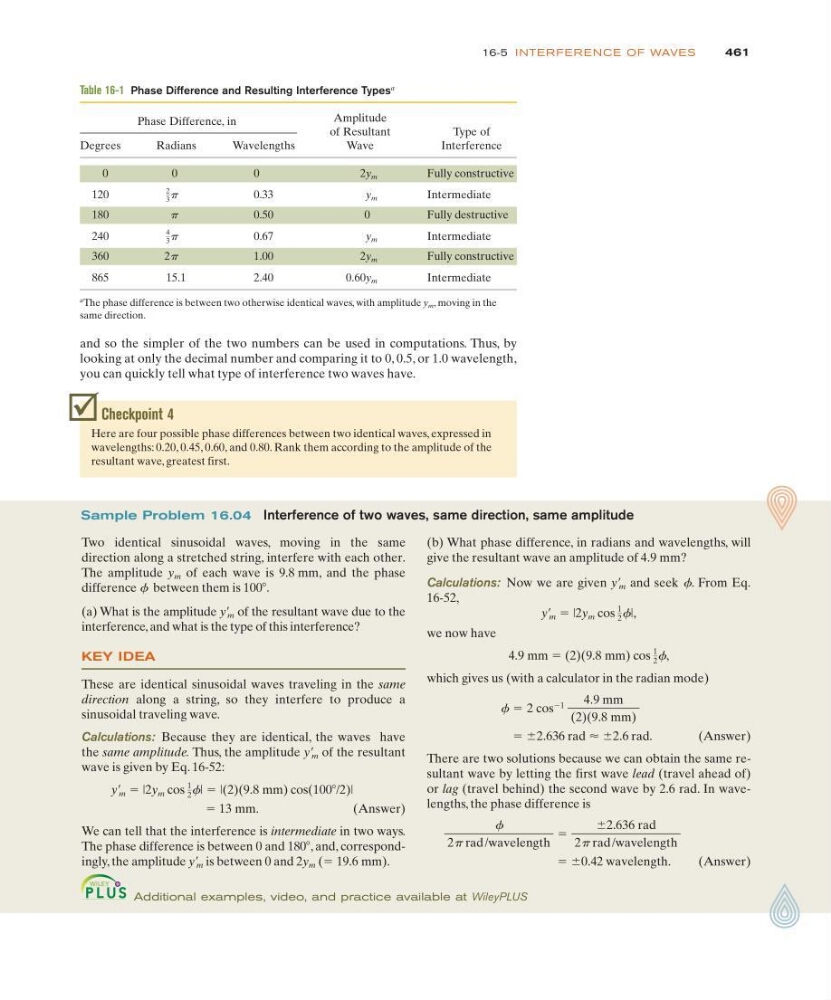
and so the simpler of the two numbers can be used in computations. Thus, by
looking at only the decimal number and comparing it to 0, 0.5, or 1.0 wavelength,
you can quickly tell what type of interference two waves have.
16-5 INTERFERENCE OF WAVES
Checkpoint 4
Here are four possible phase differences between two identical waves, expressed in
wavelengths: 0.20, 0.45, 0.60, and 0.80. Rank them according to the amplitude of the
resultant wave, greatest first.
Table 16-1 Phase Difference and Resulting Interference Types
a
Amplitude
Phase Difference, in
of Resultant
Type of
Degrees
Radians
Wavelengths
Wave
Interference
0
0
0
2 y m
Fully constructive
120
p
0.33
y m
Intermediate
180
p
0.50
0
Fully destructive
240
p
0.67
y m
Intermediate
360
2p
1.00
2y m
Fully constructive
865
15.1
2.40
0.60y m
Intermediate
a The phase difference is between two otherwise identical waves, with amplitude y m , moving in the
same direction.
4
3
2
3
(b) What phase difference, in radians and wavelengths, will
give the resultant wave an amplitude of 4.9 mm?
Calculations: Now we are given yЈ m and seek f. From Eq.
16-52,
yЈ m ϭ |2y m cos f|,
we now have
4.9 mm ϭ (2)(9.8 mm) cos f,
which gives us (with a calculator in the radian mode)
ϭ Ϯ2.636 rad Ϸ Ϯ2.6 rad.
(Answer)
There are two solutions because we can obtain the same resultant wave by letting the first wave lead (travel ahead of)
or lag (travel behind) the second wave by 2.6 rad. In wavelengths, the phase difference is
ϭ Ϯ0.42 wavelength.
(Answer)
f
2p rad /wavelength
ϭ
Ϯ2.636 rad
2p rad /wavelength
f ϭ 2 cos
Ϫ1
4.9 mm
(2)(9.8 mm)
1
2
1
2
Sample Problem 16.04 Interference of two waves, same direction, same amplitude
Two identical sinusoidal waves, moving in the same
direction along a stretched string, interfere with each other.
The amplitude y m of each wave is 9.8 mm, and the phase
difference f between them is 100Њ.
(a) What is the amplitude yЈ m of the resultant wave due to the
interference, and what is the type of this interference?
KEY IDEA
These are identical sinusoidal waves traveling in the same
direction along a string, so they interfere to produce a
sinusoidal traveling wave.
Calculations: Because they are identical, the waves have
the same amplitude. Thus, the amplitude yЈ m of the resultant
wave is given by Eq. 16-52:
yЈ m ϭ |2y m cos f| ϭ |(2)(9.8 mm) cos(100Њ/2)|
ϭ 13 mm.
(Answer)
We can tell that the interference is intermediate in two ways.
The phase difference is between 0 and 180Њ, and, correspondingly, the amplitude yЈ m is between 0 and 2y m (ϭ 19.6 mm).
1
2
Additional examples, video, and practice available at WileyPLUS
and so the simpler of the two numbers can be used in computations. Thus, by
looking at only the decimal number and comparing it to 0, 0.5, or 1.0 wavelength,
you can quickly tell what type of interference two waves have.
16-5 INTERFERENCE OF WAVES
Checkpoint 4
Here are four possible phase differences between two identical waves, expressed in
wavelengths: 0.20, 0.45, 0.60, and 0.80. Rank them according to the amplitude of the
resultant wave, greatest first.
Table 16-1 Phase Difference and Resulting Interference Types
a
Amplitude
Phase Difference, in
of Resultant
Type of
Degrees
Radians
Wavelengths
Wave
Interference
0
0
0
2 y m
Fully constructive
120
p
0.33
y m
Intermediate
180
p
0.50
0
Fully destructive
240
p
0.67
y m
Intermediate
360
2p
1.00
2y m
Fully constructive
865
15.1
2.40
0.60y m
Intermediate
a The phase difference is between two otherwise identical waves, with amplitude y m , moving in the
same direction.
4
3
2
3
(b) What phase difference, in radians and wavelengths, will
give the resultant wave an amplitude of 4.9 mm?
Calculations: Now we are given yЈ m and seek f. From Eq.
16-52,
yЈ m ϭ |2y m cos f|,
we now have
4.9 mm ϭ (2)(9.8 mm) cos f,
which gives us (with a calculator in the radian mode)
ϭ Ϯ2.636 rad Ϸ Ϯ2.6 rad.
(Answer)
There are two solutions because we can obtain the same resultant wave by letting the first wave lead (travel ahead of)
or lag (travel behind) the second wave by 2.6 rad. In wavelengths, the phase difference is
ϭ Ϯ0.42 wavelength.
(Answer)
f
2p rad /wavelength
ϭ
Ϯ2.636 rad
2p rad /wavelength
f ϭ 2 cos
Ϫ1
4.9 mm
(2)(9.8 mm)
1
2
1
2
Sample Problem 16.04 Interference of two waves, same direction, same amplitude
Two identical sinusoidal waves, moving in the same
direction along a stretched string, interfere with each other.
The amplitude y m of each wave is 9.8 mm, and the phase
difference f between them is 100Њ.
(a) What is the amplitude yЈ m of the resultant wave due to the
interference, and what is the type of this interference?
KEY IDEA
These are identical sinusoidal waves traveling in the same
direction along a string, so they interfere to produce a
sinusoidal traveling wave.
Calculations: Because they are identical, the waves have
the same amplitude. Thus, the amplitude yЈ m of the resultant
wave is given by Eq. 16-52:
yЈ m ϭ |2y m cos f| ϭ |(2)(9.8 mm) cos(100Њ/2)|
ϭ 13 mm.
(Answer)
We can tell that the interference is intermediate in two ways.
The phase difference is between 0 and 180Њ, and, correspondingly, the amplitude yЈ m is between 0 and 2y m (ϭ 19.6 mm).
1
2
Additional examples, video, and practice available at WileyPLUS