

453
16-2 WAVE SPE E D ON A STR ETCH E D STR I NG
Derivation from Newton’s Second Law
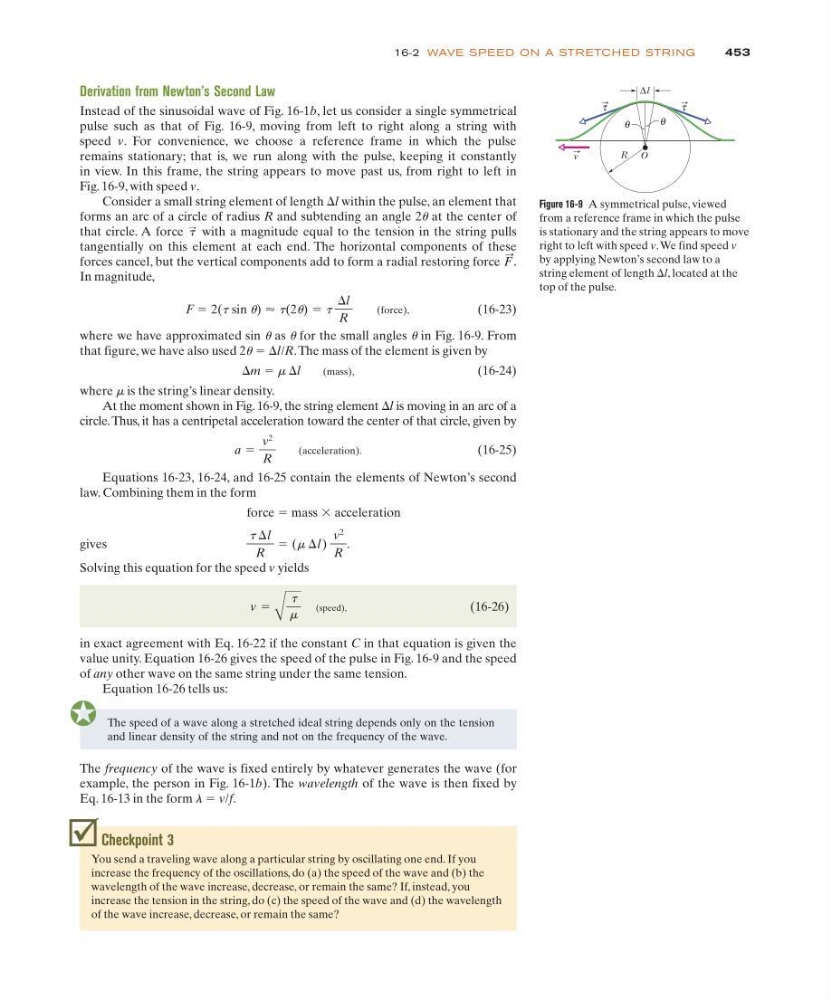
Instead of the sinusoidal wave of Fig. 16-1b, let us consider a single symmetrical
pulse such as that of Fig. 16-9, moving from left to right along a string with
speed v. For convenience, we choose a reference frame in which the pulse
remains stationary; that is, we run along with the pulse, keeping it constantly
in view. In this frame, the string appears to move past us, from right to left in
Fig. 16-9, with speed v.
Consider a small string element of length ⌬l within the pulse, an element that
forms an arc of a circle of radius R and subtending an angle 2u at the center of
that circle. A force with a magnitude equal to the tension in the string pulls
tangentially on this element at each end. The horizontal components of these
forces cancel, but the vertical components add to form a radial restoring force .
In magnitude,
(force),
(16-23)
where we have approximated sin u as u for the small angles u in Fig. 16-9. From
that figure, we have also used 2u ϭ ⌬l/R.The mass of the element is given by
⌬m ϭ m ⌬l
(mass),
(16-24)
where m is the string’s linear density.
At the moment shown in Fig. 16-9, the string element ⌬l is moving in an arc of a
circle. Thus, it has a centripetal acceleration toward the center of that circle, given by
(acceleration).
(16-25)
Equations 16-23, 16-24, and 16-25 contain the elements of Newton’s second
law. Combining them in the form
force ϭ mass ϫ acceleration
gives
Solving this equation for the speed v yields
(speed),
(16-26)
in exact agreement with Eq. 16-22 if the constant C in that equation is given the
value unity. Equation 16-26 gives the speed of the pulse in Fig. 16-9 and the speed
of any other wave on the same string under the same tension.
Equation 16-26 tells us:
v ϭ A
t
m
t ⌬l
R
ϭ (m ⌬l)
v
2
R
.
a ϭ
v
2
R
F ϭ 2(t sin u) Ϸ t(2u) ϭ t
⌬l
R
F
:
:
Figure 16-9 A symmetrical pulse, viewed
from a reference frame in which the pulse
is stationary and the string appears to move
right to left with speed v.We find speed v
by applying Newton’s second law to a
string element of length ⌬l, located at the
top of the pulse.
τ
θ
R
l
∆
O
τ
θ
v
The speed of a wave along a stretched ideal string depends only on the tension
and linear density of the string and not on the frequency of the wave.
Checkpoint 3
You send a traveling wave along a particular string by oscillating one end. If you
increase the frequency of the oscillations, do (a) the speed of the wave and (b) the
wavelength of the wave increase, decrease, or remain the same? If, instead, you
increase the tension in the string, do (c) the speed of the wave and (d) the wavelength
of the wave increase, decrease, or remain the same?
The frequency of the wave is fixed entirely by whatever generates the wave (for
example, the person in Fig. 16-1b). The wavelength of the wave is then fixed by
Eq. 16-13 in the form l ϭ v/f.
16-2 WAVE SPE E D ON A STR ETCH E D STR I NG
Derivation from Newton’s Second Law
Instead of the sinusoidal wave of Fig. 16-1b, let us consider a single symmetrical
pulse such as that of Fig. 16-9, moving from left to right along a string with
speed v. For convenience, we choose a reference frame in which the pulse
remains stationary; that is, we run along with the pulse, keeping it constantly
in view. In this frame, the string appears to move past us, from right to left in
Fig. 16-9, with speed v.
Consider a small string element of length ⌬l within the pulse, an element that
forms an arc of a circle of radius R and subtending an angle 2u at the center of
that circle. A force with a magnitude equal to the tension in the string pulls
tangentially on this element at each end. The horizontal components of these
forces cancel, but the vertical components add to form a radial restoring force .
In magnitude,
(force),
(16-23)
where we have approximated sin u as u for the small angles u in Fig. 16-9. From
that figure, we have also used 2u ϭ ⌬l/R.The mass of the element is given by
⌬m ϭ m ⌬l
(mass),
(16-24)
where m is the string’s linear density.
At the moment shown in Fig. 16-9, the string element ⌬l is moving in an arc of a
circle. Thus, it has a centripetal acceleration toward the center of that circle, given by
(acceleration).
(16-25)
Equations 16-23, 16-24, and 16-25 contain the elements of Newton’s second
law. Combining them in the form
force ϭ mass ϫ acceleration
gives
Solving this equation for the speed v yields
(speed),
(16-26)
in exact agreement with Eq. 16-22 if the constant C in that equation is given the
value unity. Equation 16-26 gives the speed of the pulse in Fig. 16-9 and the speed
of any other wave on the same string under the same tension.
Equation 16-26 tells us:
v ϭ A
t
m
t ⌬l
R
ϭ (m ⌬l)
v
2
R
.
a ϭ
v
2
R
F ϭ 2(t sin u) Ϸ t(2u) ϭ t
⌬l
R
F
:
:
Figure 16-9 A symmetrical pulse, viewed
from a reference frame in which the pulse
is stationary and the string appears to move
right to left with speed v.We find speed v
by applying Newton’s second law to a
string element of length ⌬l, located at the
top of the pulse.
τ
θ
R
l
∆
O
τ
θ
v
The speed of a wave along a stretched ideal string depends only on the tension
and linear density of the string and not on the frequency of the wave.
Checkpoint 3
You send a traveling wave along a particular string by oscillating one end. If you
increase the frequency of the oscillations, do (a) the speed of the wave and (b) the
wavelength of the wave increase, decrease, or remain the same? If, instead, you
increase the tension in the string, do (c) the speed of the wave and (d) the wavelength
of the wave increase, decrease, or remain the same?
The frequency of the wave is fixed entirely by whatever generates the wave (for
example, the person in Fig. 16-1b). The wavelength of the wave is then fixed by
Eq. 16-13 in the form l ϭ v/f.