

445
16-1 TRANSVE RSE WAVES
What Is Physics?
One of the primary subjects of physics is waves. To see how important waves are
in the modern world, just consider the music industry. Every piece of music you
hear, from some retro-punk band playing in a campus dive to the most eloquent
concerto playing on the web, depends on performers producing waves and your
detecting those waves. In between production and detection, the information
carried by the waves might need to be transmitted (as in a live performance on
the web) or recorded and then reproduced (as with CDs, DVDs, or the other
devices currently being developed in engineering labs worldwide). The
financial importance of controlling music waves is staggering, and the rewards to
engineers who develop new control techniques can be rich.
This chapter focuses on waves traveling along a stretched string, such as on
a guitar. The next chapter focuses on sound waves, such as those produced by
a guitar string being played. Before we do all this, though, our first job is to
classify the countless waves of the everyday world into basic types.
Types of Waves
Waves are of three main types:
1. Mechanical waves. These waves are most familiar because we encounter them
almost constantly; common examples include water waves, sound waves, and
seismic waves. All these waves have two central features: They are governed
by Newton’s laws, and they can exist only within a material medium, such as
water, air, and rock.
2. Electromagnetic waves. These waves are less familiar, but you use them
constantly; common examples include visible and ultraviolet light, radio and
television waves, microwaves, x rays, and radar waves. These waves require no
material medium to exist. Light waves from stars, for example, travel through
the vacuum of space to reach us. All electromagnetic waves travel through a
vacuum at the same speed c ϭ 299 792 458 m/s.
3. Matter waves. Although these waves are commonly used in modern technology, they are probably very unfamiliar to you. These waves are associated
with electrons, protons, and other fundamental particles, and even atoms and
molecules. Because we commonly think of these particles as constituting
matter, such waves are called matter waves.
Much of what we discuss in this chapter applies to waves of all kinds.
However, for specific examples we shall refer to mechanical waves.
Transverse and Longitudinal Waves
A wave sent along a stretched, taut string is the simplest mechanical wave. If you
give one end of a stretched string a single up-and-down jerk, a wave in the form
of a single pulse travels along the string. This pulse and its motion can occur
because the string is under tension. When you pull your end of the string upward,
it begins to pull upward on the adjacent section of the string via tension between
the two sections. As the adjacent section moves upward, it begins to pull the next
section upward, and so on. Meanwhile, you have pulled down on your end of the
string. As each section moves upward in turn, it begins to be pulled back
downward by neighboring sections that are already on the way down. The net
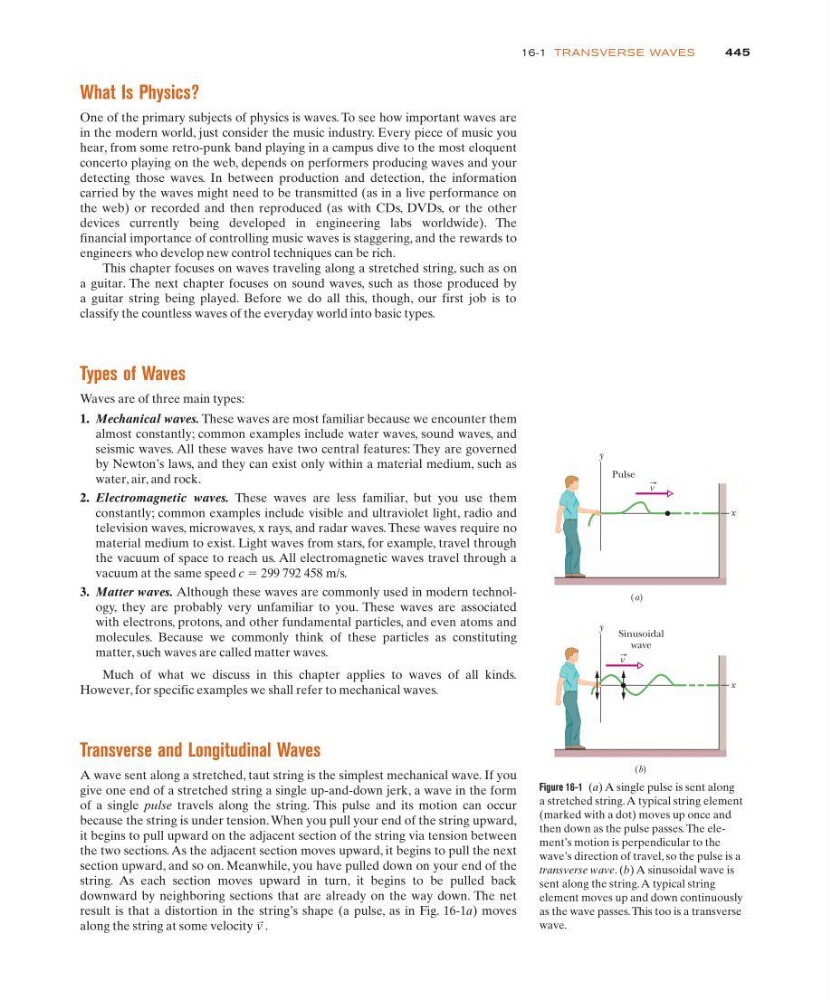
result is that a distortion in the string’s shape (a pulse, as in Fig. 16-1a) moves
along the string at some velocity .
v
:
Figure 16-1 (a) A single pulse is sent along
a stretched string. A typical string element
(marked with a dot) moves up once and
then down as the pulse passes. The element’s motion is perpendicular to the
wave’s direction of travel, so the pulse is a
transverse wave. (b) A sinusoidal wave is
sent along the string. A typical string
element moves up and down continuously
as the wave passes. This too is a transverse
wave.
y
x
y
x
(a)
(b)
Sinusoidal
wave
Pulse
v
v
16-1 TRANSVE RSE WAVES
What Is Physics?
One of the primary subjects of physics is waves. To see how important waves are
in the modern world, just consider the music industry. Every piece of music you
hear, from some retro-punk band playing in a campus dive to the most eloquent
concerto playing on the web, depends on performers producing waves and your
detecting those waves. In between production and detection, the information
carried by the waves might need to be transmitted (as in a live performance on
the web) or recorded and then reproduced (as with CDs, DVDs, or the other
devices currently being developed in engineering labs worldwide). The
financial importance of controlling music waves is staggering, and the rewards to
engineers who develop new control techniques can be rich.
This chapter focuses on waves traveling along a stretched string, such as on
a guitar. The next chapter focuses on sound waves, such as those produced by
a guitar string being played. Before we do all this, though, our first job is to
classify the countless waves of the everyday world into basic types.
Types of Waves
Waves are of three main types:
1. Mechanical waves. These waves are most familiar because we encounter them
almost constantly; common examples include water waves, sound waves, and
seismic waves. All these waves have two central features: They are governed
by Newton’s laws, and they can exist only within a material medium, such as
water, air, and rock.
2. Electromagnetic waves. These waves are less familiar, but you use them
constantly; common examples include visible and ultraviolet light, radio and
television waves, microwaves, x rays, and radar waves. These waves require no
material medium to exist. Light waves from stars, for example, travel through
the vacuum of space to reach us. All electromagnetic waves travel through a
vacuum at the same speed c ϭ 299 792 458 m/s.
3. Matter waves. Although these waves are commonly used in modern technology, they are probably very unfamiliar to you. These waves are associated
with electrons, protons, and other fundamental particles, and even atoms and
molecules. Because we commonly think of these particles as constituting
matter, such waves are called matter waves.
Much of what we discuss in this chapter applies to waves of all kinds.
However, for specific examples we shall refer to mechanical waves.
Transverse and Longitudinal Waves
A wave sent along a stretched, taut string is the simplest mechanical wave. If you
give one end of a stretched string a single up-and-down jerk, a wave in the form
of a single pulse travels along the string. This pulse and its motion can occur
because the string is under tension. When you pull your end of the string upward,
it begins to pull upward on the adjacent section of the string via tension between
the two sections. As the adjacent section moves upward, it begins to pull the next
section upward, and so on. Meanwhile, you have pulled down on your end of the
string. As each section moves upward in turn, it begins to be pulled back
downward by neighboring sections that are already on the way down. The net
result is that a distortion in the string’s shape (a pulse, as in Fig. 16-1a) moves
along the string at some velocity .
v
:
Figure 16-1 (a) A single pulse is sent along
a stretched string. A typical string element
(marked with a dot) moves up once and
then down as the pulse passes. The element’s motion is perpendicular to the
wave’s direction of travel, so the pulse is a
transverse wave. (b) A sinusoidal wave is
sent along the string. A typical string
element moves up and down continuously
as the wave passes. This too is a transverse
wave.
y
x
y
x
(a)
(b)
Sinusoidal
wave
Pulse
v
v