

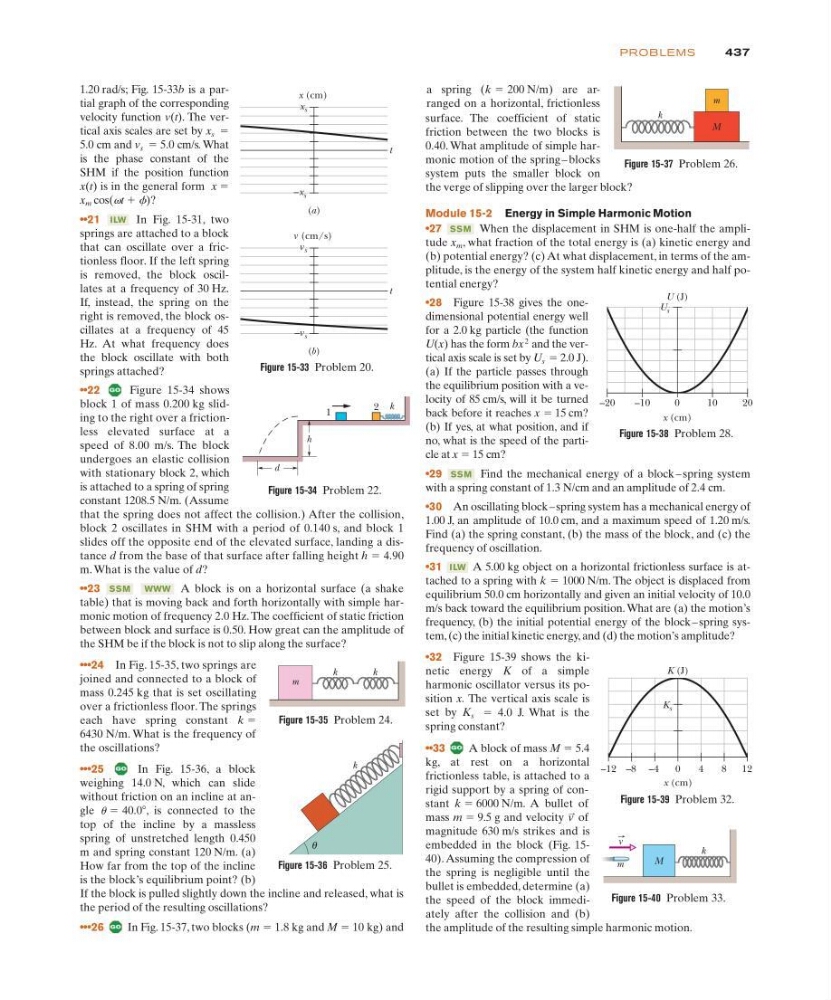
surface. The coefficient of static
friction between the two blocks is
0.40. What amplitude of simple harmonic motion of the spring – blocks
system puts the smaller block on
the verge of slipping over the larger block?
Module 15-2 Energy in Simple Harmonic Motion
•27
When the displacement in SHM is one-half the amplitude x m , what fraction of the total energy is (a) kinetic energy and
(b) potential energy? (c) At what displacement, in terms of the amplitude, is the energy of the system half kinetic energy and half potential energy?
•28 Figure 15-38 gives the onedimensional potential energy well
for a 2.0 kg particle (the function
U(x) has the form bx
2
and the vertical axis scale is set by U s ϭ 2.0 J).
(a) If the particle passes through
the equilibrium position with a velocity of 85 cm/s, will it be turned
back before it reaches x ϭ 15 cm?
(b) If yes, at what position, and if
no, what is the speed of the particle at x ϭ 15 cm?
•29
Find the mechanical energy of a block – spring system
with a spring constant of 1.3 N/cm and an amplitude of 2.4 cm.
•30 An oscillating block – spring system has a mechanical energy of
1.00 J, an amplitude of 10.0 cm, and a maximum speed of 1.20 m/s.
Find (a) the spring constant, (b) the mass of the block, and (c) the
frequency of oscillation.
•31
A 5.00 kg object on a horizontal frictionless surface is attached to a spring with k 1000 N/m. The object is displaced from
equilibrium 50.0 cm horizontally and given an initial velocity of 10.0
m/s back toward the equilibrium position. What are (a) the motion’s
frequency, (b) the initial potential energy of the block – spring system, (c) the initial kinetic energy, and (d) the motion’s amplitude?
•32 Figure 15-39 shows the kinetic energy K of a simple
harmonic oscillator versus its position x. The vertical axis scale is
set by K s ϭ 4.0 J. What is the
spring constant?
••33
A block of mass M ϭ 5.4
kg, at rest on a horizontal
frictionless table, is attached to a
rigid support by a spring of constant k ϭ 6000 N/m. A bullet of
mass m ϭ 9.5 g and velocity of
magnitude 630 m/s strikes and is
embedded in the block (Fig. 1540). Assuming the compression of
the spring is negligible until the
bullet is embedded, determine (a)
the speed of the block immediately after the collision and (b)
the amplitude of the resulting simple harmonic motion.
v
:
ϭ
ILW
SSM
SSM
437
PROB LE M S
1.20 rad/s; Fig. 15-33b is a partial graph of the corresponding
velocity function v(t). The vertical axis scales are set by x s ϭ
5.0 cm and v s ϭ 5.0 cm/s. What
is the phase constant of the
SHM if the position function
x(t) is in the general form x ϭ
x m cos(vt ϩ f)?
••21
In Fig. 15-31, two
springs are attached to a block
that can oscillate over a frictionless floor. If the left spring
is removed, the block oscillates at a frequency of 30 Hz.
If, instead, the spring on the
right is removed, the block oscillates at a frequency of 45
Hz. At what frequency does
the block oscillate with both
springs attached?
••22
Figure 15-34 shows
block 1 of mass 0.200 kg sliding to the right over a frictionless elevated surface at a
speed of 8.00 m/s. The block
undergoes an elastic collision
with stationary block 2, which
is attached to a spring of spring
constant 1208.5 N/m. (Assume
that the spring does not affect the collision.) After the collision,
block 2 oscillates in SHM with a period of 0.140 s, and block 1
slides off the opposite end of the elevated surface, landing a distance d from the base of that surface after falling height h ϭ 4.90
m. What is the value of d?
••23
A block is on a horizontal surface (a shake
table) that is moving back and forth horizontally with simple harmonic motion of frequency 2.0 Hz. The coefficient of static friction
between block and surface is 0.50. How great can the amplitude of
the SHM be if the block is not to slip along the surface?
•••24 In Fig. 15-35, two springs are
joined and connected to a block of
mass 0.245 kg that is set oscillating
over a frictionless floor. The springs
each have spring constant k ϭ
6430 N/m. What is the frequency of
the oscillations?
•••25
In Fig. 15-36, a block
weighing 14.0 N, which can slide
without friction on an incline at angle
40.0Њ, is connected to the
top of the incline by a massless
spring of unstretched length 0.450
m and spring constant 120 N/m. (a)
How far from the top of the incline
is the block’s equilibrium point? (b)
If the block is pulled slightly down the incline and released, what is
the period of the resulting oscillations?
•••26
In Fig. 15-37, two blocks (m ϭ 1.8 kg and M ϭ 10 kg) and
u ϭ
WWW
SSM
ILW
a spring (k 200 N/m) are arranged on a horizontal, frictionless
ϭ
Figure 15-33 Problem 20.
x s
–x s
x (cm)
t
(a)
v s
–v s
v (cm/s)
t
(b)
Figure 15-34 Problem 22.
1
2 k
h
d
m
k
k
Figure 15-35 Problem 24.
θ
k
Figure 15-36 Problem 25.
k
m
M
Figure 15-37 Problem 26.
Figure 15-38 Problem 28.
–20
–10
0
10
20
x (cm)
U (J)
U s
–12 –8 –4
0
4
8
12
x (cm)
K (J)
K s
Figure 15-39 Problem 32.
k
m
M
v
Figure 15-40 Problem 33.
friction between the two blocks is
0.40. What amplitude of simple harmonic motion of the spring – blocks
system puts the smaller block on
the verge of slipping over the larger block?
Module 15-2 Energy in Simple Harmonic Motion
•27
When the displacement in SHM is one-half the amplitude x m , what fraction of the total energy is (a) kinetic energy and
(b) potential energy? (c) At what displacement, in terms of the amplitude, is the energy of the system half kinetic energy and half potential energy?
•28 Figure 15-38 gives the onedimensional potential energy well
for a 2.0 kg particle (the function
U(x) has the form bx
2
and the vertical axis scale is set by U s ϭ 2.0 J).
(a) If the particle passes through
the equilibrium position with a velocity of 85 cm/s, will it be turned
back before it reaches x ϭ 15 cm?
(b) If yes, at what position, and if
no, what is the speed of the particle at x ϭ 15 cm?
•29
Find the mechanical energy of a block – spring system
with a spring constant of 1.3 N/cm and an amplitude of 2.4 cm.
•30 An oscillating block – spring system has a mechanical energy of
1.00 J, an amplitude of 10.0 cm, and a maximum speed of 1.20 m/s.
Find (a) the spring constant, (b) the mass of the block, and (c) the
frequency of oscillation.
•31
A 5.00 kg object on a horizontal frictionless surface is attached to a spring with k 1000 N/m. The object is displaced from
equilibrium 50.0 cm horizontally and given an initial velocity of 10.0
m/s back toward the equilibrium position. What are (a) the motion’s
frequency, (b) the initial potential energy of the block – spring system, (c) the initial kinetic energy, and (d) the motion’s amplitude?
•32 Figure 15-39 shows the kinetic energy K of a simple
harmonic oscillator versus its position x. The vertical axis scale is
set by K s ϭ 4.0 J. What is the
spring constant?
••33
A block of mass M ϭ 5.4
kg, at rest on a horizontal
frictionless table, is attached to a
rigid support by a spring of constant k ϭ 6000 N/m. A bullet of
mass m ϭ 9.5 g and velocity of
magnitude 630 m/s strikes and is
embedded in the block (Fig. 1540). Assuming the compression of
the spring is negligible until the
bullet is embedded, determine (a)
the speed of the block immediately after the collision and (b)
the amplitude of the resulting simple harmonic motion.
v
:
ϭ
ILW
SSM
SSM
437
PROB LE M S
1.20 rad/s; Fig. 15-33b is a partial graph of the corresponding
velocity function v(t). The vertical axis scales are set by x s ϭ
5.0 cm and v s ϭ 5.0 cm/s. What
is the phase constant of the
SHM if the position function
x(t) is in the general form x ϭ
x m cos(vt ϩ f)?
••21
In Fig. 15-31, two
springs are attached to a block
that can oscillate over a frictionless floor. If the left spring
is removed, the block oscillates at a frequency of 30 Hz.
If, instead, the spring on the
right is removed, the block oscillates at a frequency of 45
Hz. At what frequency does
the block oscillate with both
springs attached?
••22
Figure 15-34 shows
block 1 of mass 0.200 kg sliding to the right over a frictionless elevated surface at a
speed of 8.00 m/s. The block
undergoes an elastic collision
with stationary block 2, which
is attached to a spring of spring
constant 1208.5 N/m. (Assume
that the spring does not affect the collision.) After the collision,
block 2 oscillates in SHM with a period of 0.140 s, and block 1
slides off the opposite end of the elevated surface, landing a distance d from the base of that surface after falling height h ϭ 4.90
m. What is the value of d?
••23
A block is on a horizontal surface (a shake
table) that is moving back and forth horizontally with simple harmonic motion of frequency 2.0 Hz. The coefficient of static friction
between block and surface is 0.50. How great can the amplitude of
the SHM be if the block is not to slip along the surface?
•••24 In Fig. 15-35, two springs are
joined and connected to a block of
mass 0.245 kg that is set oscillating
over a frictionless floor. The springs
each have spring constant k ϭ
6430 N/m. What is the frequency of
the oscillations?
•••25
In Fig. 15-36, a block
weighing 14.0 N, which can slide
without friction on an incline at angle
40.0Њ, is connected to the
top of the incline by a massless
spring of unstretched length 0.450
m and spring constant 120 N/m. (a)
How far from the top of the incline
is the block’s equilibrium point? (b)
If the block is pulled slightly down the incline and released, what is
the period of the resulting oscillations?
•••26
In Fig. 15-37, two blocks (m ϭ 1.8 kg and M ϭ 10 kg) and
u ϭ
WWW
SSM
ILW
a spring (k 200 N/m) are arranged on a horizontal, frictionless
ϭ
Figure 15-33 Problem 20.
x s
–x s
x (cm)
t
(a)
v s
–v s
v (cm/s)
t
(b)
Figure 15-34 Problem 22.
1
2 k
h
d
m
k
k
Figure 15-35 Problem 24.
θ
k
Figure 15-36 Problem 25.
k
m
M
Figure 15-37 Problem 26.
Figure 15-38 Problem 28.
–20
–10
0
10
20
x (cm)
U (J)
U s
–12 –8 –4
0
4
8
12
x (cm)
K (J)
K s
Figure 15-39 Problem 32.
k
m
M
v
Figure 15-40 Problem 33.