

433
15-6 FORCE D OSCI LL ATIONS AN D R ESONANCE
forced, or driven, oscillations. Two angular frequencies are associated with a system undergoing driven oscillations: (1) the natural angular frequency v of the
system, which is the angular frequency at which it would oscillate if it were
suddenly disturbed and then left to oscillate freely, and (2) the angular frequency
v d of the external driving force causing the driven oscillations.
We can use Fig. 15-16 to represent an idealized forced simple harmonic oscillator if we allow the structure marked “rigid support” to move up and down at
a variable angular frequency v d . Such a forced oscillator oscillates at the angular
frequency v d of the driving force, and its displacement x(t) is given by
x(t) ϭ x m cos(v d t ϩ f),
(15-45)
where x m is the amplitude of the oscillations.
How large the displacement amplitude x m is depends on a complicated
function of v d and v. The velocity amplitude v m of the oscillations is easier to
describe: it is greatest when
v d ϭ v (resonance),
(15-46)
a condition called resonance. Equation 15-46 is also approximately the condition
at which the displacement amplitude x m of the oscillations is greatest. Thus, if you
push a swing at its natural angular frequency, the displacement and velocity
amplitudes will increase to large values, a fact that children learn quickly by trial
and error. If you push at other angular frequencies, either higher or lower, the
displacement and velocity amplitudes will be smaller.
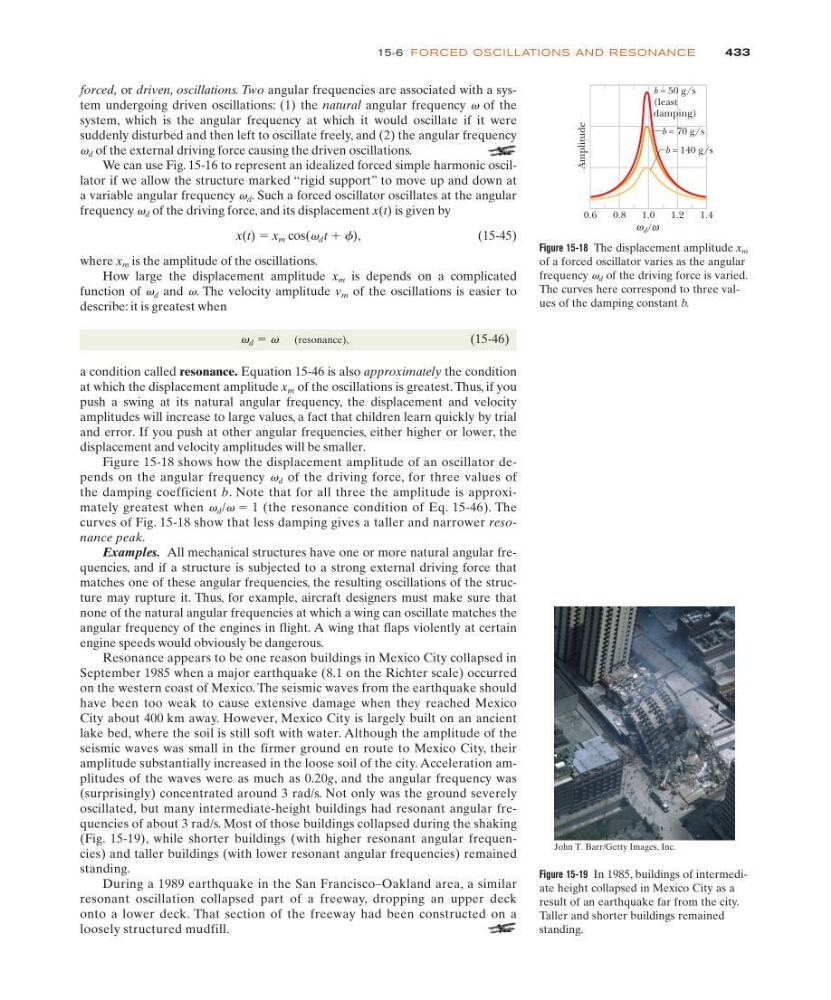
Figure 15-18 shows how the displacement amplitude of an oscillator depends on the angular frequency v d of the driving force, for three values of
the damping coefficient b. Note that for all three the amplitude is approximately greatest when v d /v ϭ 1 (the resonance condition of Eq. 15-46). The
curves of Fig. 15-18 show that less damping gives a taller and narrower resonance peak.
Examples. All mechanical structures have one or more natural angular frequencies, and if a structure is subjected to a strong external driving force that
matches one of these angular frequencies, the resulting oscillations of the structure may rupture it. Thus, for example, aircraft designers must make sure that
none of the natural angular frequencies at which a wing can oscillate matches the
angular frequency of the engines in flight. A wing that flaps violently at certain
engine speeds would obviously be dangerous.
Resonance appears to be one reason buildings in Mexico City collapsed in
September 1985 when a major earthquake (8.1 on the Richter scale) occurred
on the western coast of Mexico. The seismic waves from the earthquake should
have been too weak to cause extensive damage when they reached Mexico
City about 400 km away. However, Mexico City is largely built on an ancient
lake bed, where the soil is still soft with water. Although the amplitude of the
seismic waves was small in the firmer ground en route to Mexico City, their
amplitude substantially increased in the loose soil of the city. Acceleration amplitudes of the waves were as much as 0.20g, and the angular frequency was
(surprisingly) concentrated around 3 rad/s. Not only was the ground severely
oscillated, but many intermediate-height buildings had resonant angular frequencies of about 3 rad/s. Most of those buildings collapsed during the shaking
(Fig. 15-19), while shorter buildings (with higher resonant angular frequencies) and taller buildings (with lower resonant angular frequencies) remained
standing.
During a 1989 earthquake in the San Francisco–Oakland area, a similar
resonant oscillation collapsed part of a freeway, dropping an upper deck
onto a lower deck. That section of the freeway had been constructed on a
loosely structured mudfill.
Figure 15-18 The displacement amplitude x m
of a forced oscillator varies as the angular
frequency v d of the driving force is varied.
The curves here correspond to three values of the damping constant b.
Amplitude
0.6
0.8
1.0
1.2
1.4
ω d /ω
b = 50 g/s
(least
damping)
b = 70 g/s
b = 140 g/s
Figure 15-19 In 1985, buildings of intermediate height collapsed in Mexico City as a
result of an earthquake far from the city.
Taller and shorter buildings remained
standing.
John T. Barr/Getty Images, Inc.
15-6 FORCE D OSCI LL ATIONS AN D R ESONANCE
forced, or driven, oscillations. Two angular frequencies are associated with a system undergoing driven oscillations: (1) the natural angular frequency v of the
system, which is the angular frequency at which it would oscillate if it were
suddenly disturbed and then left to oscillate freely, and (2) the angular frequency
v d of the external driving force causing the driven oscillations.
We can use Fig. 15-16 to represent an idealized forced simple harmonic oscillator if we allow the structure marked “rigid support” to move up and down at
a variable angular frequency v d . Such a forced oscillator oscillates at the angular
frequency v d of the driving force, and its displacement x(t) is given by
x(t) ϭ x m cos(v d t ϩ f),
(15-45)
where x m is the amplitude of the oscillations.
How large the displacement amplitude x m is depends on a complicated
function of v d and v. The velocity amplitude v m of the oscillations is easier to
describe: it is greatest when
v d ϭ v (resonance),
(15-46)
a condition called resonance. Equation 15-46 is also approximately the condition
at which the displacement amplitude x m of the oscillations is greatest. Thus, if you
push a swing at its natural angular frequency, the displacement and velocity
amplitudes will increase to large values, a fact that children learn quickly by trial
and error. If you push at other angular frequencies, either higher or lower, the
displacement and velocity amplitudes will be smaller.
Figure 15-18 shows how the displacement amplitude of an oscillator depends on the angular frequency v d of the driving force, for three values of
the damping coefficient b. Note that for all three the amplitude is approximately greatest when v d /v ϭ 1 (the resonance condition of Eq. 15-46). The
curves of Fig. 15-18 show that less damping gives a taller and narrower resonance peak.
Examples. All mechanical structures have one or more natural angular frequencies, and if a structure is subjected to a strong external driving force that
matches one of these angular frequencies, the resulting oscillations of the structure may rupture it. Thus, for example, aircraft designers must make sure that
none of the natural angular frequencies at which a wing can oscillate matches the
angular frequency of the engines in flight. A wing that flaps violently at certain
engine speeds would obviously be dangerous.
Resonance appears to be one reason buildings in Mexico City collapsed in
September 1985 when a major earthquake (8.1 on the Richter scale) occurred
on the western coast of Mexico. The seismic waves from the earthquake should
have been too weak to cause extensive damage when they reached Mexico
City about 400 km away. However, Mexico City is largely built on an ancient
lake bed, where the soil is still soft with water. Although the amplitude of the
seismic waves was small in the firmer ground en route to Mexico City, their
amplitude substantially increased in the loose soil of the city. Acceleration amplitudes of the waves were as much as 0.20g, and the angular frequency was
(surprisingly) concentrated around 3 rad/s. Not only was the ground severely
oscillated, but many intermediate-height buildings had resonant angular frequencies of about 3 rad/s. Most of those buildings collapsed during the shaking
(Fig. 15-19), while shorter buildings (with higher resonant angular frequencies) and taller buildings (with lower resonant angular frequencies) remained
standing.
During a 1989 earthquake in the San Francisco–Oakland area, a similar
resonant oscillation collapsed part of a freeway, dropping an upper deck
onto a lower deck. That section of the freeway had been constructed on a
loosely structured mudfill.
Figure 15-18 The displacement amplitude x m
of a forced oscillator varies as the angular
frequency v d of the driving force is varied.
The curves here correspond to three values of the damping constant b.
Amplitude
0.6
0.8
1.0
1.2
1.4
ω d /ω
b = 50 g/s
(least
damping)
b = 70 g/s
b = 140 g/s
Figure 15-19 In 1985, buildings of intermediate height collapsed in Mexico City as a
result of an earthquake far from the city.
Taller and shorter buildings remained
standing.
John T. Barr/Getty Images, Inc.