

431
15-5 DAM PE D SI M PLE HAR M ON IC M OTION
Substituting dx/dt for v and d
2
x/dt
2
for a and rearranging give us the differential
equation
.
(15-41)
The solution of this equation is
x(t) ϭ x m e
Ϫbt/2m
cos(vЈt ϩ f),
(15-42)
where x m is the amplitude and vЈ is the angular frequency of the damped oscillator. This angular frequency is given by
(15-43)
If b ϭ 0 (there is no damping), then Eq. 15-43 reduces to Eq. 15-12 (
)
for the angular frequency of an undamped oscillator, and Eq. 15-42 reduces to
Eq. 15-3 for the displacement of an undamped oscillator. If the damping constant
is small but not zero (so that b Ӷ
), then vЈ Ϸ v.
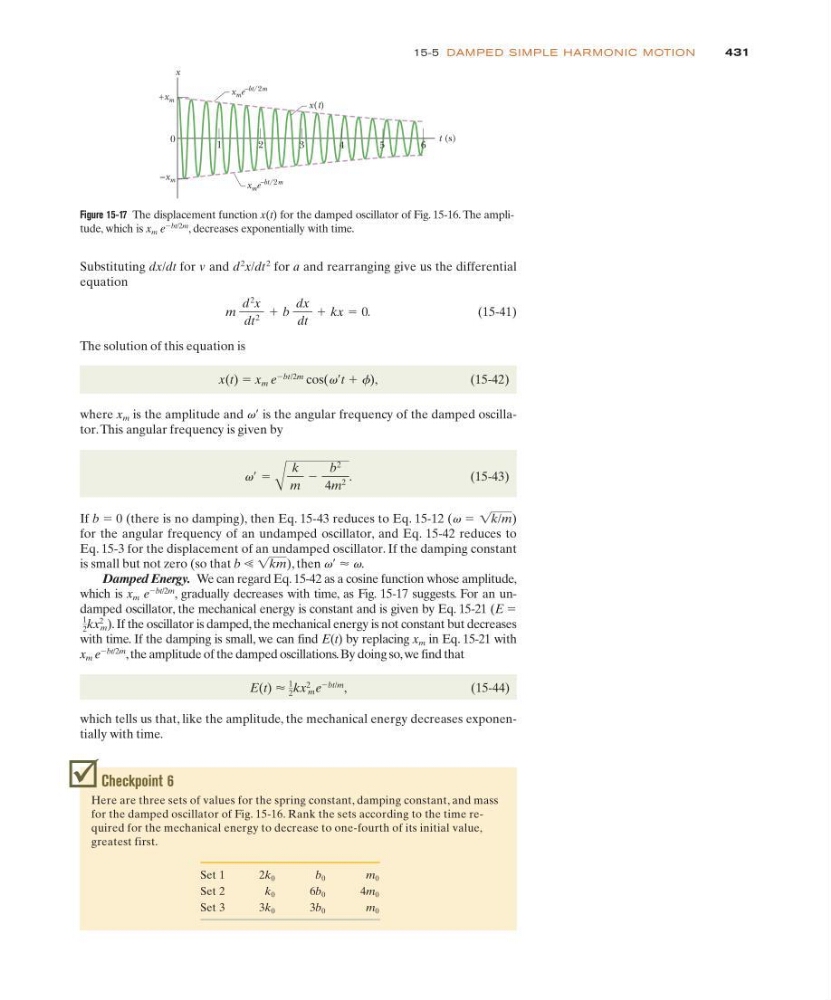
Damped Energy. We can regard Eq. 15-42 as a cosine function whose amplitude,
which is x m e
Ϫbt/2m
, gradually decreases with time, as Fig. 15-17 suggests. For an undamped oscillator, the mechanical energy is constant and is given by Eq. 15-21 (E ϭ
kx
2
m ). If the oscillator is damped, the mechanical energy is not constant but decreases
with time. If the damping is small, we can find E(t) by replacing x m in Eq. 15-21 with
x m e
Ϫbt/2m
,the amplitude of the damped oscillations.By doing so,we find that
E(t) Ϸ kx
2
m e
Ϫbt/m
,
( 1 5 - 4 4 )
which tells us that, like the amplitude, the mechanical energy decreases exponentially with time.
1
2
1
2
1km
v ϭ 1k/m
vЈ ϭ A
k
m
Ϫ
b
2
4m
2
.
m
d
2
x
dt
2
ϩ b
dx
dt
ϩ kx ϭ 0
Figure 15-17 The displacement function x(t) for the damped oscillator of Fig. 15-16. The amplitude, which is x m e
Ϫbt/2m
, decreases exponentially with time.
t (s)
0
1
2
3
4
5
6
+x m
–x m
x m e –bt/2m
x m e –bt/2m
x(t)
x
Checkpoint 6
Here are three sets of values for the spring constant, damping constant, and mass
for the damped oscillator of Fig. 15-16. Rank the sets according to the time required for the mechanical energy to decrease to one-fourth of its initial value,
greatest first.
Set 1
2k 0
b 0
m 0
Set 2
k 0
6b 0
4m 0
Set 3
3k 0
3b 0
m 0
15-5 DAM PE D SI M PLE HAR M ON IC M OTION
Substituting dx/dt for v and d
2
x/dt
2
for a and rearranging give us the differential
equation
.
(15-41)
The solution of this equation is
x(t) ϭ x m e
Ϫbt/2m
cos(vЈt ϩ f),
(15-42)
where x m is the amplitude and vЈ is the angular frequency of the damped oscillator. This angular frequency is given by
(15-43)
If b ϭ 0 (there is no damping), then Eq. 15-43 reduces to Eq. 15-12 (
)
for the angular frequency of an undamped oscillator, and Eq. 15-42 reduces to
Eq. 15-3 for the displacement of an undamped oscillator. If the damping constant
is small but not zero (so that b Ӷ
), then vЈ Ϸ v.
Damped Energy. We can regard Eq. 15-42 as a cosine function whose amplitude,
which is x m e
Ϫbt/2m
, gradually decreases with time, as Fig. 15-17 suggests. For an undamped oscillator, the mechanical energy is constant and is given by Eq. 15-21 (E ϭ
kx
2
m ). If the oscillator is damped, the mechanical energy is not constant but decreases
with time. If the damping is small, we can find E(t) by replacing x m in Eq. 15-21 with
x m e
Ϫbt/2m
,the amplitude of the damped oscillations.By doing so,we find that
E(t) Ϸ kx
2
m e
Ϫbt/m
,
( 1 5 - 4 4 )
which tells us that, like the amplitude, the mechanical energy decreases exponentially with time.
1
2
1
2
1km
v ϭ 1k/m
vЈ ϭ A
k
m
Ϫ
b
2
4m
2
.
m
d
2
x
dt
2
ϩ b
dx
dt
ϩ kx ϭ 0
Figure 15-17 The displacement function x(t) for the damped oscillator of Fig. 15-16. The amplitude, which is x m e
Ϫbt/2m
, decreases exponentially with time.
t (s)
0
1
2
3
4
5
6
+x m
–x m
x m e –bt/2m
x m e –bt/2m
x(t)
x
Checkpoint 6
Here are three sets of values for the spring constant, damping constant, and mass
for the damped oscillator of Fig. 15-16. Rank the sets according to the time required for the mechanical energy to decrease to one-fourth of its initial value,
greatest first.
Set 1
2k 0
b 0
m 0
Set 2
k 0
6b 0
4m 0
Set 3
3k 0
3b 0
m 0