

429
15-4 PE N DU LU M S, CI RCU L AR M OTION
motion is uniform circular motion viewed edge-on. In more formal language:
ω
ω
ω
O
y
x
φ
P'
P
v(t)
φ
x m
t +
t +
v
This relates the
velocities of
P and P ´.
O
y
x
P'
P
a(t)
2 x m
t + φ
ω
ω
a
This relates the
accelerations of
P and P ´.
O
y
x
t + φ
ω
x m
P'
P
x(t)
P´ is a particle
moving in a circle.
P is a projection
moving in SHM.
(b )
(c )
(a )
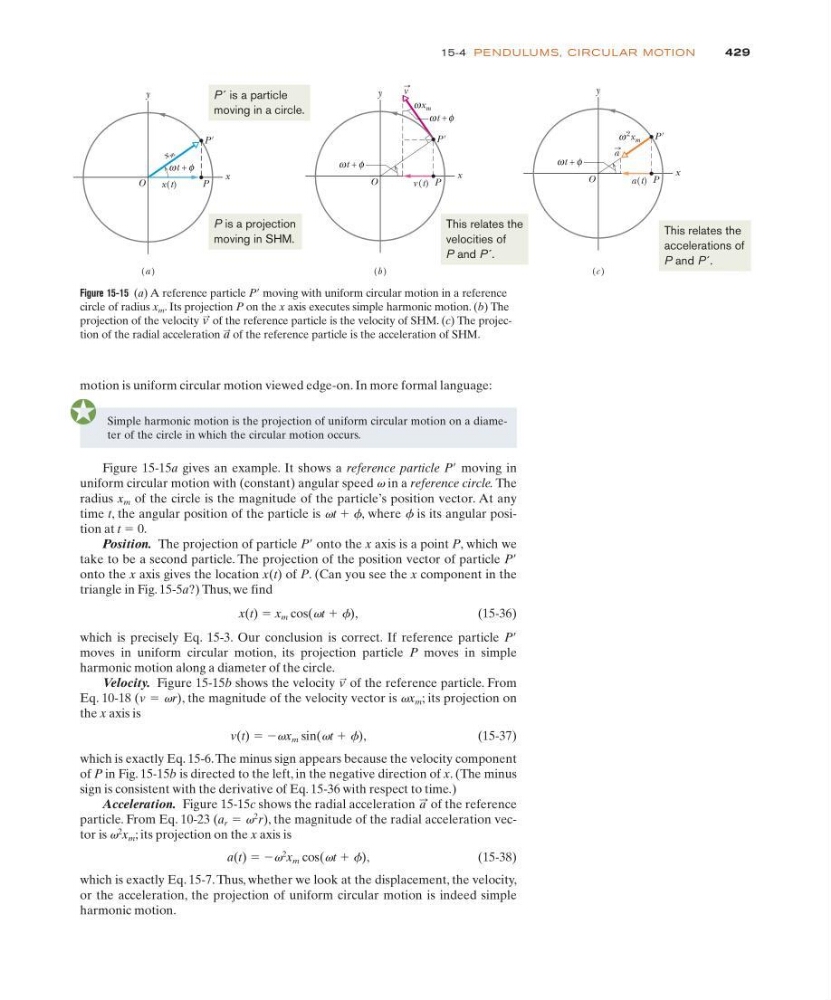
Figure 15-15 (a) A reference particle PЈ moving with uniform circular motion in a reference
circle of radius x m . Its projection P on the x axis executes simple harmonic motion. (b) The
projection of the velocity of the reference particle is the velocity of SHM. (c) The projection of the radial acceleration of the reference particle is the acceleration of SHM.
a
:
v
:
Simple harmonic motion is the projection of uniform circular motion on a diameter of the circle in which the circular motion occurs.
Figure 15-15a gives an example. It shows a reference particle PЈ moving in
uniform circular motion with (constant) angular speed v in a reference circle. The
radius x m of the circle is the magnitude of the particle’s position vector. At any
time t, the angular position of the particle is vt ϩ f, where f is its angular position at t ϭ 0.
Position. The projection of particle PЈ onto the x axis is a point P, which we
take to be a second particle. The projection of the position vector of particle PЈ
onto the x axis gives the location x(t) of P. (Can you see the x component in the
triangle in Fig. 15-5a?) Thus, we find
x(t) ϭ x m cos(vt ϩ f),
(15-36)
which is precisely Eq. 15-3. Our conclusion is correct. If reference particle PЈ
moves in uniform circular motion, its projection particle P moves in simple
harmonic motion along a diameter of the circle.
Velocity. Figure 15-15b shows the velocity of the reference particle. From
Eq. 10-18 (v
r), the magnitude of the velocity vector is x m ; its projection on
the x axis is
v(t) ϭ Ϫvx m sin(vt ϩ f),
(15-37)
which is exactly Eq. 15-6. The minus sign appears because the velocity component
of P in Fig. 15-15b is directed to the left, in the negative direction of x. (The minus
sign is consistent with the derivative of Eq. 15-36 with respect to time.)
Acceleration. Figure 15-15c shows the radial acceleration of the reference
particle. From Eq. 10-23 (a r
r), the magnitude of the radial acceleration vector is
2
x m ; its projection on the x axis is
a(t) ϭ Ϫv
2
x m cos(vt ϩ f),
(15-38)
which is exactly Eq. 15-7. Thus, whether we look at the displacement, the velocity,
or the acceleration, the projection of uniform circular motion is indeed simple
harmonic motion.
v
ϭ v
2
a
:
v
ϭ v
v
:
15-4 PE N DU LU M S, CI RCU L AR M OTION
motion is uniform circular motion viewed edge-on. In more formal language:
ω
ω
ω
O
y
x
φ
P'
P
v(t)
φ
x m
t +
t +
v
This relates the
velocities of
P and P ´.
O
y
x
P'
P
a(t)
2 x m
t + φ
ω
ω
a
This relates the
accelerations of
P and P ´.
O
y
x
t + φ
ω
x m
P'
P
x(t)
P´ is a particle
moving in a circle.
P is a projection
moving in SHM.
(b )
(c )
(a )
Figure 15-15 (a) A reference particle PЈ moving with uniform circular motion in a reference
circle of radius x m . Its projection P on the x axis executes simple harmonic motion. (b) The
projection of the velocity of the reference particle is the velocity of SHM. (c) The projection of the radial acceleration of the reference particle is the acceleration of SHM.
a
:
v
:
Simple harmonic motion is the projection of uniform circular motion on a diameter of the circle in which the circular motion occurs.
Figure 15-15a gives an example. It shows a reference particle PЈ moving in
uniform circular motion with (constant) angular speed v in a reference circle. The
radius x m of the circle is the magnitude of the particle’s position vector. At any
time t, the angular position of the particle is vt ϩ f, where f is its angular position at t ϭ 0.
Position. The projection of particle PЈ onto the x axis is a point P, which we
take to be a second particle. The projection of the position vector of particle PЈ
onto the x axis gives the location x(t) of P. (Can you see the x component in the
triangle in Fig. 15-5a?) Thus, we find
x(t) ϭ x m cos(vt ϩ f),
(15-36)
which is precisely Eq. 15-3. Our conclusion is correct. If reference particle PЈ
moves in uniform circular motion, its projection particle P moves in simple
harmonic motion along a diameter of the circle.
Velocity. Figure 15-15b shows the velocity of the reference particle. From
Eq. 10-18 (v
r), the magnitude of the velocity vector is x m ; its projection on
the x axis is
v(t) ϭ Ϫvx m sin(vt ϩ f),
(15-37)
which is exactly Eq. 15-6. The minus sign appears because the velocity component
of P in Fig. 15-15b is directed to the left, in the negative direction of x. (The minus
sign is consistent with the derivative of Eq. 15-36 with respect to time.)
Acceleration. Figure 15-15c shows the radial acceleration of the reference
particle. From Eq. 10-23 (a r
r), the magnitude of the radial acceleration vector is
2
x m ; its projection on the x axis is
a(t) ϭ Ϫv
2
x m cos(vt ϩ f),
(15-38)
which is exactly Eq. 15-7. Thus, whether we look at the displacement, the velocity,
or the acceleration, the projection of uniform circular motion is indeed simple
harmonic motion.
v
ϭ v
2
a
:
v
ϭ v
v
: