

424
CHAPTE R 15 OSCI LL ATIONS
The constant k, which is a property of the wire, is the same for
both figures; only the periods and the rotational inertias differ.
Let us square each of these equations, divide the second
by the first, and solve the resulting equation for I b .The result is
ϭ 6.12 ϫ 10
Ϫ4
kg иm
2
.
(Answer)
I b ϭ I a
T
2
b
T
2
a
ϭ (1.73 ϫ 10
Ϫ4
kg иm
2
)
(4.76 s)
2
(2.53 s)
2
T a ϭ 2p A
I a
k
and T b ϭ 2p A
I b
k
.
Sample Problem 15.04 Angular simple harmonic oscillator, rotational inertia, period
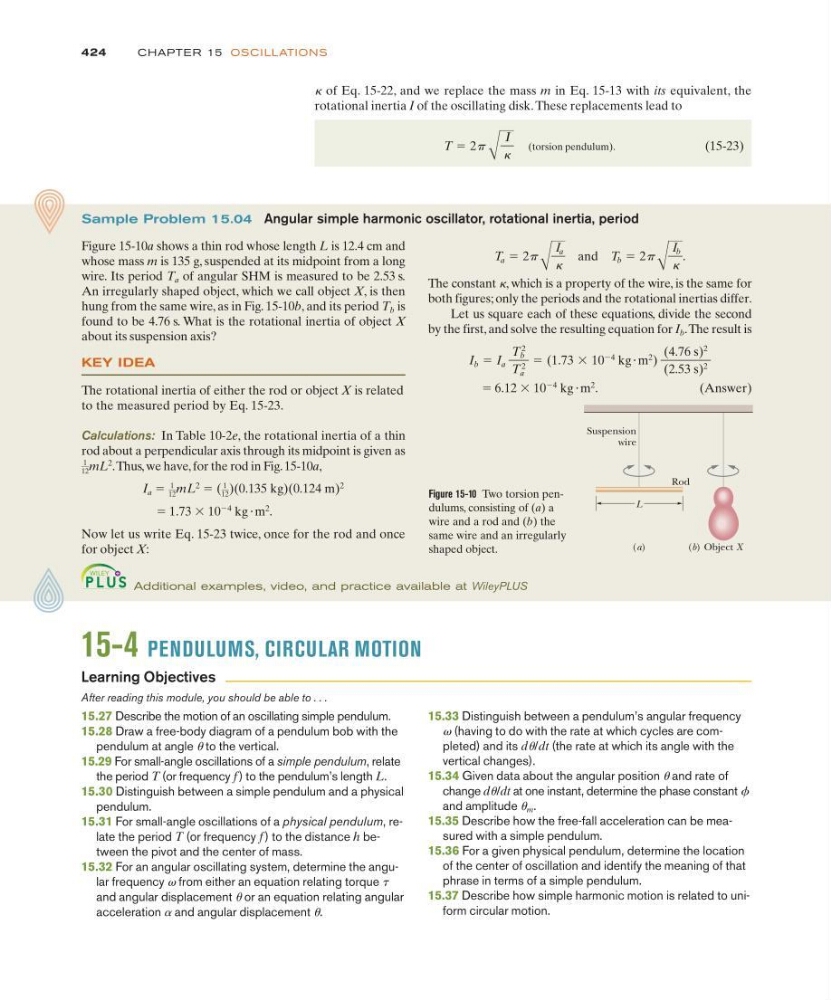
Figure 15-10a shows a thin rod whose length L is 12.4 cm and
whose mass m is 135 g, suspended at its midpoint from a long
wire. Its period T a of angular SHM is measured to be 2.53 s.
An irregularly shaped object, which we call object X, is then
hung from the same wire, as in Fig. 15-10b, and its period T b is
found to be 4.76 s. What is the rotational inertia of object X
about its suspension axis?
KEY IDEA
The rotational inertia of either the rod or object X is related
to the measured period by Eq. 15-23.
Calculations: In Table 10-2e, the rotational inertia of a thin
rod about a perpendicular axis through its midpoint is given as
mL
2
.Thus, we have, for the rod in Fig. 15-10a,
I a ϭ mL
2 ϭ ( )(0.135 kg)(0.124 m)
2
ϭ 1.73 ϫ 10
Ϫ4
kg иm
2
.
Now let us write Eq. 15-23 twice, once for the rod and once
for object X:
1
12
1
12
1
12
Figure 15-10 Two torsion pendulums, consisting of (a) a
wire and a rod and (b) the
same wire and an irregularly
shaped object.
Suspension
wire
Rod
L
Object X
(a)
(b)
Additional examples, video, and practice available at WileyPLUS
15-4 PENDULUMS, CIRCULAR MOTION
After reading this module, you should be able to . . .
15.27 Describe the motion of an oscillating simple pendulum.
15.28 Draw a free-body diagram of a pendulum bob with the
pendulum at angle u to the vertical.
15.29 For small-angle oscillations of a simple pendulum, relate
the period T (or frequency f ) to the pendulum’s length L.
15.30 Distinguish between a simple pendulum and a physical
pendulum.
15.31 For small-angle oscillations of a physical pendulum, relate the period T (or frequency f ) to the distance h between the pivot and the center of mass.
15.32 For an angular oscillating system, determine the angular frequency v from either an equation relating torque t
and angular displacement u or an equation relating angular
acceleration a and angular displacement u.
15.33 Distinguish between a pendulum’s angular frequency
v (having to do with the rate at which cycles are completed) and its du/dt (the rate at which its angle with the
vertical changes).
15.34 Given data about the angular position u and rate of
change du/dt at one instant, determine the phase constant f
and amplitude u m .
15.35 Describe how the free-fall acceleration can be measured with a simple pendulum.
15.36 For a given physical pendulum, determine the location
of the center of oscillation and identify the meaning of that
phrase in terms of a simple pendulum.
15.37 Describe how simple harmonic motion is related to uniform circular motion.
Learning Objectives
k of Eq. 15-22, and we replace the mass m in Eq. 15-13 with its equivalent, the
rotational inertia I of the oscillating disk. These replacements lead to
(torsion pendulum).
(15-23)
T ϭ 2p A
⌱
k
CHAPTE R 15 OSCI LL ATIONS
The constant k, which is a property of the wire, is the same for
both figures; only the periods and the rotational inertias differ.
Let us square each of these equations, divide the second
by the first, and solve the resulting equation for I b .The result is
ϭ 6.12 ϫ 10
Ϫ4
kg иm
2
.
(Answer)
I b ϭ I a
T
2
b
T
2
a
ϭ (1.73 ϫ 10
Ϫ4
kg иm
2
)
(4.76 s)
2
(2.53 s)
2
T a ϭ 2p A
I a
k
and T b ϭ 2p A
I b
k
.
Sample Problem 15.04 Angular simple harmonic oscillator, rotational inertia, period
Figure 15-10a shows a thin rod whose length L is 12.4 cm and
whose mass m is 135 g, suspended at its midpoint from a long
wire. Its period T a of angular SHM is measured to be 2.53 s.
An irregularly shaped object, which we call object X, is then
hung from the same wire, as in Fig. 15-10b, and its period T b is
found to be 4.76 s. What is the rotational inertia of object X
about its suspension axis?
KEY IDEA
The rotational inertia of either the rod or object X is related
to the measured period by Eq. 15-23.
Calculations: In Table 10-2e, the rotational inertia of a thin
rod about a perpendicular axis through its midpoint is given as
mL
2
.Thus, we have, for the rod in Fig. 15-10a,
I a ϭ mL
2 ϭ ( )(0.135 kg)(0.124 m)
2
ϭ 1.73 ϫ 10
Ϫ4
kg иm
2
.
Now let us write Eq. 15-23 twice, once for the rod and once
for object X:
1
12
1
12
1
12
Figure 15-10 Two torsion pendulums, consisting of (a) a
wire and a rod and (b) the
same wire and an irregularly
shaped object.
Suspension
wire
Rod
L
Object X
(a)
(b)
Additional examples, video, and practice available at WileyPLUS
15-4 PENDULUMS, CIRCULAR MOTION
After reading this module, you should be able to . . .
15.27 Describe the motion of an oscillating simple pendulum.
15.28 Draw a free-body diagram of a pendulum bob with the
pendulum at angle u to the vertical.
15.29 For small-angle oscillations of a simple pendulum, relate
the period T (or frequency f ) to the pendulum’s length L.
15.30 Distinguish between a simple pendulum and a physical
pendulum.
15.31 For small-angle oscillations of a physical pendulum, relate the period T (or frequency f ) to the distance h between the pivot and the center of mass.
15.32 For an angular oscillating system, determine the angular frequency v from either an equation relating torque t
and angular displacement u or an equation relating angular
acceleration a and angular displacement u.
15.33 Distinguish between a pendulum’s angular frequency
v (having to do with the rate at which cycles are completed) and its du/dt (the rate at which its angle with the
vertical changes).
15.34 Given data about the angular position u and rate of
change du/dt at one instant, determine the phase constant f
and amplitude u m .
15.35 Describe how the free-fall acceleration can be measured with a simple pendulum.
15.36 For a given physical pendulum, determine the location
of the center of oscillation and identify the meaning of that
phrase in terms of a simple pendulum.
15.37 Describe how simple harmonic motion is related to uniform circular motion.
Learning Objectives
k of Eq. 15-22, and we replace the mass m in Eq. 15-13 with its equivalent, the
rotational inertia I of the oscillating disk. These replacements lead to
(torsion pendulum).
(15-23)
T ϭ 2p A
⌱
k