

419
15-1 SI M PLE HAR M ON IC M OTION
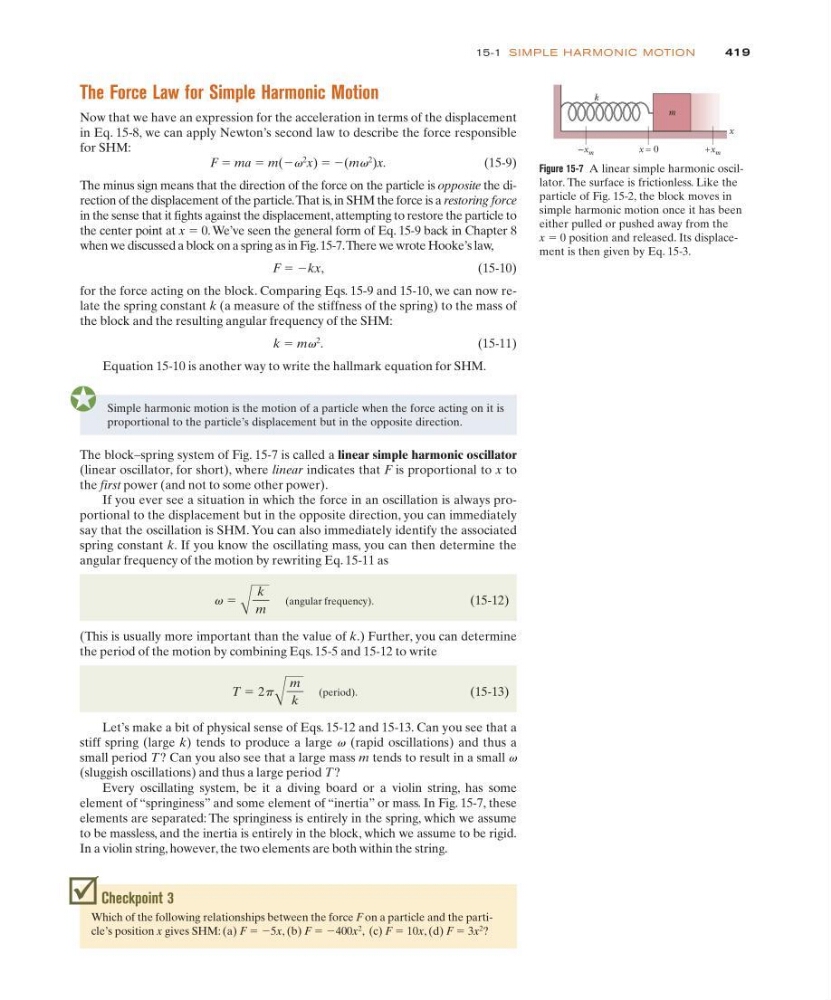
Figure 15-7 A linear simple harmonic oscillator. The surface is frictionless. Like the
particle of Fig. 15-2, the block moves in
simple harmonic motion once it has been
either pulled or pushed away from the
x ϭ 0 position and released. Its displacement is then given by Eq. 15-3.
k
x
–x m
x = 0
+x m
m
Simple harmonic motion is the motion of a particle when the force acting on it is
proportional to the particle’s displacement but in the opposite direction.
The Force Law for Simple Harmonic Motion
Now that we have an expression for the acceleration in terms of the displacement
in Eq. 15-8, we can apply Newton’s second law to describe the force responsible
for SHM:
F ϭ ma ϭ m(Ϫv
2
x) ϭ Ϫ(mv
2
)x.
(15-9)
The minus sign means that the direction of the force on the particle is opposite the direction of the displacement of the particle.That is, in SHM the force is a restoring force
in the sense that it fights against the displacement, attempting to restore the particle to
the center point at x ϭ 0. We’ve seen the general form of Eq. 15-9 back in Chapter 8
when we discussed a block on a spring as in Fig. 15-7.There we wrote Hooke’s law,
F ϭ Ϫkx,
( 1 5 - 1 0 )
for the force acting on the block. Comparing Eqs. 15-9 and 15-10, we can now relate the spring constant k (a measure of the stiffness of the spring) to the mass of
the block and the resulting angular frequency of the SHM:
k ϭ mv
2
.
( 1 5 - 1 1 )
Equation 15-10 is another way to write the hallmark equation for SHM.
Checkpoint 3
Which of the following relationships between the force F on a particle and the particle’s position x gives SHM: (a) F ϭ Ϫ5x, (b) F ϭ Ϫ400x
2
, (c) F ϭ 10x, (d) F ϭ 3x
2
?
The block–spring system of Fig. 15-7 is called a linear simple harmonic oscillator
(linear oscillator, for short), where linear indicates that F is proportional to x to
the first power (and not to some other power).
If you ever see a situation in which the force in an oscillation is always proportional to the displacement but in the opposite direction, you can immediately
say that the oscillation is SHM. You can also immediately identify the associated
spring constant k. If you know the oscillating mass, you can then determine the
angular frequency of the motion by rewriting Eq. 15-11 as
(angular frequency).
(15-12)
(This is usually more important than the value of k.) Further, you can determine
the period of the motion by combining Eqs. 15-5 and 15-12 to write
(period).
(15-13)
Let’s make a bit of physical sense of Eqs. 15-12 and 15-13. Can you see that a
stiff spring (large k) tends to produce a large v (rapid oscillations) and thus a
small period T ? Can you also see that a large mass m tends to result in a small v
(sluggish oscillations) and thus a large period T ?
Every oscillating system, be it a diving board or a violin string, has some
element of “springiness” and some element of “inertia” or mass. In Fig. 15-7, these
elements are separated: The springiness is entirely in the spring, which we assume
to be massless, and the inertia is entirely in the block, which we assume to be rigid.
In a violin string, however, the two elements are both within the string.
T ϭ 2p A
m
k
v ϭ A
k
m
15-1 SI M PLE HAR M ON IC M OTION
Figure 15-7 A linear simple harmonic oscillator. The surface is frictionless. Like the
particle of Fig. 15-2, the block moves in
simple harmonic motion once it has been
either pulled or pushed away from the
x ϭ 0 position and released. Its displacement is then given by Eq. 15-3.
k
x
–x m
x = 0
+x m
m
Simple harmonic motion is the motion of a particle when the force acting on it is
proportional to the particle’s displacement but in the opposite direction.
The Force Law for Simple Harmonic Motion
Now that we have an expression for the acceleration in terms of the displacement
in Eq. 15-8, we can apply Newton’s second law to describe the force responsible
for SHM:
F ϭ ma ϭ m(Ϫv
2
x) ϭ Ϫ(mv
2
)x.
(15-9)
The minus sign means that the direction of the force on the particle is opposite the direction of the displacement of the particle.That is, in SHM the force is a restoring force
in the sense that it fights against the displacement, attempting to restore the particle to
the center point at x ϭ 0. We’ve seen the general form of Eq. 15-9 back in Chapter 8
when we discussed a block on a spring as in Fig. 15-7.There we wrote Hooke’s law,
F ϭ Ϫkx,
( 1 5 - 1 0 )
for the force acting on the block. Comparing Eqs. 15-9 and 15-10, we can now relate the spring constant k (a measure of the stiffness of the spring) to the mass of
the block and the resulting angular frequency of the SHM:
k ϭ mv
2
.
( 1 5 - 1 1 )
Equation 15-10 is another way to write the hallmark equation for SHM.
Checkpoint 3
Which of the following relationships between the force F on a particle and the particle’s position x gives SHM: (a) F ϭ Ϫ5x, (b) F ϭ Ϫ400x
2
, (c) F ϭ 10x, (d) F ϭ 3x
2
?
The block–spring system of Fig. 15-7 is called a linear simple harmonic oscillator
(linear oscillator, for short), where linear indicates that F is proportional to x to
the first power (and not to some other power).
If you ever see a situation in which the force in an oscillation is always proportional to the displacement but in the opposite direction, you can immediately
say that the oscillation is SHM. You can also immediately identify the associated
spring constant k. If you know the oscillating mass, you can then determine the
angular frequency of the motion by rewriting Eq. 15-11 as
(angular frequency).
(15-12)
(This is usually more important than the value of k.) Further, you can determine
the period of the motion by combining Eqs. 15-5 and 15-12 to write
(period).
(15-13)
Let’s make a bit of physical sense of Eqs. 15-12 and 15-13. Can you see that a
stiff spring (large k) tends to produce a large v (rapid oscillations) and thus a
small period T ? Can you also see that a large mass m tends to result in a small v
(sluggish oscillations) and thus a large period T ?
Every oscillating system, be it a diving board or a violin string, has some
element of “springiness” and some element of “inertia” or mass. In Fig. 15-7, these
elements are separated: The springiness is entirely in the spring, which we assume
to be massless, and the inertia is entirely in the block, which we assume to be rigid.
In a violin string, however, the two elements are both within the string.
T ϭ 2p A
m
k
v ϭ A
k
m