

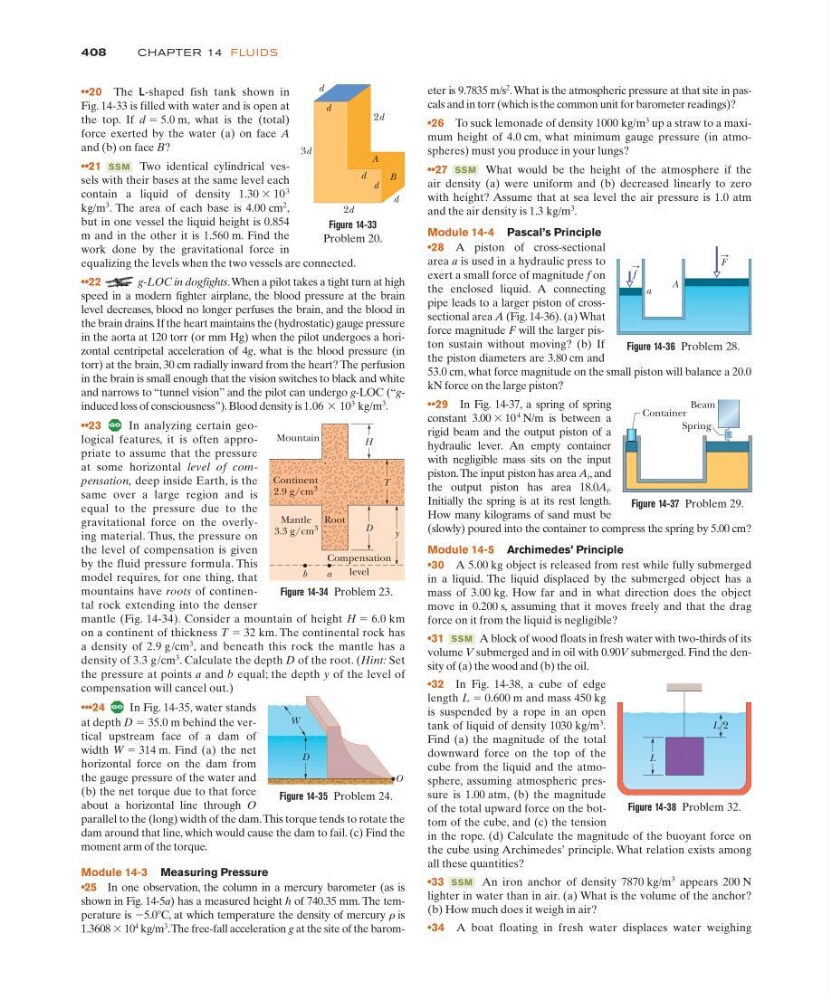
at depth D ϭ 35.0 m behind the vertical upstream face of a dam of
width W ϭ 314 m. Find (a) the net
horizontal force on the dam from
the gauge pressure of the water and
(b) the net torque due to that force
about a horizontal line through O
parallel to the (long) width of the dam.This torque tends to rotate the
dam around that line, which would cause the dam to fail. (c) Find the
moment arm of the torque.
Module 14-3 Measuring Pressure
•25 In one observation, the column in a mercury barometer (as is
shown in Fig. 14-5a) has a measured height h of 740.35 mm. The temperature is Ϫ5.0ЊC, at which temperature the density of mercury r is
1.3608 ϫ 10
4
kg/m
3
.The free-fall acceleration g at the site of the barom408
CHAPTE R 14 FLU I DS
eter is 9.7835 m/s
2
.What is the atmospheric pressure at that site in pascals and in torr (which is the common unit for barometer readings)?
•26 To suck lemonade of density 1000 kg/m
3
up a straw to a maximum height of 4.0 cm, what minimum gauge pressure (in atmospheres) must you produce in your lungs?
••27
What would be the height of the atmosphere if the
air density (a) were uniform and (b) decreased linearly to zero
with height? Assume that at sea level the air pressure is 1.0 atm
and the air density is 1.3 kg/m
3
.
Module 14-4 Pascal’s Principle
•28 A piston of cross-sectional
area a is used in a hydraulic press to
exert a small force of magnitude f on
the enclosed liquid. A connecting
pipe leads to a larger piston of crosssectional area A (Fig. 14-36). (a) What
force magnitude F will the larger piston sustain without moving? (b) If
the piston diameters are 3.80 cm and
53.0 cm, what force magnitude on the small piston will balance a 20.0
kN force on the large piston?
••29 In Fig. 14-37, a spring of spring
constant 3.00 ϫ 10
4
N/m is between a
rigid beam and the output piston of a
hydraulic lever. An empty container
with negligible mass sits on the input
piston.The input piston has area A i , and
the output piston has area 18.0A i .
Initially the spring is at its rest length.
How many kilograms of sand must be
(slowly) poured into the container to compress the spring by 5.00 cm?
Module 14-5 Archimedes’ Principle
•30 A 5.00 kg object is released from rest while fully submerged
in a liquid. The liquid displaced by the submerged object has a
mass of 3.00 kg. How far and in what direction does the object
move in 0.200 s, assuming that it moves freely and that the drag
force on it from the liquid is negligible?
•31
A block of wood floats in fresh water with two-thirds of its
volume V submerged and in oil with 0.90V submerged. Find the density of (a) the wood and (b) the oil.
•32 In Fig. 14-38, a cube of edge
length L ϭ 0.600 m and mass 450 kg
is suspended by a rope in an open
tank of liquid of density 1030 kg/m
3
.
Find (a) the magnitude of the total
downward force on the top of the
cube from the liquid and the atmosphere, assuming atmospheric pressure is 1.00 atm, (b) the magnitude
of the total upward force on the bottom of the cube, and (c) the tension
in the rope. (d) Calculate the magnitude of the buoyant force on
the cube using Archimedes’ principle. What relation exists among
all these quantities?
•33
An iron anchor of density 7870 kg/m
3
appears 200 N
lighter in water than in air. (a) What is the volume of the anchor?
(b) How much does it weigh in air?
•34 A boat floating in fresh water displaces water weighing
SSM
SSM
SSM
••20 The L-shaped fish tank shown in
Fig. 14-33 is filled with water and is open at
the top. If d ϭ 5.0 m, what is the (total)
force exerted by the water (a) on face A
and (b) on face B?
••21
Two identical cylindrical vessels with their bases at the same level each
contain a liquid of density 1.30 ϫ 10
3
kg/m
3
. The area of each base is 4.00 cm
2
,
but in one vessel the liquid height is 0.854
m and in the other it is 1.560 m. Find the
work done by the gravitational force in
equalizing the levels when the two vessels are connected.
••22
g-LOC in dogfights.When a pilot takes a tight turn at high
speed in a modern fighter airplane, the blood pressure at the brain
level decreases, blood no longer perfuses the brain, and the blood in
the brain drains. If the heart maintains the (hydrostatic) gauge pressure
in the aorta at 120 torr (or mm Hg) when the pilot undergoes a horizontal centripetal acceleration of 4g, what is the blood pressure (in
torr) at the brain, 30 cm radially inward from the heart? The perfusion
in the brain is small enough that the vision switches to black and white
and narrows to “tunnel vision” and the pilot can undergo g-LOC (“ginduced loss of consciousness”). Blood density is
.
••23
In analyzing certain geological features, it is often appropriate to assume that the pressure
at some horizontal level of compensation, deep inside Earth, is the
same over a large region and is
equal to the pressure due to the
gravitational force on the overlying material. Thus, the pressure on
the level of compensation is given
by the fluid pressure formula. This
model requires, for one thing, that
mountains have roots of continental rock extending into the denser
mantle (Fig. 14-34). Consider a mountain of height H ϭ 6.0 km
on a continent of thickness T ϭ 32 km. The continental rock has
a density of 2.9 g/cm
3
, and beneath this rock the mantle has a
density of 3.3 g /cm
3
. Calculate the depth D of the root. (Hint: Set
the pressure at points a and b equal; the depth y of the level of
compensation will cancel out.)
•••24
In Fig. 14-35, water stands
1.06 ϫ 10
3
kg/m
3
SSM
Figure 14-36 Problem 28.
a
A
F
f
Beam
Spring
Container
Figure 14-37 Problem 29.
L
L/2
Figure 14-38 Problem 32.
d
d
d
d
d
3d
2d
2d
A
B
Figure 14-33
Problem 20.
Mountain
Mantle
3.3 g/cm
3
Compensation
level
b
a
H
D
y
T
Continent
2.9 g/cm
3
Root
Figure 14-34 Problem 23.
O
D
W
Figure 14-35 Problem 24.
width W ϭ 314 m. Find (a) the net
horizontal force on the dam from
the gauge pressure of the water and
(b) the net torque due to that force
about a horizontal line through O
parallel to the (long) width of the dam.This torque tends to rotate the
dam around that line, which would cause the dam to fail. (c) Find the
moment arm of the torque.
Module 14-3 Measuring Pressure
•25 In one observation, the column in a mercury barometer (as is
shown in Fig. 14-5a) has a measured height h of 740.35 mm. The temperature is Ϫ5.0ЊC, at which temperature the density of mercury r is
1.3608 ϫ 10
4
kg/m
3
.The free-fall acceleration g at the site of the barom408
CHAPTE R 14 FLU I DS
eter is 9.7835 m/s
2
.What is the atmospheric pressure at that site in pascals and in torr (which is the common unit for barometer readings)?
•26 To suck lemonade of density 1000 kg/m
3
up a straw to a maximum height of 4.0 cm, what minimum gauge pressure (in atmospheres) must you produce in your lungs?
••27
What would be the height of the atmosphere if the
air density (a) were uniform and (b) decreased linearly to zero
with height? Assume that at sea level the air pressure is 1.0 atm
and the air density is 1.3 kg/m
3
.
Module 14-4 Pascal’s Principle
•28 A piston of cross-sectional
area a is used in a hydraulic press to
exert a small force of magnitude f on
the enclosed liquid. A connecting
pipe leads to a larger piston of crosssectional area A (Fig. 14-36). (a) What
force magnitude F will the larger piston sustain without moving? (b) If
the piston diameters are 3.80 cm and
53.0 cm, what force magnitude on the small piston will balance a 20.0
kN force on the large piston?
••29 In Fig. 14-37, a spring of spring
constant 3.00 ϫ 10
4
N/m is between a
rigid beam and the output piston of a
hydraulic lever. An empty container
with negligible mass sits on the input
piston.The input piston has area A i , and
the output piston has area 18.0A i .
Initially the spring is at its rest length.
How many kilograms of sand must be
(slowly) poured into the container to compress the spring by 5.00 cm?
Module 14-5 Archimedes’ Principle
•30 A 5.00 kg object is released from rest while fully submerged
in a liquid. The liquid displaced by the submerged object has a
mass of 3.00 kg. How far and in what direction does the object
move in 0.200 s, assuming that it moves freely and that the drag
force on it from the liquid is negligible?
•31
A block of wood floats in fresh water with two-thirds of its
volume V submerged and in oil with 0.90V submerged. Find the density of (a) the wood and (b) the oil.
•32 In Fig. 14-38, a cube of edge
length L ϭ 0.600 m and mass 450 kg
is suspended by a rope in an open
tank of liquid of density 1030 kg/m
3
.
Find (a) the magnitude of the total
downward force on the top of the
cube from the liquid and the atmosphere, assuming atmospheric pressure is 1.00 atm, (b) the magnitude
of the total upward force on the bottom of the cube, and (c) the tension
in the rope. (d) Calculate the magnitude of the buoyant force on
the cube using Archimedes’ principle. What relation exists among
all these quantities?
•33
An iron anchor of density 7870 kg/m
3
appears 200 N
lighter in water than in air. (a) What is the volume of the anchor?
(b) How much does it weigh in air?
•34 A boat floating in fresh water displaces water weighing
SSM
SSM
SSM
••20 The L-shaped fish tank shown in
Fig. 14-33 is filled with water and is open at
the top. If d ϭ 5.0 m, what is the (total)
force exerted by the water (a) on face A
and (b) on face B?
••21
Two identical cylindrical vessels with their bases at the same level each
contain a liquid of density 1.30 ϫ 10
3
kg/m
3
. The area of each base is 4.00 cm
2
,
but in one vessel the liquid height is 0.854
m and in the other it is 1.560 m. Find the
work done by the gravitational force in
equalizing the levels when the two vessels are connected.
••22
g-LOC in dogfights.When a pilot takes a tight turn at high
speed in a modern fighter airplane, the blood pressure at the brain
level decreases, blood no longer perfuses the brain, and the blood in
the brain drains. If the heart maintains the (hydrostatic) gauge pressure
in the aorta at 120 torr (or mm Hg) when the pilot undergoes a horizontal centripetal acceleration of 4g, what is the blood pressure (in
torr) at the brain, 30 cm radially inward from the heart? The perfusion
in the brain is small enough that the vision switches to black and white
and narrows to “tunnel vision” and the pilot can undergo g-LOC (“ginduced loss of consciousness”). Blood density is
.
••23
In analyzing certain geological features, it is often appropriate to assume that the pressure
at some horizontal level of compensation, deep inside Earth, is the
same over a large region and is
equal to the pressure due to the
gravitational force on the overlying material. Thus, the pressure on
the level of compensation is given
by the fluid pressure formula. This
model requires, for one thing, that
mountains have roots of continental rock extending into the denser
mantle (Fig. 14-34). Consider a mountain of height H ϭ 6.0 km
on a continent of thickness T ϭ 32 km. The continental rock has
a density of 2.9 g/cm
3
, and beneath this rock the mantle has a
density of 3.3 g /cm
3
. Calculate the depth D of the root. (Hint: Set
the pressure at points a and b equal; the depth y of the level of
compensation will cancel out.)
•••24
In Fig. 14-35, water stands
1.06 ϫ 10
3
kg/m
3
SSM
Figure 14-36 Problem 28.
a
A
F
f
Beam
Spring
Container
Figure 14-37 Problem 29.
L
L/2
Figure 14-38 Problem 32.
d
d
d
d
d
3d
2d
2d
A
B
Figure 14-33
Problem 20.
Mountain
Mantle
3.3 g/cm
3
Compensation
level
b
a
H
D
y
T
Continent
2.9 g/cm
3
Root
Figure 14-34 Problem 23.
O
D
W
Figure 14-35 Problem 24.