

399
14-6 TH E EQUATION OF CONTI N U ITY
particles added to a gas flow (Fig. 14-12). Each bit of a tracer follows a streamline, which is the path that a tiny element of the fluid would take as the fluid
flows. Recall from Chapter 4 that the velocity of a particle is always tangent to
the path taken by the particle. Here the particle is the fluid element, and its velocity
is always tangent to a streamline (Fig. 14-14). For this reason, two
streamlines can never intersect; if they did, then an element arriving at
their intersection would have two different velocities simultaneously — an
impossibility.
The Equation of Continuity
You may have noticed that you can increase the speed of the water emerging
from a garden hose by partially closing the hose opening with your thumb.
Apparently the speed v of the water depends on the cross-sectional area A
through which the water flows.
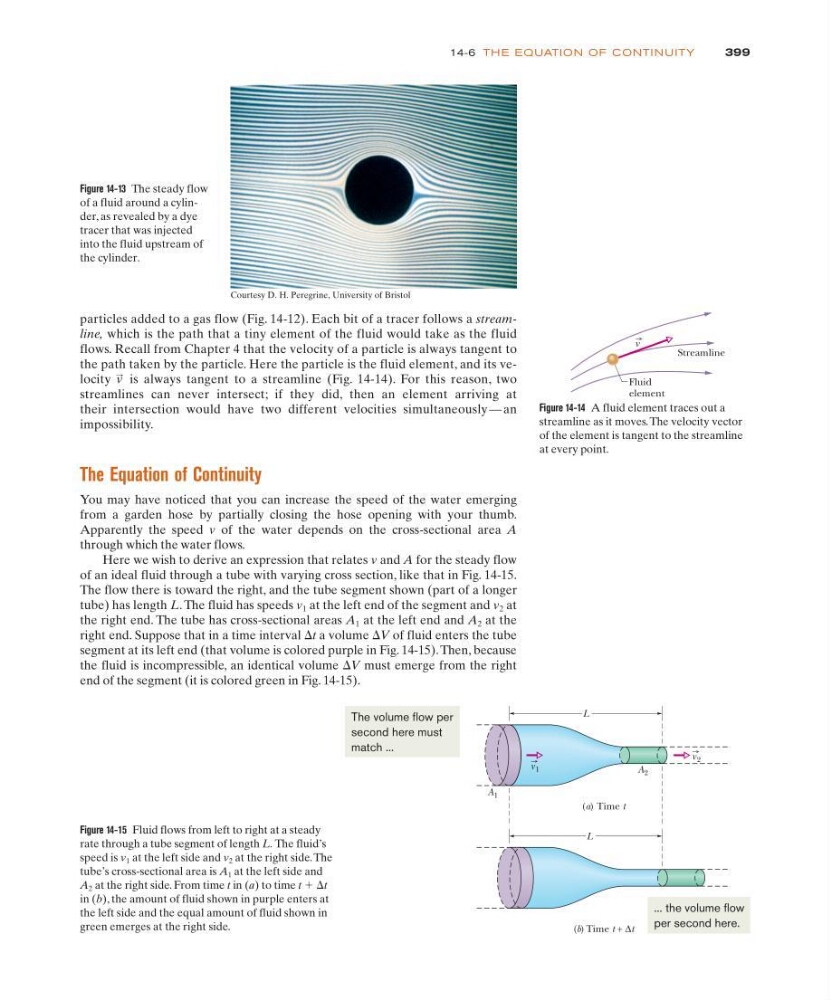
Here we wish to derive an expression that relates v and A for the steady flow
of an ideal fluid through a tube with varying cross section, like that in Fig. 14-15.
The flow there is toward the right, and the tube segment shown (part of a longer
tube) has length L. The fluid has speeds v 1 at the left end of the segment and v 2 at
the right end. The tube has cross-sectional areas A 1 at the left end and A 2 at the
right end. Suppose that in a time interval ⌬t a volume ⌬V of fluid enters the tube
segment at its left end (that volume is colored purple in Fig. 14-15). Then, because
the fluid is incompressible, an identical volume ⌬V must emerge from the right
end of the segment (it is colored green in Fig. 14-15).
v
:
Courtesy D. H. Peregrine, University of Bristol
Figure 14-13 The steady flow
of a fluid around a cylinder, as revealed by a dye
tracer that was injected
into the fluid upstream of
the cylinder.
Streamline
Fluid
element
v
Figure 14-14 A fluid element traces out a
streamline as it moves. The velocity vector
of the element is tangent to the streamline
at every point.
Figure 14-15 Fluid flows from left to right at a steady
rate through a tube segment of length L. The fluid’s
speed is v 1 at the left side and v 2 at the right side. The
tube’s cross-sectional area is A 1 at the left side and
A 2 at the right side. From time t in (a) to time t ϩ ⌬t
in (b), the amount of fluid shown in purple enters at
the left side and the equal amount of fluid shown in
green emerges at the right side.
L
v 1
A 1
A 2
v 2
(a) Time t
L
(b) Time t + ∆t
The volume flow per
second here must
match ...
... the volume flow
per second here.
14-6 TH E EQUATION OF CONTI N U ITY
particles added to a gas flow (Fig. 14-12). Each bit of a tracer follows a streamline, which is the path that a tiny element of the fluid would take as the fluid
flows. Recall from Chapter 4 that the velocity of a particle is always tangent to
the path taken by the particle. Here the particle is the fluid element, and its velocity
is always tangent to a streamline (Fig. 14-14). For this reason, two
streamlines can never intersect; if they did, then an element arriving at
their intersection would have two different velocities simultaneously — an
impossibility.
The Equation of Continuity
You may have noticed that you can increase the speed of the water emerging
from a garden hose by partially closing the hose opening with your thumb.
Apparently the speed v of the water depends on the cross-sectional area A
through which the water flows.
Here we wish to derive an expression that relates v and A for the steady flow
of an ideal fluid through a tube with varying cross section, like that in Fig. 14-15.
The flow there is toward the right, and the tube segment shown (part of a longer
tube) has length L. The fluid has speeds v 1 at the left end of the segment and v 2 at
the right end. The tube has cross-sectional areas A 1 at the left end and A 2 at the
right end. Suppose that in a time interval ⌬t a volume ⌬V of fluid enters the tube
segment at its left end (that volume is colored purple in Fig. 14-15). Then, because
the fluid is incompressible, an identical volume ⌬V must emerge from the right
end of the segment (it is colored green in Fig. 14-15).
v
:
Courtesy D. H. Peregrine, University of Bristol
Figure 14-13 The steady flow
of a fluid around a cylinder, as revealed by a dye
tracer that was injected
into the fluid upstream of
the cylinder.
Streamline
Fluid
element
v
Figure 14-14 A fluid element traces out a
streamline as it moves. The velocity vector
of the element is tangent to the streamline
at every point.
Figure 14-15 Fluid flows from left to right at a steady
rate through a tube segment of length L. The fluid’s
speed is v 1 at the left side and v 2 at the right side. The
tube’s cross-sectional area is A 1 at the left side and
A 2 at the right side. From time t in (a) to time t ϩ ⌬t
in (b), the amount of fluid shown in purple enters at
the left side and the equal amount of fluid shown in
green emerges at the right side.
L
v 1
A 1
A 2
v 2
(a) Time t
L
(b) Time t + ∆t
The volume flow per
second here must
match ...
... the volume flow
per second here.