

397
If, in some test of strength, you had to lift a heavy stone, you could do it more
easily with the stone underwater. Then your applied force would need to exceed
only the stone’s apparent weight, not its larger actual weight.
The magnitude of the buoyant force on a floating body is equal to the body’s
weight. Equation 14-19 thus tells us that a floating body has an apparent weight of
zero — the body would produce a reading of zero on a scale. For example, when astronauts prepare to perform a complex task in space, they practice the task floating
underwater, where their suits are adjusted to give them an apparent weight of zero.
14-5 ARCH I M E DES’ PR I NCI PLE
Checkpoint 2
A penguin floats first in a fluid of density r 0 , then in a fluid of density 0.95r 0 , and then
in a fluid of density 1.1r 0 . (a) Rank the densities according to the magnitude of the
buoyant force on the penguin, greatest first. (b) Rank the densities according to the
amount of fluid displaced by the penguin, greatest first.
Sample Problem 14.04 Floating, buoyancy, and density
In Fig. 14-11, a block of density
floats face
down in a fluid of density
. The block has
height
.
(a) By what depth h is the block submerged?
KEY IDEAS
(1) Floating requires that the upward buoyant force on the
block match the downward gravitational force on the block.
(2) The buoyant force is equal to the weight
of the fluid
displaced by the submerged portion of the block.
Calculations: From Eq. 14-16, we know that the buoyant
force has the magnitude
, where
is the mass of
the fluid displaced by the block’s submerged volume
From Eq. 14-2
, we know that the mass of the displaced fluid is
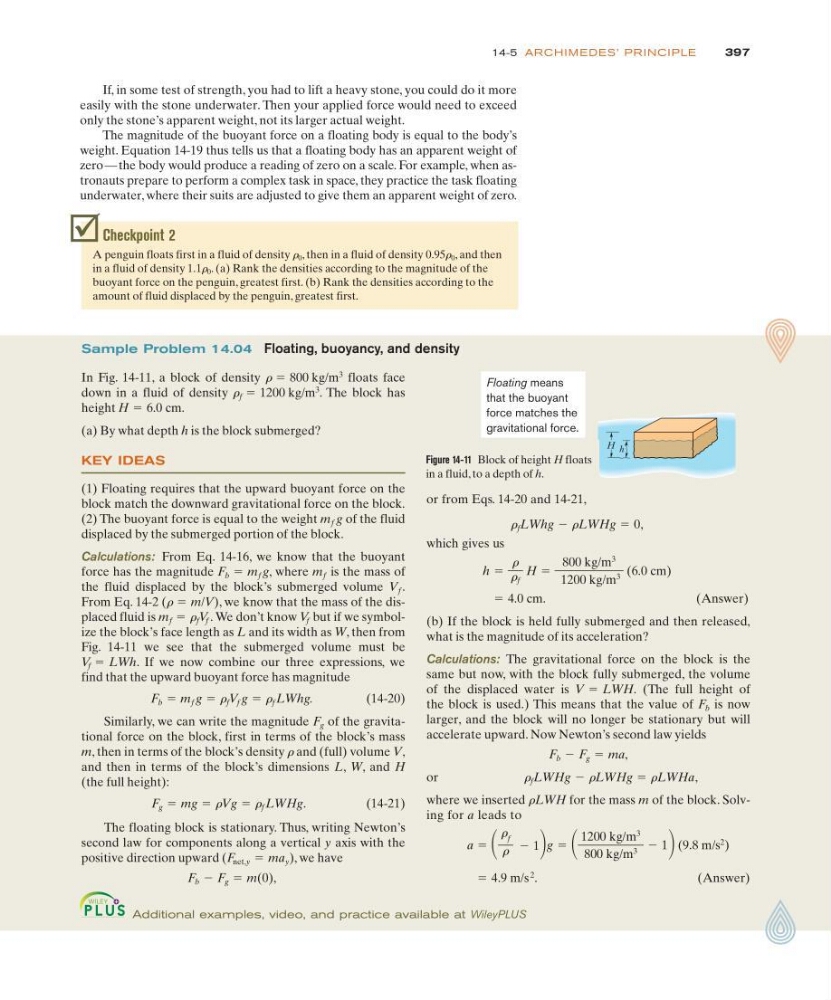
We don’t know but if we symbolize the block’s face length as L and its width as W, then from
Fig. 14-11 we see that the submerged volume must be
. If we now combine our three expressions, we
find that the upward buoyant force has magnitude
(14-20)
Similarly, we can write the magnitude of the gravitational force on the block, first in terms of the block’s mass
m, then in terms of the block’s density r and (full) volume V,
and then in terms of the block’s dimensions L, W, and H
(the full height):
.
( 1 4 - 2 1 )
The floating block is stationary. Thus, writing Newton’s
second law for components along a vertical y axis with the
positive direction upward
, we have
F b Ϫ F g ϭ m(0),
(F net,y ϭ ma y )
F g ϭ mg ϭ rVg ϭ r f LWHg
F g
F b ϭ m f g ϭ r f V f g ϭ r f LWhg.
V f ϭ LWh
V f
m f ϭ r f V f .
(r ϭ m/V)
V f .
m f
F b ϭ m f g
m f g
H ϭ 6.0 cm
r f ϭ 1200 kg/m
3
r ϭ 800 kg/m
3
or from Eqs. 14-20 and 14-21,
which gives us
.
( A n s w e r )
(b) If the block is held fully submerged and then released,
what is the magnitude of its acceleration?
Calculations: The gravitational force on the block is the
same but now, with the block fully submerged, the volume
of the displaced water is
(The full height of
the block is used.) This means that the value of
is now
larger, and the block will no longer be stationary but will
accelerate upward. Now Newton’s second law yields
,
or
,
where we inserted
for the mass m of the block. Solving for a leads to
(Answer)
ϭ 4.9 m/s
2
.
a ϭ
r f
r Ϫ 1 g ϭ
1200 kg/m
3
800 kg/m
3
Ϫ 1 (9.8 m/s
2
)
rLWH
r f LWHg Ϫ rLWHg ϭ rLWHa
F b Ϫ F g ϭ ma
F b
V ϭ LWH.
ϭ 4.0 cm
h ϭ
r
r f
H ϭ
800 kg/m
3
1200 kg/m
3
(6.0 cm)
r f LWhg Ϫ rLWHg ϭ 0,
h
H
Floating means
that the buoyant
force matches the
gravitational force.
Figure 14-11 Block of height H floats
in a fluid, to a depth of h.
Additional examples, video, and practice available at WileyPLUS
Floating means
that the buoyant
force matches the
gravitational force.
If, in some test of strength, you had to lift a heavy stone, you could do it more
easily with the stone underwater. Then your applied force would need to exceed
only the stone’s apparent weight, not its larger actual weight.
The magnitude of the buoyant force on a floating body is equal to the body’s
weight. Equation 14-19 thus tells us that a floating body has an apparent weight of
zero — the body would produce a reading of zero on a scale. For example, when astronauts prepare to perform a complex task in space, they practice the task floating
underwater, where their suits are adjusted to give them an apparent weight of zero.
14-5 ARCH I M E DES’ PR I NCI PLE
Checkpoint 2
A penguin floats first in a fluid of density r 0 , then in a fluid of density 0.95r 0 , and then
in a fluid of density 1.1r 0 . (a) Rank the densities according to the magnitude of the
buoyant force on the penguin, greatest first. (b) Rank the densities according to the
amount of fluid displaced by the penguin, greatest first.
Sample Problem 14.04 Floating, buoyancy, and density
In Fig. 14-11, a block of density
floats face
down in a fluid of density
. The block has
height
.
(a) By what depth h is the block submerged?
KEY IDEAS
(1) Floating requires that the upward buoyant force on the
block match the downward gravitational force on the block.
(2) The buoyant force is equal to the weight
of the fluid
displaced by the submerged portion of the block.
Calculations: From Eq. 14-16, we know that the buoyant
force has the magnitude
, where
is the mass of
the fluid displaced by the block’s submerged volume
From Eq. 14-2
, we know that the mass of the displaced fluid is
We don’t know but if we symbolize the block’s face length as L and its width as W, then from
Fig. 14-11 we see that the submerged volume must be
. If we now combine our three expressions, we
find that the upward buoyant force has magnitude
(14-20)
Similarly, we can write the magnitude of the gravitational force on the block, first in terms of the block’s mass
m, then in terms of the block’s density r and (full) volume V,
and then in terms of the block’s dimensions L, W, and H
(the full height):
.
( 1 4 - 2 1 )
The floating block is stationary. Thus, writing Newton’s
second law for components along a vertical y axis with the
positive direction upward
, we have
F b Ϫ F g ϭ m(0),
(F net,y ϭ ma y )
F g ϭ mg ϭ rVg ϭ r f LWHg
F g
F b ϭ m f g ϭ r f V f g ϭ r f LWhg.
V f ϭ LWh
V f
m f ϭ r f V f .
(r ϭ m/V)
V f .
m f
F b ϭ m f g
m f g
H ϭ 6.0 cm
r f ϭ 1200 kg/m
3
r ϭ 800 kg/m
3
or from Eqs. 14-20 and 14-21,
which gives us
.
( A n s w e r )
(b) If the block is held fully submerged and then released,
what is the magnitude of its acceleration?
Calculations: The gravitational force on the block is the
same but now, with the block fully submerged, the volume
of the displaced water is
(The full height of
the block is used.) This means that the value of
is now
larger, and the block will no longer be stationary but will
accelerate upward. Now Newton’s second law yields
,
or
,
where we inserted
for the mass m of the block. Solving for a leads to
(Answer)
ϭ 4.9 m/s
2
.
a ϭ
r f
r Ϫ 1 g ϭ
1200 kg/m
3
800 kg/m
3
Ϫ 1 (9.8 m/s
2
)
rLWH
r f LWHg Ϫ rLWHg ϭ rLWHa
F b Ϫ F g ϭ ma
F b
V ϭ LWH.
ϭ 4.0 cm
h ϭ
r
r f
H ϭ
800 kg/m
3
1200 kg/m
3
(6.0 cm)
r f LWhg Ϫ rLWHg ϭ 0,
h
H
Floating means
that the buoyant
force matches the
gravitational force.
Figure 14-11 Block of height H floats
in a fluid, to a depth of h.
Additional examples, video, and practice available at WileyPLUS
Floating means
that the buoyant
force matches the
gravitational force.