

392
CHAPTE R 14 FLU I DS
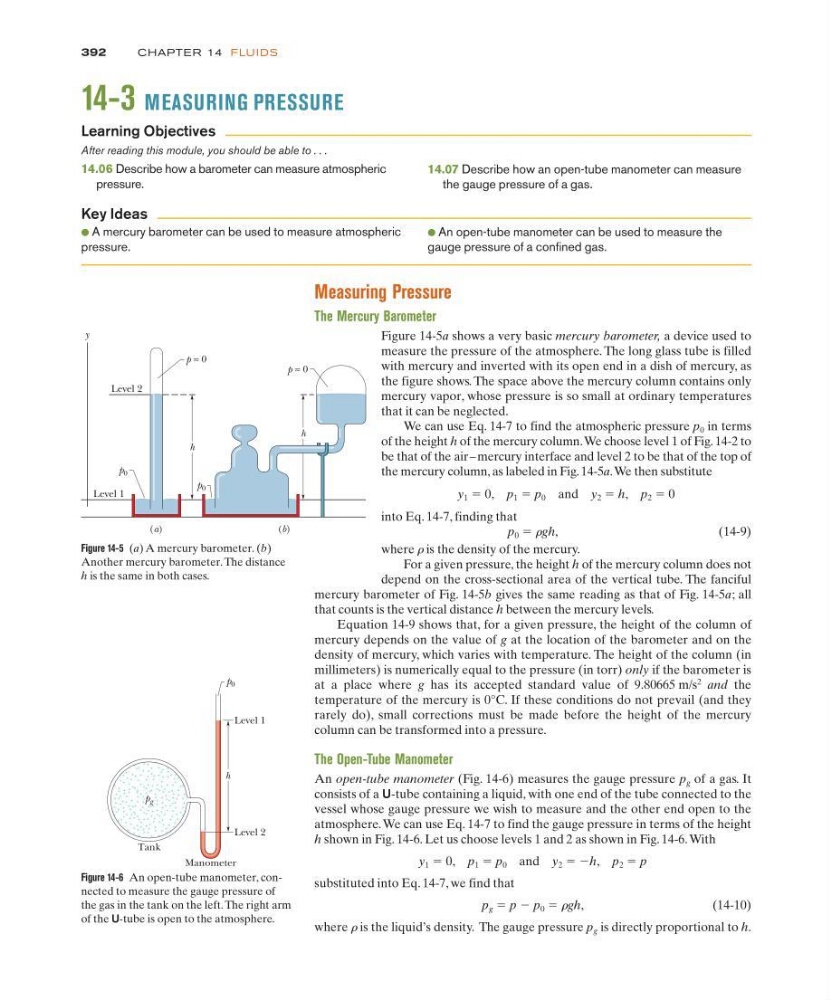
Figure 14-6 An open-tube manometer, connected to measure the gauge pressure of
the gas in the tank on the left. The right arm
of the U-tube is open to the atmosphere.
Tank
Manometer
Level 2
Level 1
p 0
h
p g
Measuring Pressure
The Mercury Barometer
Figure 14-5a shows a very basic mercury barometer, a device used to
measure the pressure of the atmosphere. The long glass tube is filled
with mercury and inverted with its open end in a dish of mercury, as
the figure shows. The space above the mercury column contains only
mercury vapor, whose pressure is so small at ordinary temperatures
that it can be neglected.
We can use Eq. 14-7 to find the atmospheric pressure p 0 in terms
of the height h of the mercury column.We choose level 1 of Fig. 14-2 to
be that of the air – mercury interface and level 2 to be that of the top of
the mercury column, as labeled in Fig. 14-5a.We then substitute
y 1 ϭ 0, p 1 ϭ p 0 and y 2 ϭ h, p 2 ϭ 0
into Eq. 14-7, finding that
p 0 ϭ rgh,
( 1 4 - 9 )
where r is the density of the mercury.
For a given pressure, the height h of the mercury column does not
depend on the cross-sectional area of the vertical tube. The fanciful
mercury barometer of Fig. 14-5b gives the same reading as that of Fig. 14-5a; all
that counts is the vertical distance h between the mercury levels.
Equation 14-9 shows that, for a given pressure, the height of the column of
mercury depends on the value of g at the location of the barometer and on the
density of mercury, which varies with temperature. The height of the column (in
millimeters) is numerically equal to the pressure (in torr) only if the barometer is
at a place where g has its accepted standard value of 9.80665 m/s
2
and the
temperature of the mercury is 0°C. If these conditions do not prevail (and they
rarely do), small corrections must be made before the height of the mercury
column can be transformed into a pressure.
The Open-Tube Manometer
An open-tube manometer (Fig. 14-6) measures the gauge pressure p g of a gas. It
consists of a U-tube containing a liquid, with one end of the tube connected to the
vessel whose gauge pressure we wish to measure and the other end open to the
atmosphere. We can use Eq. 14-7 to find the gauge pressure in terms of the height
h shown in Fig. 14-6. Let us choose levels 1 and 2 as shown in Fig. 14-6. With
y 1 ϭ 0, p 1 ϭ p 0 and y 2 ϭ Ϫh, p 2 ϭ p
substituted into Eq. 14-7, we find that
p g ϭ p Ϫ p 0 ϭ rgh,
( 1 4 - 1 0 )
where r is the liquid’s density. The gauge pressure p g is directly proportional to h.
14-3 MEASURING PRESSURE
After reading this module, you should be able to . . .
14.06 Describe how a barometer can measure atmospheric
pressure.
14.07 Describe how an open-tube manometer can measure
the gauge pressure of a gas.
Learning Objectives
● A mercury barometer can be used to measure atmospheric
pressure.
● An open-tube manometer can be used to measure the
gauge pressure of a confined gas.
Key Ideas
Level 1
p 0
y
Level 2
h
p ≈ 0
h
p 0
p ≈ 0
(a)
(b)
Figure 14-5 (a) A mercury barometer. (b)
Another mercury barometer. The distance
h is the same in both cases.
CHAPTE R 14 FLU I DS
Figure 14-6 An open-tube manometer, connected to measure the gauge pressure of
the gas in the tank on the left. The right arm
of the U-tube is open to the atmosphere.
Tank
Manometer
Level 2
Level 1
p 0
h
p g
Measuring Pressure
The Mercury Barometer
Figure 14-5a shows a very basic mercury barometer, a device used to
measure the pressure of the atmosphere. The long glass tube is filled
with mercury and inverted with its open end in a dish of mercury, as
the figure shows. The space above the mercury column contains only
mercury vapor, whose pressure is so small at ordinary temperatures
that it can be neglected.
We can use Eq. 14-7 to find the atmospheric pressure p 0 in terms
of the height h of the mercury column.We choose level 1 of Fig. 14-2 to
be that of the air – mercury interface and level 2 to be that of the top of
the mercury column, as labeled in Fig. 14-5a.We then substitute
y 1 ϭ 0, p 1 ϭ p 0 and y 2 ϭ h, p 2 ϭ 0
into Eq. 14-7, finding that
p 0 ϭ rgh,
( 1 4 - 9 )
where r is the density of the mercury.
For a given pressure, the height h of the mercury column does not
depend on the cross-sectional area of the vertical tube. The fanciful
mercury barometer of Fig. 14-5b gives the same reading as that of Fig. 14-5a; all
that counts is the vertical distance h between the mercury levels.
Equation 14-9 shows that, for a given pressure, the height of the column of
mercury depends on the value of g at the location of the barometer and on the
density of mercury, which varies with temperature. The height of the column (in
millimeters) is numerically equal to the pressure (in torr) only if the barometer is
at a place where g has its accepted standard value of 9.80665 m/s
2
and the
temperature of the mercury is 0°C. If these conditions do not prevail (and they
rarely do), small corrections must be made before the height of the mercury
column can be transformed into a pressure.
The Open-Tube Manometer
An open-tube manometer (Fig. 14-6) measures the gauge pressure p g of a gas. It
consists of a U-tube containing a liquid, with one end of the tube connected to the
vessel whose gauge pressure we wish to measure and the other end open to the
atmosphere. We can use Eq. 14-7 to find the gauge pressure in terms of the height
h shown in Fig. 14-6. Let us choose levels 1 and 2 as shown in Fig. 14-6. With
y 1 ϭ 0, p 1 ϭ p 0 and y 2 ϭ Ϫh, p 2 ϭ p
substituted into Eq. 14-7, we find that
p g ϭ p Ϫ p 0 ϭ rgh,
( 1 4 - 1 0 )
where r is the liquid’s density. The gauge pressure p g is directly proportional to h.
14-3 MEASURING PRESSURE
After reading this module, you should be able to . . .
14.06 Describe how a barometer can measure atmospheric
pressure.
14.07 Describe how an open-tube manometer can measure
the gauge pressure of a gas.
Learning Objectives
● A mercury barometer can be used to measure atmospheric
pressure.
● An open-tube manometer can be used to measure the
gauge pressure of a confined gas.
Key Ideas
Level 1
p 0
y
Level 2
h
p ≈ 0
h
p 0
p ≈ 0
(a)
(b)
Figure 14-5 (a) A mercury barometer. (b)
Another mercury barometer. The distance
h is the same in both cases.