

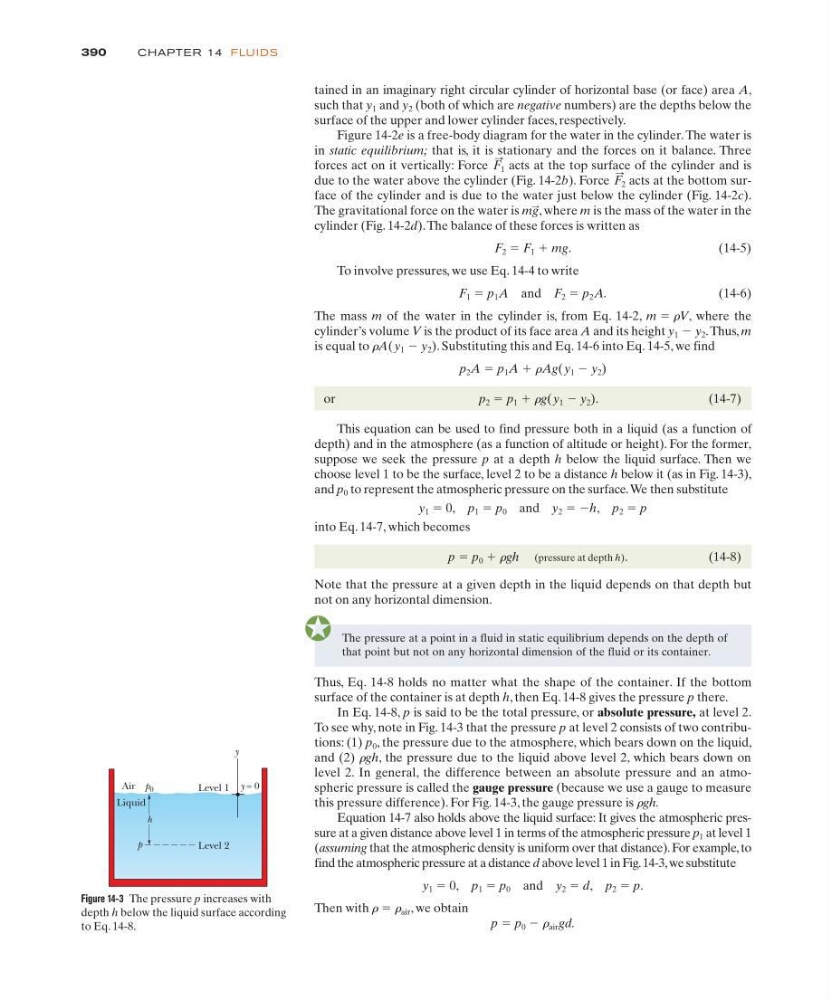
Figure 14-3 The pressure p increases with
depth h below the liquid surface according
to Eq. 14-8.
p
h
Level 1
Level 2
Air
Liquid
y = 0
y
p 0
The pressure at a point in a fluid in static equilibrium depends on the depth of
that point but not on any horizontal dimension of the fluid or its container.
390
CHAPTE R 14 FLU I DS
tained in an imaginary right circular cylinder of horizontal base (or face) area A,
such that y 1 and y 2 (both of which are negative numbers) are the depths below the
surface of the upper and lower cylinder faces, respectively.
Figure 14-2e is a free-body diagram for the water in the cylinder. The water is
in static equilibrium; that is, it is stationary and the forces on it balance. Three
forces act on it vertically: Force
acts at the top surface of the cylinder and is
due to the water above the cylinder (Fig. 14-2b). Force
acts at the bottom surface of the cylinder and is due to the water just below the cylinder (Fig. 14-2c).
The gravitational force on the water is m , where m is the mass of the water in the
cylinder (Fig. 14-2d). The balance of these forces is written as
F 2 ϭ F 1 ϩ mg.
( 1 4 - 5 )
To involve pressures, we use Eq. 14-4 to write
F 1 ϭ p 1 A and F 2 ϭ p 2 A.
(14-6)
The mass m of the water in the cylinder is, from Eq. 14-2, m ϭ rV, where the
cylinder’s volume V is the product of its face area A and its height y 1 Ϫ y 2 .Thus, m
is equal to rA(y 1 Ϫ y 2 ). Substituting this and Eq. 14-6 into Eq. 14-5, we find
p 2 A ϭ p 1 A ϩ rAg(y 1 Ϫ y 2 )
or
p 2 ϭ p 1 ϩ rg(y 1 Ϫ y 2 ).
(14-7)
This equation can be used to find pressure both in a liquid (as a function of
depth) and in the atmosphere (as a function of altitude or height). For the former,
suppose we seek the pressure p at a depth h below the liquid surface. Then we
choose level 1 to be the surface, level 2 to be a distance h below it (as in Fig. 14-3),
and p 0 to represent the atmospheric pressure on the surface.We then substitute
y 1 ϭ 0, p 1 ϭ p 0 and y 2 ϭ Ϫh, p 2 ϭ p
into Eq. 14-7, which becomes
p ϭ p 0 ϩ rgh (pressure at depth h).
( 1 4 - 8 )
Note that the pressure at a given depth in the liquid depends on that depth but
not on any horizontal dimension.
g
:
F
:
2
F
:
1
Thus, Eq. 14-8 holds no matter what the shape of the container. If the bottom
surface of the container is at depth h, then Eq. 14-8 gives the pressure p there.
In Eq. 14-8, p is said to be the total pressure, or absolute pressure, at level 2.
To see why, note in Fig. 14-3 that the pressure p at level 2 consists of two contributions: (1) p 0 , the pressure due to the atmosphere, which bears down on the liquid,
and (2) rgh, the pressure due to the liquid above level 2, which bears down on
level 2. In general, the difference between an absolute pressure and an atmospheric pressure is called the gauge pressure (because we use a gauge to measure
this pressure difference). For Fig. 14-3, the gauge pressure is rgh.
Equation 14-7 also holds above the liquid surface: It gives the atmospheric pressure at a given distance above level 1 in terms of the atmospheric pressure p 1 at level 1
(assuming that the atmospheric density is uniform over that distance). For example, to
find the atmospheric pressure at a distance d above level 1 in Fig. 14-3, we substitute
y 1 ϭ 0, p 1 ϭ p 0 and y 2 ϭ d, p 2 ϭ p.
Then with r ϭ r air , we obtain
p ϭ p 0 Ϫ r air gd.
depth h below the liquid surface according
to Eq. 14-8.
p
h
Level 1
Level 2
Air
Liquid
y = 0
y
p 0
The pressure at a point in a fluid in static equilibrium depends on the depth of
that point but not on any horizontal dimension of the fluid or its container.
390
CHAPTE R 14 FLU I DS
tained in an imaginary right circular cylinder of horizontal base (or face) area A,
such that y 1 and y 2 (both of which are negative numbers) are the depths below the
surface of the upper and lower cylinder faces, respectively.
Figure 14-2e is a free-body diagram for the water in the cylinder. The water is
in static equilibrium; that is, it is stationary and the forces on it balance. Three
forces act on it vertically: Force
acts at the top surface of the cylinder and is
due to the water above the cylinder (Fig. 14-2b). Force
acts at the bottom surface of the cylinder and is due to the water just below the cylinder (Fig. 14-2c).
The gravitational force on the water is m , where m is the mass of the water in the
cylinder (Fig. 14-2d). The balance of these forces is written as
F 2 ϭ F 1 ϩ mg.
( 1 4 - 5 )
To involve pressures, we use Eq. 14-4 to write
F 1 ϭ p 1 A and F 2 ϭ p 2 A.
(14-6)
The mass m of the water in the cylinder is, from Eq. 14-2, m ϭ rV, where the
cylinder’s volume V is the product of its face area A and its height y 1 Ϫ y 2 .Thus, m
is equal to rA(y 1 Ϫ y 2 ). Substituting this and Eq. 14-6 into Eq. 14-5, we find
p 2 A ϭ p 1 A ϩ rAg(y 1 Ϫ y 2 )
or
p 2 ϭ p 1 ϩ rg(y 1 Ϫ y 2 ).
(14-7)
This equation can be used to find pressure both in a liquid (as a function of
depth) and in the atmosphere (as a function of altitude or height). For the former,
suppose we seek the pressure p at a depth h below the liquid surface. Then we
choose level 1 to be the surface, level 2 to be a distance h below it (as in Fig. 14-3),
and p 0 to represent the atmospheric pressure on the surface.We then substitute
y 1 ϭ 0, p 1 ϭ p 0 and y 2 ϭ Ϫh, p 2 ϭ p
into Eq. 14-7, which becomes
p ϭ p 0 ϩ rgh (pressure at depth h).
( 1 4 - 8 )
Note that the pressure at a given depth in the liquid depends on that depth but
not on any horizontal dimension.
g
:
F
:
2
F
:
1
Thus, Eq. 14-8 holds no matter what the shape of the container. If the bottom
surface of the container is at depth h, then Eq. 14-8 gives the pressure p there.
In Eq. 14-8, p is said to be the total pressure, or absolute pressure, at level 2.
To see why, note in Fig. 14-3 that the pressure p at level 2 consists of two contributions: (1) p 0 , the pressure due to the atmosphere, which bears down on the liquid,
and (2) rgh, the pressure due to the liquid above level 2, which bears down on
level 2. In general, the difference between an absolute pressure and an atmospheric pressure is called the gauge pressure (because we use a gauge to measure
this pressure difference). For Fig. 14-3, the gauge pressure is rgh.
Equation 14-7 also holds above the liquid surface: It gives the atmospheric pressure at a given distance above level 1 in terms of the atmospheric pressure p 1 at level 1
(assuming that the atmospheric density is uniform over that distance). For example, to
find the atmospheric pressure at a distance d above level 1 in Fig. 14-3, we substitute
y 1 ϭ 0, p 1 ϭ p 0 and y 2 ϭ d, p 2 ϭ p.
Then with r ϭ r air , we obtain
p ϭ p 0 Ϫ r air gd.