

383
PROB LE M S
Module 13-7 Satellites: Orbits and Energy
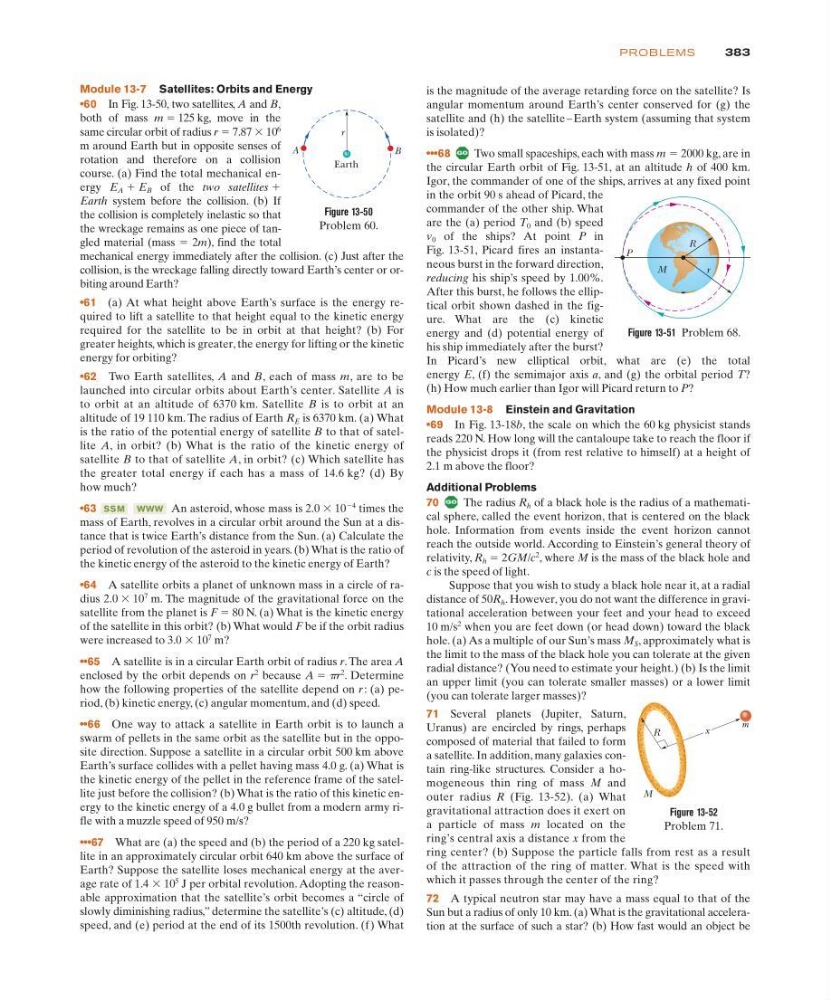
•60 In Fig. 13-50, two satellites, A and B,
both of mass m ϭ 125 kg, move in the
same circular orbit of radius r ϭ 7.87 ϫ 10
6
m around Earth but in opposite senses of
rotation and therefore on a collision
course. (a) Find the total mechanical energy E A ϩ E B of the two satellites ϩ
Earth system before the collision. (b) If
the collision is completely inelastic so that
the wreckage remains as one piece of tangled material (mass ϭ 2m), find the total
mechanical energy immediately after the collision. (c) Just after the
collision, is the wreckage falling directly toward Earth’s center or orbiting around Earth?
•61 (a) At what height above Earth’s surface is the energy required to lift a satellite to that height equal to the kinetic energy
required for the satellite to be in orbit at that height? (b) For
greater heights, which is greater, the energy for lifting or the kinetic
energy for orbiting?
•62 Two Earth satellites, A and B, each of mass m, are to be
launched into circular orbits about Earth’s center. Satellite A is
to orbit at an altitude of 6370 km. Satellite B is to orbit at an
altitude of 19 110 km. The radius of Earth R E is 6370 km. (a) What
is the ratio of the potential energy of satellite B to that of satellite A, in orbit? (b) What is the ratio of the kinetic energy of
satellite B to that of satellite A, in orbit? (c) Which satellite has
the greater total energy if each has a mass of 14.6 kg? (d) By
how much?
•63
An asteroid, whose mass is 2.0 ϫ 10
Ϫ4
times the
mass of Earth, revolves in a circular orbit around the Sun at a distance that is twice Earth’s distance from the Sun. (a) Calculate the
period of revolution of the asteroid in years. (b) What is the ratio of
the kinetic energy of the asteroid to the kinetic energy of Earth?
•64 A satellite orbits a planet of unknown mass in a circle of radius 2.0 ϫ 10
7
m. The magnitude of the gravitational force on the
satellite from the planet is F ϭ 80 N. (a) What is the kinetic energy
of the satellite in this orbit? (b) What would F be if the orbit radius
were increased to 3.0 ϫ 10
7
m?
••65 A satellite is in a circular Earth orbit of radius r. The area A
enclosed by the orbit depends on r
2
because A ϭ pr
2
. Determine
how the following properties of the satellite depend on r: (a) period, (b) kinetic energy, (c) angular momentum, and (d) speed.
••66 One way to attack a satellite in Earth orbit is to launch a
swarm of pellets in the same orbit as the satellite but in the opposite direction. Suppose a satellite in a circular orbit 500 km above
Earth’s surface collides with a pellet having mass 4.0 g. (a) What is
the kinetic energy of the pellet in the reference frame of the satellite just before the collision? (b) What is the ratio of this kinetic energy to the kinetic energy of a 4.0 g bullet from a modern army rifle with a muzzle speed of 950 m/s?
•••67 What are (a) the speed and (b) the period of a 220 kg satellite in an approximately circular orbit 640 km above the surface of
Earth? Suppose the satellite loses mechanical energy at the average rate of 1.4 ϫ 10
5
J per orbital revolution. Adopting the reasonable approximation that the satellite’s orbit becomes a “circle of
slowly diminishing radius,” determine the satellite’s (c) altitude, (d)
speed, and (e) period at the end of its 1500th revolution. (f) What
WWW
SSM
is the magnitude of the average retarding force on the satellite? Is
angular momentum around Earth’s center conserved for (g) the
satellite and (h) the satellite – Earth system (assuming that system
is isolated)?
•••68
Two small spaceships, each with mass m ϭ 2000 kg, are in
the circular Earth orbit of Fig. 13-51, at an altitude h of 400 km.
Igor, the commander of one of the ships, arrives at any fixed point
in the orbit 90 s ahead of Picard, the
commander of the other ship. What
are the (a) period T 0 and (b) speed
v 0 of the ships? At point P in
Fig. 13-51, Picard fires an instantaneous burst in the forward direction,
reducing his ship’s speed by 1.00%.
After this burst, he follows the elliptical orbit shown dashed in the figure. What are the (c) kinetic
energy and (d) potential energy of
his ship immediately after the burst?
In Picard’s new elliptical orbit, what are (e) the total
energy E, (f) the semimajor axis a, and (g) the orbital period T?
(h) How much earlier than Igor will Picard return to P?
Module 13-8 Einstein and Gravitation
•69 In Fig. 13-18b, the scale on which the 60 kg physicist stands
reads 220 N. How long will the cantaloupe take to reach the floor if
the physicist drops it (from rest relative to himself) at a height of
2.1 m above the floor?
Additional Problems
70
The radius R h of a black hole is the radius of a mathematical sphere, called the event horizon, that is centered on the black
hole. Information from events inside the event horizon cannot
reach the outside world. According to Einstein’s general theory of
relativity, R h ϭ 2GM/c
2
, where M is the mass of the black hole and
c is the speed of light.
Suppose that you wish to study a black hole near it, at a radial
distance of 50R h . However, you do not want the difference in gravitational acceleration between your feet and your head to exceed
10 m/s
2
when you are feet down (or head down) toward the black
hole. (a) As a multiple of our Sun’s mass M S , approximately what is
the limit to the mass of the black hole you can tolerate at the given
radial distance? (You need to estimate your height.) (b) Is the limit
an upper limit (you can tolerate smaller masses) or a lower limit
(you can tolerate larger masses)?
71 Several planets (Jupiter, Saturn,
Uranus) are encircled by rings, perhaps
composed of material that failed to form
a satellite. In addition, many galaxies contain ring-like structures. Consider a homogeneous thin ring of mass M and
outer radius R (Fig. 13-52). (a) What
gravitational attraction does it exert on
a particle of mass m located on the
ring’s central axis a distance x from the
ring center? (b) Suppose the particle falls from rest as a result
of the attraction of the ring of matter. What is the speed with
which it passes through the center of the ring?
72 A typical neutron star may have a mass equal to that of the
Sun but a radius of only 10 km. (a) What is the gravitational acceleration at the surface of such a star? (b) How fast would an object be
A
r
Earth
B
Figure 13-50
Problem 60.
R
r
M
P
Figure 13-51 Problem 68.
M
m
R
x
Figure 13-52
Problem 71.
PROB LE M S
Module 13-7 Satellites: Orbits and Energy
•60 In Fig. 13-50, two satellites, A and B,
both of mass m ϭ 125 kg, move in the
same circular orbit of radius r ϭ 7.87 ϫ 10
6
m around Earth but in opposite senses of
rotation and therefore on a collision
course. (a) Find the total mechanical energy E A ϩ E B of the two satellites ϩ
Earth system before the collision. (b) If
the collision is completely inelastic so that
the wreckage remains as one piece of tangled material (mass ϭ 2m), find the total
mechanical energy immediately after the collision. (c) Just after the
collision, is the wreckage falling directly toward Earth’s center or orbiting around Earth?
•61 (a) At what height above Earth’s surface is the energy required to lift a satellite to that height equal to the kinetic energy
required for the satellite to be in orbit at that height? (b) For
greater heights, which is greater, the energy for lifting or the kinetic
energy for orbiting?
•62 Two Earth satellites, A and B, each of mass m, are to be
launched into circular orbits about Earth’s center. Satellite A is
to orbit at an altitude of 6370 km. Satellite B is to orbit at an
altitude of 19 110 km. The radius of Earth R E is 6370 km. (a) What
is the ratio of the potential energy of satellite B to that of satellite A, in orbit? (b) What is the ratio of the kinetic energy of
satellite B to that of satellite A, in orbit? (c) Which satellite has
the greater total energy if each has a mass of 14.6 kg? (d) By
how much?
•63
An asteroid, whose mass is 2.0 ϫ 10
Ϫ4
times the
mass of Earth, revolves in a circular orbit around the Sun at a distance that is twice Earth’s distance from the Sun. (a) Calculate the
period of revolution of the asteroid in years. (b) What is the ratio of
the kinetic energy of the asteroid to the kinetic energy of Earth?
•64 A satellite orbits a planet of unknown mass in a circle of radius 2.0 ϫ 10
7
m. The magnitude of the gravitational force on the
satellite from the planet is F ϭ 80 N. (a) What is the kinetic energy
of the satellite in this orbit? (b) What would F be if the orbit radius
were increased to 3.0 ϫ 10
7
m?
••65 A satellite is in a circular Earth orbit of radius r. The area A
enclosed by the orbit depends on r
2
because A ϭ pr
2
. Determine
how the following properties of the satellite depend on r: (a) period, (b) kinetic energy, (c) angular momentum, and (d) speed.
••66 One way to attack a satellite in Earth orbit is to launch a
swarm of pellets in the same orbit as the satellite but in the opposite direction. Suppose a satellite in a circular orbit 500 km above
Earth’s surface collides with a pellet having mass 4.0 g. (a) What is
the kinetic energy of the pellet in the reference frame of the satellite just before the collision? (b) What is the ratio of this kinetic energy to the kinetic energy of a 4.0 g bullet from a modern army rifle with a muzzle speed of 950 m/s?
•••67 What are (a) the speed and (b) the period of a 220 kg satellite in an approximately circular orbit 640 km above the surface of
Earth? Suppose the satellite loses mechanical energy at the average rate of 1.4 ϫ 10
5
J per orbital revolution. Adopting the reasonable approximation that the satellite’s orbit becomes a “circle of
slowly diminishing radius,” determine the satellite’s (c) altitude, (d)
speed, and (e) period at the end of its 1500th revolution. (f) What
WWW
SSM
is the magnitude of the average retarding force on the satellite? Is
angular momentum around Earth’s center conserved for (g) the
satellite and (h) the satellite – Earth system (assuming that system
is isolated)?
•••68
Two small spaceships, each with mass m ϭ 2000 kg, are in
the circular Earth orbit of Fig. 13-51, at an altitude h of 400 km.
Igor, the commander of one of the ships, arrives at any fixed point
in the orbit 90 s ahead of Picard, the
commander of the other ship. What
are the (a) period T 0 and (b) speed
v 0 of the ships? At point P in
Fig. 13-51, Picard fires an instantaneous burst in the forward direction,
reducing his ship’s speed by 1.00%.
After this burst, he follows the elliptical orbit shown dashed in the figure. What are the (c) kinetic
energy and (d) potential energy of
his ship immediately after the burst?
In Picard’s new elliptical orbit, what are (e) the total
energy E, (f) the semimajor axis a, and (g) the orbital period T?
(h) How much earlier than Igor will Picard return to P?
Module 13-8 Einstein and Gravitation
•69 In Fig. 13-18b, the scale on which the 60 kg physicist stands
reads 220 N. How long will the cantaloupe take to reach the floor if
the physicist drops it (from rest relative to himself) at a height of
2.1 m above the floor?
Additional Problems
70
The radius R h of a black hole is the radius of a mathematical sphere, called the event horizon, that is centered on the black
hole. Information from events inside the event horizon cannot
reach the outside world. According to Einstein’s general theory of
relativity, R h ϭ 2GM/c
2
, where M is the mass of the black hole and
c is the speed of light.
Suppose that you wish to study a black hole near it, at a radial
distance of 50R h . However, you do not want the difference in gravitational acceleration between your feet and your head to exceed
10 m/s
2
when you are feet down (or head down) toward the black
hole. (a) As a multiple of our Sun’s mass M S , approximately what is
the limit to the mass of the black hole you can tolerate at the given
radial distance? (You need to estimate your height.) (b) Is the limit
an upper limit (you can tolerate smaller masses) or a lower limit
(you can tolerate larger masses)?
71 Several planets (Jupiter, Saturn,
Uranus) are encircled by rings, perhaps
composed of material that failed to form
a satellite. In addition, many galaxies contain ring-like structures. Consider a homogeneous thin ring of mass M and
outer radius R (Fig. 13-52). (a) What
gravitational attraction does it exert on
a particle of mass m located on the
ring’s central axis a distance x from the
ring center? (b) Suppose the particle falls from rest as a result
of the attraction of the ring of matter. What is the speed with
which it passes through the center of the ring?
72 A typical neutron star may have a mass equal to that of the
Sun but a radius of only 10 km. (a) What is the gravitational acceleration at the surface of such a star? (b) How fast would an object be
A
r
Earth
B
Figure 13-50
Problem 60.
R
r
M
P
Figure 13-51 Problem 68.
M
m
R
x
Figure 13-52
Problem 71.