

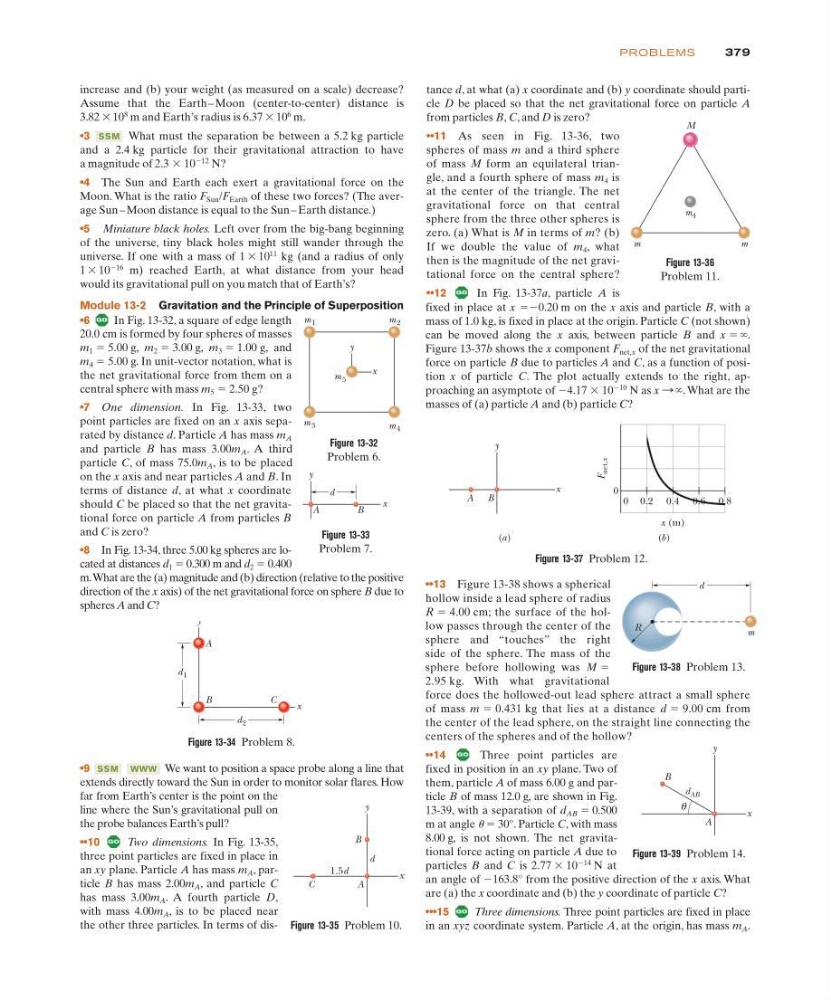
20.0 cm is formed by four spheres of masses
m 1 ϭ 5.00 g, m 2 ϭ 3.00 g, m 3 ϭ 1.00 g, and
m 4 ϭ 5.00 g. In unit-vector notation, what is
the net gravitational force from them on a
central sphere with mass m 5 ϭ 2.50 g?
•7 One dimension. In Fig. 13-33, two
point particles are fixed on an x axis separated by distance d. Particle A has mass m A
and particle B has mass 3.00m A . A third
particle C, of mass 75.0m A , is to be placed
on the x axis and near particles A and B. In
terms of distance d, at what x coordinate
should C be placed so that the net gravitational force on particle A from particles B
and C is zero?
•8 In Fig. 13-34, three 5.00 kg spheres are located at distances d 1 ϭ 0.300 m and d 2 ϭ 0.400
m.What are the (a) magnitude and (b) direction (relative to the positive
direction of the x axis) of the net gravitational force on sphere B due to
spheres A and C?
increase and (b) your weight (as measured on a scale) decrease?
Assume that the Earth – Moon (center-to-center) distance is
3.82 ϫ 10
8
m and Earth’s radius is 6.37 ϫ 10
6
m.
•3
What must the separation be between a 5.2 kg particle
and a 2.4 kg particle for their gravitational attraction to have
a magnitude of 2.3 ϫ 10
Ϫ12
N?
•4 The Sun and Earth each exert a gravitational force on the
Moon. What is the ratio F Sun /F Earth of these two forces? (The average Sun – Moon distance is equal to the Sun – Earth distance.)
•5 Miniature black holes. Left over from the big-bang beginning
of the universe, tiny black holes might still wander through the
universe. If one with a mass of 1 ϫ 10
11
kg (and a radius of only
1 ϫ 10
Ϫ16
m) reached Earth, at what distance from your head
would its gravitational pull on you match that of Earth’s?
Module 13-2 Gravitation and the Principle of Superposition
•6
In Fig. 13-32, a square of edge length
SSM
fixed in place at x ϭϪ0.20 m on the x axis and particle B, with a
mass of 1.0 kg, is fixed in place at the origin. Particle C (not shown)
can be moved along the x axis, between particle B and x ϭ ϱ.
Figure 13-37b shows the x component F net,x of the net gravitational
force on particle B due to particles A and C, as a function of position x of particle C. The plot actually extends to the right, approaching an asymptote of Ϫ4.17 ϫ 10
Ϫ10
N as x : ϱ. What are the
masses of (a) particle A and (b) particle C?
379
PROB LE M S
tance d, at what (a) x coordinate and (b) y coordinate should particle D be placed so that the net gravitational force on particle A
from particles B, C, and D is zero?
••11 As seen in Fig. 13-36, two
spheres of mass m and a third sphere
of mass M form an equilateral triangle, and a fourth sphere of mass m 4 is
at the center of the triangle. The net
gravitational force on that central
sphere from the three other spheres is
zero. (a) What is M in terms of m? (b)
If we double the value of m 4 , what
then is the magnitude of the net gravitational force on the central sphere?
••12
In Fig. 13-37a, particle A is
m 1
m 3
m 4
m 5
m 2
y
x
Figure 13-32
Problem 6.
y
x
d
A
B
Figure 13-33
Problem 7.
Figure 13-34 Problem 8.
y
x
d 2
d 1
A
B
C
m
m
m 4
M
Figure 13-36
Problem 11.
y
x
(a)
( b)
A B
0
0
x (m)
F
net,x
0.2 0.4 0.6 0.8
Figure 13-37 Problem 12.
••13 Figure 13-38 shows a spherical
hollow inside a lead sphere of radius
R ϭ 4.00 cm; the surface of the hollow passes through the center of the
sphere and “touches” the right
side of the sphere. The mass of the
sphere before hollowing was M ϭ
2.95 kg. With what gravitational
force does the hollowed-out lead sphere attract a small sphere
of mass m ϭ 0.431 kg that lies at a distance d ϭ 9.00 cm from
the center of the lead sphere, on the straight line connecting the
centers of the spheres and of the hollow?
••14
Three point particles are
fixed in position in an xy plane. Two of
them, particle A of mass 6.00 g and particle B of mass 12.0 g, are shown in Fig.
13-39, with a separation of d AB ϭ 0.500
m at angle u ϭ 30°. Particle C, with mass
8.00 g, is not shown. The net gravitational force acting on particle A due to
particles B and C is 2.77 ϫ 10
Ϫ14
N at
an angle of Ϫ163.8° from the positive direction of the x axis. What
are (a) the x coordinate and (b) the y coordinate of particle C?
•••15
Three dimensions. Three point particles are fixed in place
in an xyz coordinate system. Particle A, at the origin, has mass m A .
m
R
d
Figure 13-38 Problem 13.
y
x
A
B
d AB
θ
Figure 13-39 Problem 14.
•9
We want to position a space probe along a line that
extends directly toward the Sun in order to monitor solar flares. How
far from Earth’s center is the point on the
line where the Sun’s gravitational pull on
the probe balances Earth’s pull?
••10
Two dimensions. In Fig. 13-35,
three point particles are fixed in place in
an xy plane. Particle A has mass m A , particle B has mass 2.00m A , and particle C
has mass 3.00m A . A fourth particle D,
with mass 4.00m A , is to be placed near
the other three particles. In terms of disWWW
SSM
y
x
B
A
C
d
1.5d
Figure 13-35 Problem 10.
m 1 ϭ 5.00 g, m 2 ϭ 3.00 g, m 3 ϭ 1.00 g, and
m 4 ϭ 5.00 g. In unit-vector notation, what is
the net gravitational force from them on a
central sphere with mass m 5 ϭ 2.50 g?
•7 One dimension. In Fig. 13-33, two
point particles are fixed on an x axis separated by distance d. Particle A has mass m A
and particle B has mass 3.00m A . A third
particle C, of mass 75.0m A , is to be placed
on the x axis and near particles A and B. In
terms of distance d, at what x coordinate
should C be placed so that the net gravitational force on particle A from particles B
and C is zero?
•8 In Fig. 13-34, three 5.00 kg spheres are located at distances d 1 ϭ 0.300 m and d 2 ϭ 0.400
m.What are the (a) magnitude and (b) direction (relative to the positive
direction of the x axis) of the net gravitational force on sphere B due to
spheres A and C?
increase and (b) your weight (as measured on a scale) decrease?
Assume that the Earth – Moon (center-to-center) distance is
3.82 ϫ 10
8
m and Earth’s radius is 6.37 ϫ 10
6
m.
•3
What must the separation be between a 5.2 kg particle
and a 2.4 kg particle for their gravitational attraction to have
a magnitude of 2.3 ϫ 10
Ϫ12
N?
•4 The Sun and Earth each exert a gravitational force on the
Moon. What is the ratio F Sun /F Earth of these two forces? (The average Sun – Moon distance is equal to the Sun – Earth distance.)
•5 Miniature black holes. Left over from the big-bang beginning
of the universe, tiny black holes might still wander through the
universe. If one with a mass of 1 ϫ 10
11
kg (and a radius of only
1 ϫ 10
Ϫ16
m) reached Earth, at what distance from your head
would its gravitational pull on you match that of Earth’s?
Module 13-2 Gravitation and the Principle of Superposition
•6
In Fig. 13-32, a square of edge length
SSM
fixed in place at x ϭϪ0.20 m on the x axis and particle B, with a
mass of 1.0 kg, is fixed in place at the origin. Particle C (not shown)
can be moved along the x axis, between particle B and x ϭ ϱ.
Figure 13-37b shows the x component F net,x of the net gravitational
force on particle B due to particles A and C, as a function of position x of particle C. The plot actually extends to the right, approaching an asymptote of Ϫ4.17 ϫ 10
Ϫ10
N as x : ϱ. What are the
masses of (a) particle A and (b) particle C?
379
PROB LE M S
tance d, at what (a) x coordinate and (b) y coordinate should particle D be placed so that the net gravitational force on particle A
from particles B, C, and D is zero?
••11 As seen in Fig. 13-36, two
spheres of mass m and a third sphere
of mass M form an equilateral triangle, and a fourth sphere of mass m 4 is
at the center of the triangle. The net
gravitational force on that central
sphere from the three other spheres is
zero. (a) What is M in terms of m? (b)
If we double the value of m 4 , what
then is the magnitude of the net gravitational force on the central sphere?
••12
In Fig. 13-37a, particle A is
m 1
m 3
m 4
m 5
m 2
y
x
Figure 13-32
Problem 6.
y
x
d
A
B
Figure 13-33
Problem 7.
Figure 13-34 Problem 8.
y
x
d 2
d 1
A
B
C
m
m
m 4
M
Figure 13-36
Problem 11.
y
x
(a)
( b)
A B
0
0
x (m)
F
net,x
0.2 0.4 0.6 0.8
Figure 13-37 Problem 12.
••13 Figure 13-38 shows a spherical
hollow inside a lead sphere of radius
R ϭ 4.00 cm; the surface of the hollow passes through the center of the
sphere and “touches” the right
side of the sphere. The mass of the
sphere before hollowing was M ϭ
2.95 kg. With what gravitational
force does the hollowed-out lead sphere attract a small sphere
of mass m ϭ 0.431 kg that lies at a distance d ϭ 9.00 cm from
the center of the lead sphere, on the straight line connecting the
centers of the spheres and of the hollow?
••14
Three point particles are
fixed in position in an xy plane. Two of
them, particle A of mass 6.00 g and particle B of mass 12.0 g, are shown in Fig.
13-39, with a separation of d AB ϭ 0.500
m at angle u ϭ 30°. Particle C, with mass
8.00 g, is not shown. The net gravitational force acting on particle A due to
particles B and C is 2.77 ϫ 10
Ϫ14
N at
an angle of Ϫ163.8° from the positive direction of the x axis. What
are (a) the x coordinate and (b) the y coordinate of particle C?
•••15
Three dimensions. Three point particles are fixed in place
in an xyz coordinate system. Particle A, at the origin, has mass m A .
m
R
d
Figure 13-38 Problem 13.
y
x
A
B
d AB
θ
Figure 13-39 Problem 14.
•9
We want to position a space probe along a line that
extends directly toward the Sun in order to monitor solar flares. How
far from Earth’s center is the point on the
line where the Sun’s gravitational pull on
the probe balances Earth’s pull?
••10
Two dimensions. In Fig. 13-35,
three point particles are fixed in place in
an xy plane. Particle A has mass m A , particle B has mass 2.00m A , and particle C
has mass 3.00m A . A fourth particle D,
with mass 4.00m A , is to be placed near
the other three particles. In terms of disWWW
SSM
y
x
B
A
C
d
1.5d
Figure 13-35 Problem 10.