

372
CHAPTE R 13 GRAVITATION
Figure 13-16 The variation of kinetic energy
K, potential energy U, and total energy E
with radius r for a satellite in a circular orbit. For any value of r, the values of U and
E are negative, the value of K is positive,
and E ϭ ϪK.As r : ϱ, all three energy
curves approach a value of zero.
Energy
r
0
K(r)
E(r)
U(r)
This is a plot of a
satellite's energies
versus orbit radius.
The kinetic energy
is positive.
The potential energy
and total energy
are negative.
Checkpoint 5
In the figure here, a space shuttle is initially in a circular orbit of radius r about Earth. At point P,
the pilot briefly fires a forward-pointing thruster
to decrease the shuttle’s kinetic energy K and mechanical energy E. (a) Which of the dashed elliptical orbits shown in the figure will the shuttle then
take? (b) Is the orbital period T of the shuttle (the
time to return to P) then greater than, less than, or
the same as in the circular orbit?
r
P
1
2
The potential energy of the system is given by Eq. 13-21:
(with U ϭ 0 for infinite separation). Here r is the radius of the satellite’s orbit,
assumed for the time being to be circular, and M and m are the masses of Earth
and the satellite, respectively.
To find the kinetic energy of a satellite in a circular orbit, we write Newton’s
second law (F ϭ ma) as
(13-37)
where v
2
/r is the centripetal acceleration of the satellite. Then, from Eq. 13-37, the
kinetic energy is
(13-38)
which shows us that for a satellite in a circular orbit,
(circular orbit).
(13-39)
The total mechanical energy of the orbiting satellite is
or
(circular orbit).
(13-40)
This tells us that for a satellite in a circular orbit, the total energy E is the negative of
the kinetic energy K:
E ϭ ϪK (circular orbit).
(13-41)
For a satellite in an elliptical orbit of semimajor axis a, we can substitute a for r in
Eq. 13-40 to find the mechanical energy:
(elliptical orbit).
(13-42)
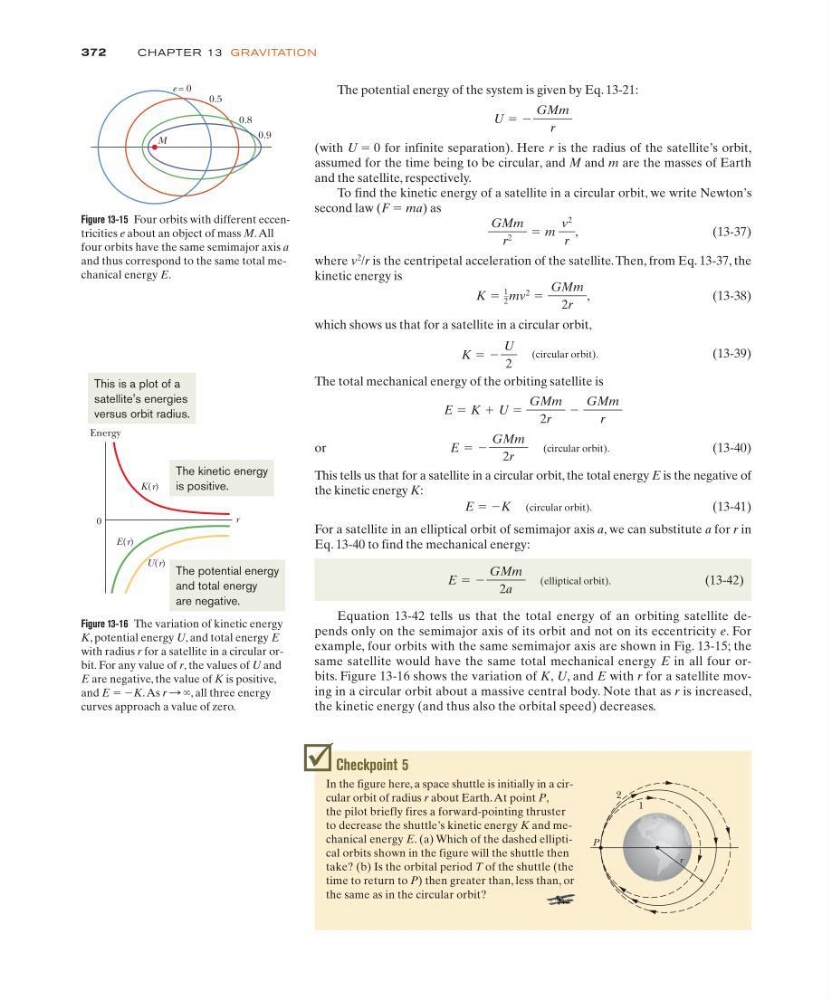
Equation 13-42 tells us that the total energy of an orbiting satellite depends only on the semimajor axis of its orbit and not on its eccentricity e. For
example, four orbits with the same semimajor axis are shown in Fig. 13-15; the
same satellite would have the same total mechanical energy E in all four orbits. Figure 13-16 shows the variation of K, U, and E with r for a satellite moving in a circular orbit about a massive central body. Note that as r is increased,
the kinetic energy (and thus also the orbital speed) decreases.
E ϭ Ϫ
GMm
2a
E ϭ Ϫ
GMm
2r
E ϭ K ϩ U ϭ
GMm
2r
Ϫ
GMm
r
K ϭ Ϫ
U
2
K ϭ
1
2 mv
2 ϭ
GMm
2r
,
GMm
r
2
ϭ m
v
2
r
,
U ϭ Ϫ
GMm
r
Figure 13-15 Four orbits with different eccentricities e about an object of mass M.All
four orbits have the same semimajor axis a
and thus correspond to the same total mechanical energy E.
e = 0
0.5
0.8
0.9
M
CHAPTE R 13 GRAVITATION
Figure 13-16 The variation of kinetic energy
K, potential energy U, and total energy E
with radius r for a satellite in a circular orbit. For any value of r, the values of U and
E are negative, the value of K is positive,
and E ϭ ϪK.As r : ϱ, all three energy
curves approach a value of zero.
Energy
r
0
K(r)
E(r)
U(r)
This is a plot of a
satellite's energies
versus orbit radius.
The kinetic energy
is positive.
The potential energy
and total energy
are negative.
Checkpoint 5
In the figure here, a space shuttle is initially in a circular orbit of radius r about Earth. At point P,
the pilot briefly fires a forward-pointing thruster
to decrease the shuttle’s kinetic energy K and mechanical energy E. (a) Which of the dashed elliptical orbits shown in the figure will the shuttle then
take? (b) Is the orbital period T of the shuttle (the
time to return to P) then greater than, less than, or
the same as in the circular orbit?
r
P
1
2
The potential energy of the system is given by Eq. 13-21:
(with U ϭ 0 for infinite separation). Here r is the radius of the satellite’s orbit,
assumed for the time being to be circular, and M and m are the masses of Earth
and the satellite, respectively.
To find the kinetic energy of a satellite in a circular orbit, we write Newton’s
second law (F ϭ ma) as
(13-37)
where v
2
/r is the centripetal acceleration of the satellite. Then, from Eq. 13-37, the
kinetic energy is
(13-38)
which shows us that for a satellite in a circular orbit,
(circular orbit).
(13-39)
The total mechanical energy of the orbiting satellite is
or
(circular orbit).
(13-40)
This tells us that for a satellite in a circular orbit, the total energy E is the negative of
the kinetic energy K:
E ϭ ϪK (circular orbit).
(13-41)
For a satellite in an elliptical orbit of semimajor axis a, we can substitute a for r in
Eq. 13-40 to find the mechanical energy:
(elliptical orbit).
(13-42)
Equation 13-42 tells us that the total energy of an orbiting satellite depends only on the semimajor axis of its orbit and not on its eccentricity e. For
example, four orbits with the same semimajor axis are shown in Fig. 13-15; the
same satellite would have the same total mechanical energy E in all four orbits. Figure 13-16 shows the variation of K, U, and E with r for a satellite moving in a circular orbit about a massive central body. Note that as r is increased,
the kinetic energy (and thus also the orbital speed) decreases.
E ϭ Ϫ
GMm
2a
E ϭ Ϫ
GMm
2r
E ϭ K ϩ U ϭ
GMm
2r
Ϫ
GMm
r
K ϭ Ϫ
U
2
K ϭ
1
2 mv
2 ϭ
GMm
2r
,
GMm
r
2
ϭ m
v
2
r
,
U ϭ Ϫ
GMm
r
Figure 13-15 Four orbits with different eccentricities e about an object of mass M.All
four orbits have the same semimajor axis a
and thus correspond to the same total mechanical energy E.
e = 0
0.5
0.8
0.9
M