

370
CHAPTE R 13 GRAVITATION
Table 13-3 Kepler’s Law of Periods for the
Solar System
Semimajor
T
2
/a
3
Axis
Period
(10
Ϫ34
Planet
a (10
10
m)
T (y)
y
2
/m
3
)
Mercury
5.79
0.241
2.99
Venus
10.8
0.615
3.00
Earth
15.0
1.00
2.96
Mars
22.8
1.88
2.98
Jupiter
77.8
11.9
3.01
Saturn
143
29.5
2.98
Uranus
287
84.0
2.98
Neptune
450
165
2.99
Pluto
590
248
2.99
Checkpoint 4
Satellite 1 is in a certain circular orbit around a planet, while satellite 2 is in a larger
circular orbit. Which satellite has (a) the longer period and (b) the greater speed?
a triangle with base r ⌬u and height r. Since the area of a triangle is one-half of the
base times the height, ⌬A Ϸ r
2
⌬u. This expression for ⌬A becomes more exact
1
2
3. THE LAW OF PERIODS: The square of the period of any planet is proportional to the cube of the semimajor axis of its orbit.
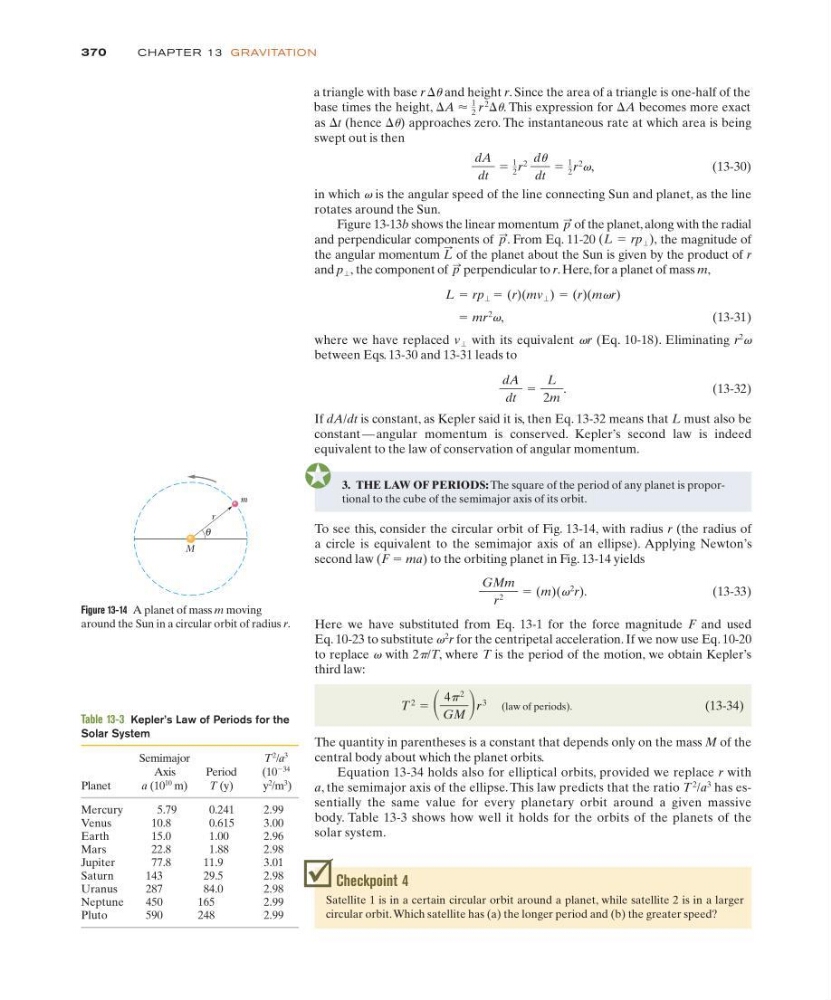
To see this, consider the circular orbit of Fig. 13-14, with radius r (the radius of
a circle is equivalent to the semimajor axis of an ellipse). Applying Newton’s
second law (F ϭ ma) to the orbiting planet in Fig. 13-14 yields
(13-33)
Here we have substituted from Eq. 13-1 for the force magnitude F and used
Eq. 10-23 to substitute v
2
r for the centripetal acceleration. If we now use Eq. 10-20
to replace v with 2p/T, where T is the period of the motion, we obtain Kepler’s
third law:
(law of periods).
(13-34)
The quantity in parentheses is a constant that depends only on the mass M of the
central body about which the planet orbits.
Equation 13-34 holds also for elliptical orbits, provided we replace r with
a, the semimajor axis of the ellipse. This law predicts that the ratio T
2
/a
3
has essentially the same value for every planetary orbit around a given massive
body. Table 13-3 shows how well it holds for the orbits of the planets of the
solar system.
T
2 ϭ
4p
2
GM r
3
GMm
r
2
ϭ (m)(v
2
r).
Figure 13-14 A planet of mass m moving
around the Sun in a circular orbit of radius r.
θ
M
r
m
as ⌬t (hence ⌬u) approaches zero. The instantaneous rate at which area is being
swept out is then
(13-30)
in which v is the angular speed of the line connecting Sun and planet, as the line
rotates around the Sun.
Figure 13-13b shows the linear momentum of the planet, along with the radial
and perpendicular components of . From Eq. 11-20
the magnitude of
the angular momentum of the planet about the Sun is given by the product of r
and
the component of perpendicular to r. Here, for a planet of mass m,
(13-31)
where we have replaced
with its equivalent vr (Eq. 10-18). Eliminating r
2
v
between Eqs. 13-30 and 13-31 leads to
(13-32)
If dA/dt is constant, as Kepler said it is, then Eq. 13-32 means that L must also be
constant — angular momentum is conserved. Kepler’s second law is indeed
equivalent to the law of conservation of angular momentum.
dA
dt
ϭ
L
2m
.
v Ќ
ϭ mr
2 v,
L ϭ rp Ќ ϭ (r)(mv Ќ ) ϭ (r)(mvr)
p
:
p Ќ ,
L
:
(L ϭ rp Ќ ),
p
:
p
:
dA
dt
ϭ
1
2 r
2
du
dt
ϭ
1
2 r
2
v,
CHAPTE R 13 GRAVITATION
Table 13-3 Kepler’s Law of Periods for the
Solar System
Semimajor
T
2
/a
3
Axis
Period
(10
Ϫ34
Planet
a (10
10
m)
T (y)
y
2
/m
3
)
Mercury
5.79
0.241
2.99
Venus
10.8
0.615
3.00
Earth
15.0
1.00
2.96
Mars
22.8
1.88
2.98
Jupiter
77.8
11.9
3.01
Saturn
143
29.5
2.98
Uranus
287
84.0
2.98
Neptune
450
165
2.99
Pluto
590
248
2.99
Checkpoint 4
Satellite 1 is in a certain circular orbit around a planet, while satellite 2 is in a larger
circular orbit. Which satellite has (a) the longer period and (b) the greater speed?
a triangle with base r ⌬u and height r. Since the area of a triangle is one-half of the
base times the height, ⌬A Ϸ r
2
⌬u. This expression for ⌬A becomes more exact
1
2
3. THE LAW OF PERIODS: The square of the period of any planet is proportional to the cube of the semimajor axis of its orbit.
To see this, consider the circular orbit of Fig. 13-14, with radius r (the radius of
a circle is equivalent to the semimajor axis of an ellipse). Applying Newton’s
second law (F ϭ ma) to the orbiting planet in Fig. 13-14 yields
(13-33)
Here we have substituted from Eq. 13-1 for the force magnitude F and used
Eq. 10-23 to substitute v
2
r for the centripetal acceleration. If we now use Eq. 10-20
to replace v with 2p/T, where T is the period of the motion, we obtain Kepler’s
third law:
(law of periods).
(13-34)
The quantity in parentheses is a constant that depends only on the mass M of the
central body about which the planet orbits.
Equation 13-34 holds also for elliptical orbits, provided we replace r with
a, the semimajor axis of the ellipse. This law predicts that the ratio T
2
/a
3
has essentially the same value for every planetary orbit around a given massive
body. Table 13-3 shows how well it holds for the orbits of the planets of the
solar system.
T
2 ϭ
4p
2
GM r
3
GMm
r
2
ϭ (m)(v
2
r).
Figure 13-14 A planet of mass m moving
around the Sun in a circular orbit of radius r.
θ
M
r
m
as ⌬t (hence ⌬u) approaches zero. The instantaneous rate at which area is being
swept out is then
(13-30)
in which v is the angular speed of the line connecting Sun and planet, as the line
rotates around the Sun.
Figure 13-13b shows the linear momentum of the planet, along with the radial
and perpendicular components of . From Eq. 11-20
the magnitude of
the angular momentum of the planet about the Sun is given by the product of r
and
the component of perpendicular to r. Here, for a planet of mass m,
(13-31)
where we have replaced
with its equivalent vr (Eq. 10-18). Eliminating r
2
v
between Eqs. 13-30 and 13-31 leads to
(13-32)
If dA/dt is constant, as Kepler said it is, then Eq. 13-32 means that L must also be
constant — angular momentum is conserved. Kepler’s second law is indeed
equivalent to the law of conservation of angular momentum.
dA
dt
ϭ
L
2m
.
v Ќ
ϭ mr
2 v,
L ϭ rp Ќ ϭ (r)(mv Ќ ) ϭ (r)(mvr)
p
:
p Ќ ,
L
:
(L ϭ rp Ќ ),
p
:
p
:
dA
dt
ϭ
1
2 r
2
du
dt
ϭ
1
2 r
2
v,