

366
CHAPTE R 13 GRAVITATION
180° for f and Eq. 13-1 for F(r), Eq. 13-24 becomes
where M is Earth’s mass and m is the mass of the ball.
Substituting this into Eq. 13-23 and integrating give us
(13-25)
where W is the work required to move the ball from point P (at distance R) to
infinity. Equation 8-1 (⌬U ϭ ϪW) tells us that we can also write that work in terms
of potential energies as
U ϱ Ϫ U ϭ ϪW.
Because the potential energy U ϱ at infinity is zero, U is the potential energy at P,
and W is given by Eq. 13-25, this equation becomes
Switching R to r gives us Eq. 13-21, which we set out to prove.
Path Independence
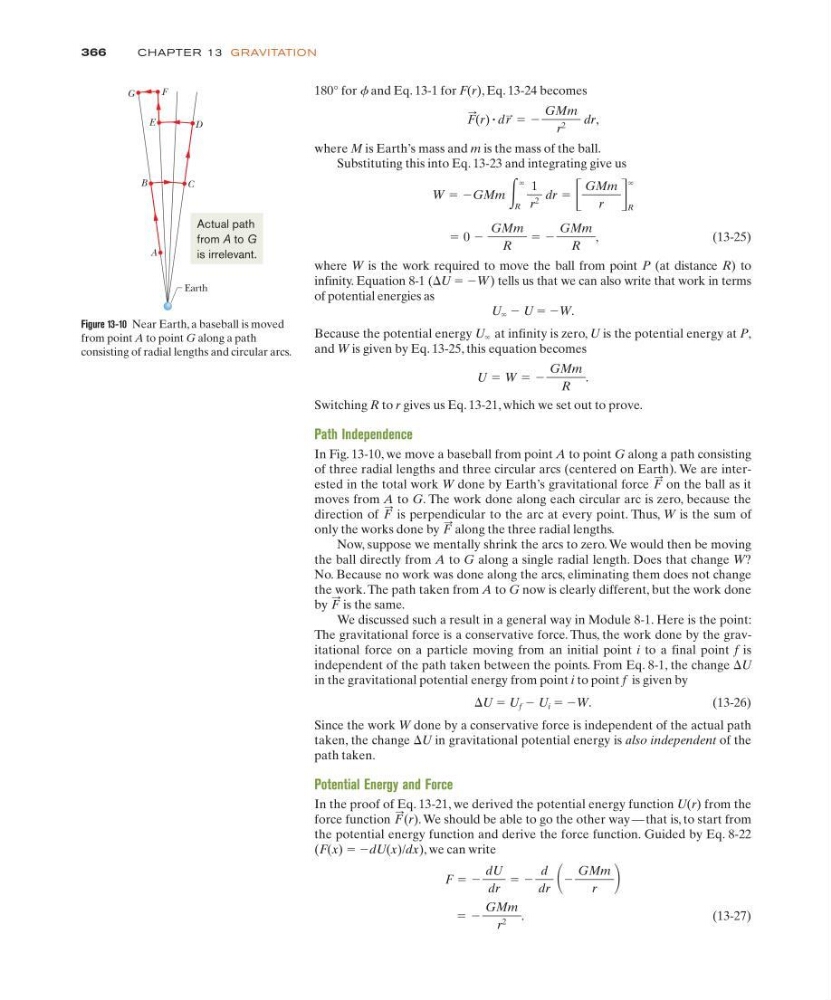
In Fig. 13-10, we move a baseball from point A to point G along a path consisting
of three radial lengths and three circular arcs (centered on Earth). We are interested in the total work W done by Earth’s gravitational force on the ball as it
moves from A to G. The work done along each circular arc is zero, because the
direction of is perpendicular to the arc at every point. Thus, W is the sum of
only the works done by along the three radial lengths.
Now, suppose we mentally shrink the arcs to zero. We would then be moving
the ball directly from A to G along a single radial length. Does that change W?
No. Because no work was done along the arcs, eliminating them does not change
the work. The path taken from A to G now is clearly different, but the work done
by is the same.
We discussed such a result in a general way in Module 8-1. Here is the point:
The gravitational force is a conservative force. Thus, the work done by the gravitational force on a particle moving from an initial point i to a final point f is
independent of the path taken between the points. From Eq. 8-1, the change ⌬U
in the gravitational potential energy from point i to point f is given by
⌬U ϭ U f Ϫ U i ϭ ϪW.
( 1 3 - 2 6 )
Since the work W done by a conservative force is independent of the actual path
taken, the change ⌬U in gravitational potential energy is also independent of the
path taken.
Potential Energy and Force
In the proof of Eq. 13-21, we derived the potential energy function U(r) from the
force function (r). We should be able to go the other way — that is, to start from
the potential energy function and derive the force function. Guided by Eq. 8-22
(F(x) ϭ ϪdU(x)/dx), we can write
(13-27)
ϭ Ϫ
GMm
r
2
.
F ϭ Ϫ
dU
dr
ϭ Ϫ
d
dr Ϫ
GMm
r
F
:
F
:
F
:
F
:
F
:
U ϭ W ϭ Ϫ
GMm
R
.
ϭ 0 Ϫ
GMm
R
ϭ Ϫ
GMm
R
,
W ϭ ϪGMm ͵
ϱ
R
1
r
2
dr ϭ ΄
GMm
r ΅
ϱ
R
F
:
(r) ؒ dr
: ϭ Ϫ
GMm
r
2
dr,
Figure 13-10 Near Earth, a baseball is moved
from point A to point G along a path
consisting of radial lengths and circular arcs.
F
E
G
D
A
C
B
Earth
Actual path
from A to G
is irrelevant.
CHAPTE R 13 GRAVITATION
180° for f and Eq. 13-1 for F(r), Eq. 13-24 becomes
where M is Earth’s mass and m is the mass of the ball.
Substituting this into Eq. 13-23 and integrating give us
(13-25)
where W is the work required to move the ball from point P (at distance R) to
infinity. Equation 8-1 (⌬U ϭ ϪW) tells us that we can also write that work in terms
of potential energies as
U ϱ Ϫ U ϭ ϪW.
Because the potential energy U ϱ at infinity is zero, U is the potential energy at P,
and W is given by Eq. 13-25, this equation becomes
Switching R to r gives us Eq. 13-21, which we set out to prove.
Path Independence
In Fig. 13-10, we move a baseball from point A to point G along a path consisting
of three radial lengths and three circular arcs (centered on Earth). We are interested in the total work W done by Earth’s gravitational force on the ball as it
moves from A to G. The work done along each circular arc is zero, because the
direction of is perpendicular to the arc at every point. Thus, W is the sum of
only the works done by along the three radial lengths.
Now, suppose we mentally shrink the arcs to zero. We would then be moving
the ball directly from A to G along a single radial length. Does that change W?
No. Because no work was done along the arcs, eliminating them does not change
the work. The path taken from A to G now is clearly different, but the work done
by is the same.
We discussed such a result in a general way in Module 8-1. Here is the point:
The gravitational force is a conservative force. Thus, the work done by the gravitational force on a particle moving from an initial point i to a final point f is
independent of the path taken between the points. From Eq. 8-1, the change ⌬U
in the gravitational potential energy from point i to point f is given by
⌬U ϭ U f Ϫ U i ϭ ϪW.
( 1 3 - 2 6 )
Since the work W done by a conservative force is independent of the actual path
taken, the change ⌬U in gravitational potential energy is also independent of the
path taken.
Potential Energy and Force
In the proof of Eq. 13-21, we derived the potential energy function U(r) from the
force function (r). We should be able to go the other way — that is, to start from
the potential energy function and derive the force function. Guided by Eq. 8-22
(F(x) ϭ ϪdU(x)/dx), we can write
(13-27)
ϭ Ϫ
GMm
r
2
.
F ϭ Ϫ
dU
dr
ϭ Ϫ
d
dr Ϫ
GMm
r
F
:
F
:
F
:
F
:
F
:
U ϭ W ϭ Ϫ
GMm
R
.
ϭ 0 Ϫ
GMm
R
ϭ Ϫ
GMm
R
,
W ϭ ϪGMm ͵
ϱ
R
1
r
2
dr ϭ ΄
GMm
r ΅
ϱ
R
F
:
(r) ؒ dr
: ϭ Ϫ
GMm
r
2
dr,
Figure 13-10 Near Earth, a baseball is moved
from point A to point G along a path
consisting of radial lengths and circular arcs.
F
E
G
D
A
C
B
Earth
Actual path
from A to G
is irrelevant.