

363
13-4 GRAVITATION INSIDE EARTH
Gravitation Inside Earth
Newton’s shell theorem can also be applied to a situation in which a particle is
located inside a uniform shell, to show the following:
A uniform shell of matter exerts no net gravitational force on a particle located
inside it.
Caution: This statement does not mean that the gravitational forces on the particle from the various elements of the shell magically disappear. Rather, it
means that the sum of the force vectors on the particle from all the elements
is zero.
If Earth’s mass were uniformly distributed, the gravitational force acting
on a particle would be a maximum at Earth’s surface and would decrease as
the particle moved outward, away from the planet. If the particle were to move
inward, perhaps down a deep mine shaft, the gravitational force would change
for two reasons. (1) It would tend to increase because the particle would
be moving closer to the center of Earth. (2) It would tend to decrease because
the thickening shell of material lying outside the particle’s radial position
would not exert any net force on the particle.
To find an expression for the gravitational force inside a uniform Earth, let’s
use the plot in Pole to Pole, an early science fiction story by George Griffith.Three
explorers attempt to travel by capsule through a naturally formed (and, of course,
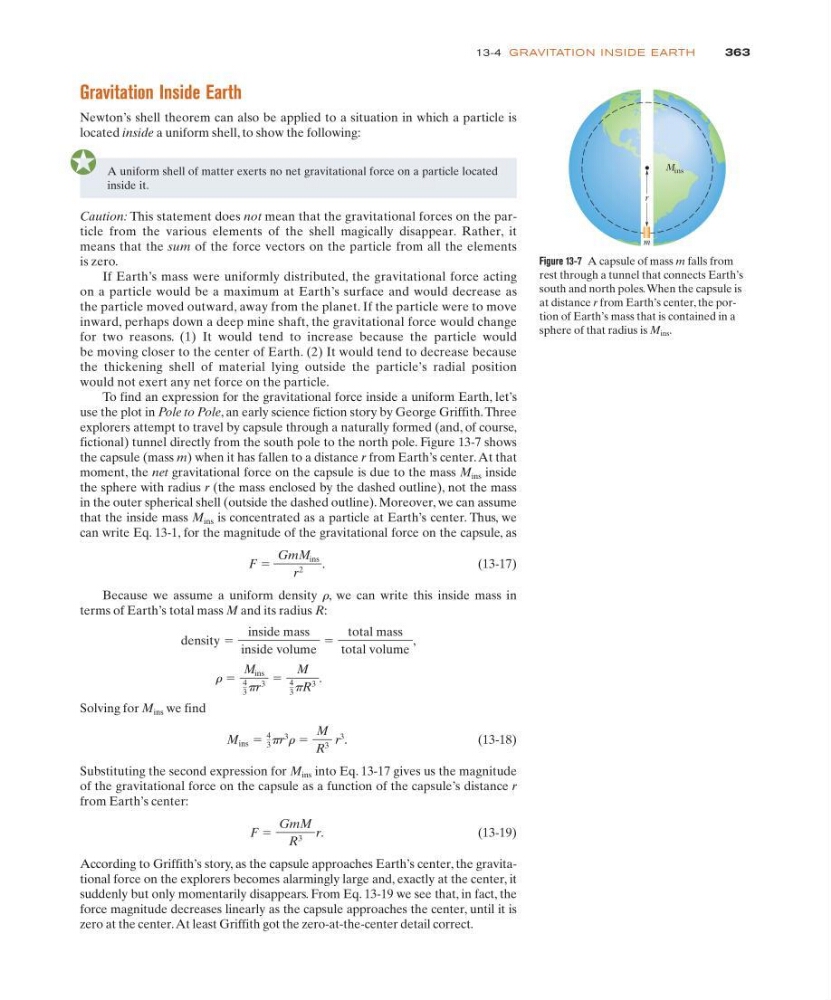
fictional) tunnel directly from the south pole to the north pole. Figure 13-7 shows
the capsule (mass m) when it has fallen to a distance r from Earth’s center. At that
moment, the net gravitational force on the capsule is due to the mass M ins inside
the sphere with radius r (the mass enclosed by the dashed outline), not the mass
in the outer spherical shell (outside the dashed outline). Moreover, we can assume
that the inside mass M ins is concentrated as a particle at Earth’s center. Thus, we
can write Eq. 13-1, for the magnitude of the gravitational force on the capsule, as
(13-17)
Because we assume a uniform density r, we can write this inside mass in
terms of Earth’s total mass M and its radius R:
Solving for M ins we find
(13-18)
Substituting the second expression for M ins into Eq. 13-17 gives us the magnitude
of the gravitational force on the capsule as a function of the capsule’s distance r
from Earth’s center:
(13-19)
According to Griffith’s story, as the capsule approaches Earth’s center, the gravitational force on the explorers becomes alarmingly large and, exactly at the center, it
suddenly but only momentarily disappears. From Eq. 13-19 we see that, in fact, the
force magnitude decreases linearly as the capsule approaches the center, until it is
zero at the center.At least Griffith got the zero-at-the-center detail correct.
F ϭ
GmM
R
3
r.
M ins ϭ
4
3 pr
3 r ϭ
M
R
3
r
3
.
r ϭ
M ins
4
3 pr
3
ϭ
M
4
3 pR
3
.
density ϭ
inside mass
inside volume
ϭ
total mass
total volume
,
F ϭ
GmM ins
r
2
.
m
r
M ins
Figure 13-7 A capsule of mass m falls from
rest through a tunnel that connects Earth’s
south and north poles.When the capsule is
at distance r from Earth’s center, the portion of Earth’s mass that is contained in a
sphere of that radius is M ins .
13-4 GRAVITATION INSIDE EARTH
Gravitation Inside Earth
Newton’s shell theorem can also be applied to a situation in which a particle is
located inside a uniform shell, to show the following:
A uniform shell of matter exerts no net gravitational force on a particle located
inside it.
Caution: This statement does not mean that the gravitational forces on the particle from the various elements of the shell magically disappear. Rather, it
means that the sum of the force vectors on the particle from all the elements
is zero.
If Earth’s mass were uniformly distributed, the gravitational force acting
on a particle would be a maximum at Earth’s surface and would decrease as
the particle moved outward, away from the planet. If the particle were to move
inward, perhaps down a deep mine shaft, the gravitational force would change
for two reasons. (1) It would tend to increase because the particle would
be moving closer to the center of Earth. (2) It would tend to decrease because
the thickening shell of material lying outside the particle’s radial position
would not exert any net force on the particle.
To find an expression for the gravitational force inside a uniform Earth, let’s
use the plot in Pole to Pole, an early science fiction story by George Griffith.Three
explorers attempt to travel by capsule through a naturally formed (and, of course,
fictional) tunnel directly from the south pole to the north pole. Figure 13-7 shows
the capsule (mass m) when it has fallen to a distance r from Earth’s center. At that
moment, the net gravitational force on the capsule is due to the mass M ins inside
the sphere with radius r (the mass enclosed by the dashed outline), not the mass
in the outer spherical shell (outside the dashed outline). Moreover, we can assume
that the inside mass M ins is concentrated as a particle at Earth’s center. Thus, we
can write Eq. 13-1, for the magnitude of the gravitational force on the capsule, as
(13-17)
Because we assume a uniform density r, we can write this inside mass in
terms of Earth’s total mass M and its radius R:
Solving for M ins we find
(13-18)
Substituting the second expression for M ins into Eq. 13-17 gives us the magnitude
of the gravitational force on the capsule as a function of the capsule’s distance r
from Earth’s center:
(13-19)
According to Griffith’s story, as the capsule approaches Earth’s center, the gravitational force on the explorers becomes alarmingly large and, exactly at the center, it
suddenly but only momentarily disappears. From Eq. 13-19 we see that, in fact, the
force magnitude decreases linearly as the capsule approaches the center, until it is
zero at the center.At least Griffith got the zero-at-the-center detail correct.
F ϭ
GmM
R
3
r.
M ins ϭ
4
3 pr
3 r ϭ
M
R
3
r
3
.
r ϭ
M ins
4
3 pr
3
ϭ
M
4
3 pR
3
.
density ϭ
inside mass
inside volume
ϭ
total mass
total volume
,
F ϭ
GmM ins
r
2
.
m
r
M ins
Figure 13-7 A capsule of mass m falls from
rest through a tunnel that connects Earth’s
south and north poles.When the capsule is
at distance r from Earth’s center, the portion of Earth’s mass that is contained in a
sphere of that radius is M ins .