

361
13-3 GRAVITATION NEAR EARTH’S SURFACE
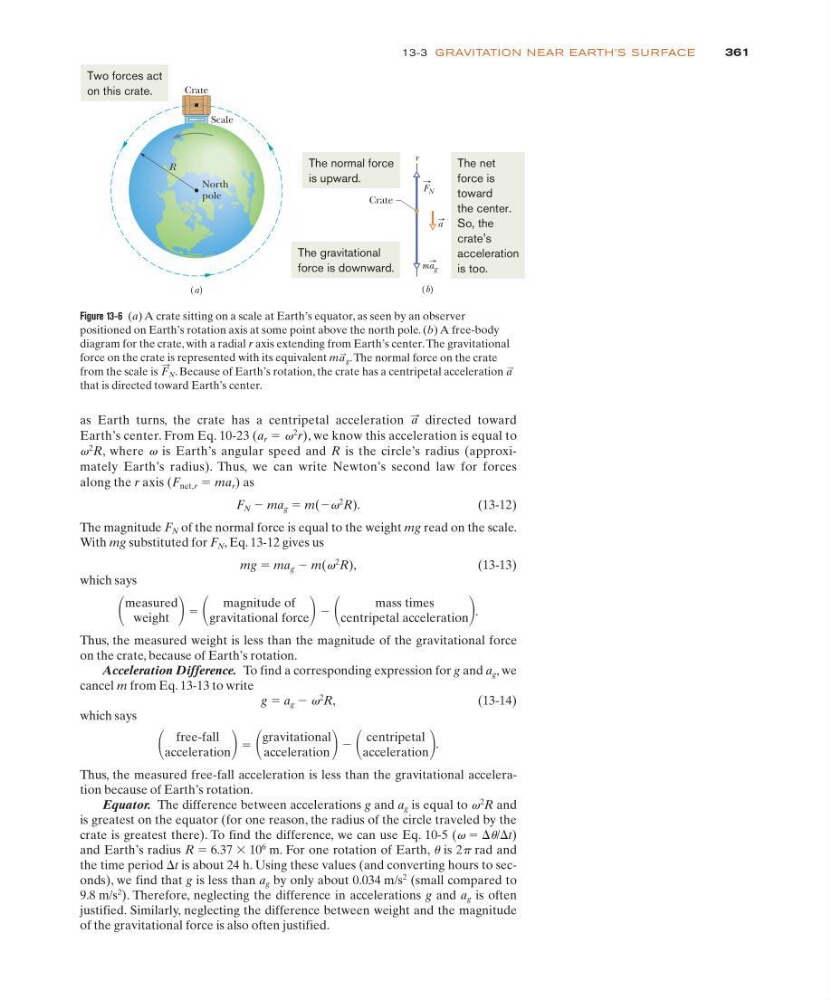
as Earth turns, the crate has a centripetal acceleration
directed toward
Earth’s center. From Eq. 10-23 (a r ϭ v
2
r), we know this acceleration is equal to
v
2
R, where v is Earth’s angular speed and R is the circle’s radius (approximately Earth’s radius). Thus, we can write Newton’s second law for forces
along the r axis (F net,r ϭ ma r ) as
F N Ϫ ma g ϭ m(Ϫv
2
R).
(13-12)
The magnitude F N of the normal force is equal to the weight mg read on the scale.
With mg substituted for F N , Eq. 13-12 gives us
mg ϭ ma g Ϫ m(v
2
R),
(13-13)
which says
Thus, the measured weight is less than the magnitude of the gravitational force
on the crate, because of Earth’s rotation.
Acceleration Difference. To find a corresponding expression for g and a g , we
cancel m from Eq. 13-13 to write
g ϭ a g Ϫ v
2
R,
( 1 3 - 1 4 )
which says
Thus, the measured free-fall acceleration is less than the gravitational acceleration because of Earth’s rotation.
Equator. The difference between accelerations g and a g is equal to v
2
R and
is greatest on the equator (for one reason, the radius of the circle traveled by the
crate is greatest there). To find the difference, we can use Eq. 10-5 (v ϭ ⌬u/⌬t)
and Earth’s radius R ϭ 6.37 ϫ 10
6
m. For one rotation of Earth, u is 2p rad and
the time period ⌬t is about 24 h. Using these values (and converting hours to seconds), we find that g is less than a g by only about 0.034 m/s
2
(small compared to
9.8 m/s
2
). Therefore, neglecting the difference in accelerations g and a g is often
justified. Similarly, neglecting the difference between weight and the magnitude
of the gravitational force is also often justified.
free-fall
acceleration ϭ
gravitational
acceleration Ϫ
centripetal
acceleration .
measured
weight ϭ
magnitude of
gravitational force Ϫ
mass times
centripetal acceleration .
a
:
Figure 13-6 (a) A crate sitting on a scale at Earth’s equator, as seen by an observer
positioned on Earth’s rotation axis at some point above the north pole. (b) A free-body
diagram for the crate, with a radial r axis extending from Earth’s center. The gravitational
force on the crate is represented with its equivalent m g .The normal force on the crate
from the scale is . Because of Earth’s rotation, the crate has a centripetal acceleration
that is directed toward Earth’s center.
a
:
F
:
N
a
:
North
pole
R
Scale
Crate
(a)
Two forces act
on this crate.
ma g
r
(b)
Crate
a
F N
The normal force
is upward.
The gravitational
force is downward.
The net
force is
toward
the center.
So, the
crate's
acceleration
is too.
13-3 GRAVITATION NEAR EARTH’S SURFACE
as Earth turns, the crate has a centripetal acceleration
directed toward
Earth’s center. From Eq. 10-23 (a r ϭ v
2
r), we know this acceleration is equal to
v
2
R, where v is Earth’s angular speed and R is the circle’s radius (approximately Earth’s radius). Thus, we can write Newton’s second law for forces
along the r axis (F net,r ϭ ma r ) as
F N Ϫ ma g ϭ m(Ϫv
2
R).
(13-12)
The magnitude F N of the normal force is equal to the weight mg read on the scale.
With mg substituted for F N , Eq. 13-12 gives us
mg ϭ ma g Ϫ m(v
2
R),
(13-13)
which says
Thus, the measured weight is less than the magnitude of the gravitational force
on the crate, because of Earth’s rotation.
Acceleration Difference. To find a corresponding expression for g and a g , we
cancel m from Eq. 13-13 to write
g ϭ a g Ϫ v
2
R,
( 1 3 - 1 4 )
which says
Thus, the measured free-fall acceleration is less than the gravitational acceleration because of Earth’s rotation.
Equator. The difference between accelerations g and a g is equal to v
2
R and
is greatest on the equator (for one reason, the radius of the circle traveled by the
crate is greatest there). To find the difference, we can use Eq. 10-5 (v ϭ ⌬u/⌬t)
and Earth’s radius R ϭ 6.37 ϫ 10
6
m. For one rotation of Earth, u is 2p rad and
the time period ⌬t is about 24 h. Using these values (and converting hours to seconds), we find that g is less than a g by only about 0.034 m/s
2
(small compared to
9.8 m/s
2
). Therefore, neglecting the difference in accelerations g and a g is often
justified. Similarly, neglecting the difference between weight and the magnitude
of the gravitational force is also often justified.
free-fall
acceleration ϭ
gravitational
acceleration Ϫ
centripetal
acceleration .
measured
weight ϭ
magnitude of
gravitational force Ϫ
mass times
centripetal acceleration .
a
:
Figure 13-6 (a) A crate sitting on a scale at Earth’s equator, as seen by an observer
positioned on Earth’s rotation axis at some point above the north pole. (b) A free-body
diagram for the crate, with a radial r axis extending from Earth’s center. The gravitational
force on the crate is represented with its equivalent m g .The normal force on the crate
from the scale is . Because of Earth’s rotation, the crate has a centripetal acceleration
that is directed toward Earth’s center.
a
:
F
:
N
a
:
North
pole
R
Scale
Crate
(a)
Two forces act
on this crate.
ma g
r
(b)
Crate
a
F N
The normal force
is upward.
The gravitational
force is downward.
The net
force is
toward
the center.
So, the
crate's
acceleration
is too.