

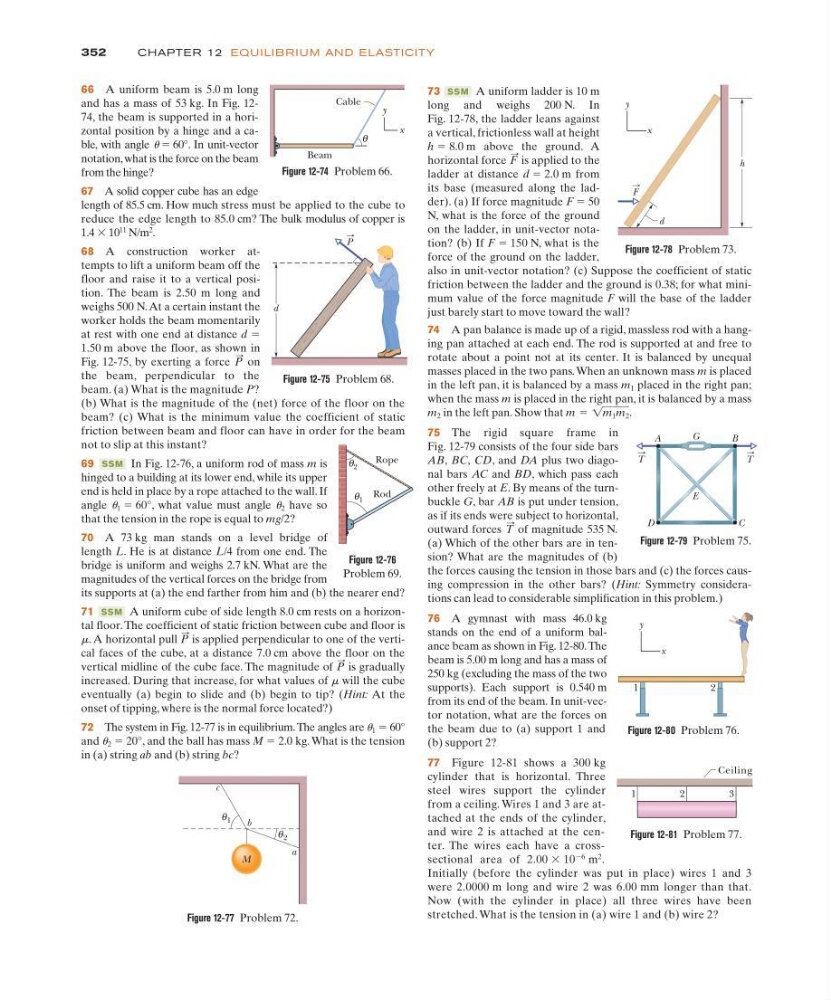
66 A uniform beam is 5.0 m long
and has a mass of 53 kg. In Fig. 1274, the beam is supported in a horizontal position by a hinge and a cable, with angle u ϭ 60°. In unit-vector
notation, what is the force on the beam
from the hinge?
67 A solid copper cube has an edge
length of 85.5 cm. How much stress must be applied to the cube to
reduce the edge length to 85.0 cm? The bulk modulus of copper is
1.4 ϫ 10
11
N/m
2
.
68 A construction worker attempts to lift a uniform beam off the
floor and raise it to a vertical position. The beam is 2.50 m long and
weighs 500 N. At a certain instant the
worker holds the beam momentarily
at rest with one end at distance d ϭ
1.50 m above the floor, as shown in
Fig. 12-75, by exerting a force
on
the beam, perpendicular to the
beam. (a) What is the magnitude P?
(b) What is the magnitude of the (net) force of the floor on the
beam? (c) What is the minimum value the coefficient of static
friction between beam and floor can have in order for the beam
not to slip at this instant?
69
In Fig. 12-76, a uniform rod of mass m is
hinged to a building at its lower end, while its upper
end is held in place by a rope attached to the wall. If
angle u 1 ϭ 60°, what value must angle u 2 have so
that the tension in the rope is equal to mg/2?
70 A 73 kg man stands on a level bridge of
length L. He is at distance L/4 from one end. The
bridge is uniform and weighs 2.7 kN. What are the
magnitudes of the vertical forces on the bridge from
its supports at (a) the end farther from him and (b) the nearer end?
71
A uniform cube of side length 8.0 cm rests on a horizontal floor. The coefficient of static friction between cube and floor is
m. A horizontal pull is applied perpendicular to one of the vertical faces of the cube, at a distance 7.0 cm above the floor on the
vertical midline of the cube face. The magnitude of is gradually
increased. During that increase, for what values of m will the cube
eventually (a) begin to slide and (b) begin to tip? (Hint: At the
onset of tipping, where is the normal force located?)
72 The system in Fig. 12-77 is in equilibrium. The angles are u 1 ϭ 60°
and u 2 ϭ 20°, and the ball has mass M ϭ 2.0 kg. What is the tension
in (a) string ab and (b) string bc?
P
:
P
:
SSM
SSM
P
:
352
CHAPTE R 12 EQU I LI B R I U M AN D E L ASTICITY
73
A uniform ladder is 10 m
long and weighs 200 N. In
Fig. 12-78, the ladder leans against
a vertical, frictionless wall at height
h ϭ 8.0 m above the ground. A
horizontal force is applied to the
ladder at distance d ϭ 2.0 m from
its base (measured along the ladder). (a) If force magnitude F ϭ 50
N, what is the force of the ground
on the ladder, in unit-vector notation? (b) If F ϭ 150 N, what is the
force of the ground on the ladder,
also in unit-vector notation? (c) Suppose the coefficient of static
friction between the ladder and the ground is 0.38; for what minimum value of the force magnitude F will the base of the ladder
just barely start to move toward the wall?
74 A pan balance is made up of a rigid, massless rod with a hanging pan attached at each end. The rod is supported at and free to
rotate about a point not at its center. It is balanced by unequal
masses placed in the two pans. When an unknown mass m is placed
in the left pan, it is balanced by a mass m 1 placed in the right pan;
when the mass m is placed in the right pan, it is balanced by a mass
m 2 in the left pan. Show that
75 The rigid square frame in
Fig. 12-79 consists of the four side bars
AB, BC, CD, and DA plus two diagonal bars AC and BD, which pass each
other freely at E. By means of the turnbuckle G, bar AB is put under tension,
as if its ends were subject to horizontal,
outward forces of magnitude 535 N.
(a) Which of the other bars are in tension? What are the magnitudes of (b)
the forces causing the tension in those bars and (c) the forces causing compression in the other bars? (Hint: Symmetry considerations can lead to considerable simplification in this problem.)
76 A gymnast with mass 46.0 kg
stands on the end of a uniform balance beam as shown in Fig. 12-80. The
beam is 5.00 m long and has a mass of
250 kg (excluding the mass of the two
supports). Each support is 0.540 m
from its end of the beam. In unit-vector notation, what are the forces on
the beam due to (a) support 1 and
(b) support 2?
77 Figure 12-81 shows a 300 kg
cylinder that is horizontal. Three
steel wires support the cylinder
from a ceiling. Wires 1 and 3 are attached at the ends of the cylinder,
and wire 2 is attached at the center. The wires each have a crosssectional area of 2.00 ϫ 10
Ϫ6
m
2
.
Initially (before the cylinder was put in place) wires 1 and 3
were 2.0000 m long and wire 2 was 6.00 mm longer than that.
Now (with the cylinder in place) all three wires have been
stretched. What is the tension in (a) wire 1 and (b) wire 2?
T
:
m ϭ 1m 1 m 2 .
F
:
SSM
θ
Cable
Beam
y
x
Figure 12-74 Problem 66.
d
P
Figure 12-75 Problem 68.
Figure 12-76
Problem 69.
Rod
Rope
1
θ
2
θ
θ
c
a
b
2
θ 1
M
Figure 12-77 Problem 72.
x
y
h
d
F
Figure 12-78 Problem 73.
T
T
G
A
B
D
C
E
Figure 12-79 Problem 75.
x
y
1
2
Figure 12-80 Problem 76.
1
2
3
Ceiling
Figure 12-81 Problem 77.
and has a mass of 53 kg. In Fig. 1274, the beam is supported in a horizontal position by a hinge and a cable, with angle u ϭ 60°. In unit-vector
notation, what is the force on the beam
from the hinge?
67 A solid copper cube has an edge
length of 85.5 cm. How much stress must be applied to the cube to
reduce the edge length to 85.0 cm? The bulk modulus of copper is
1.4 ϫ 10
11
N/m
2
.
68 A construction worker attempts to lift a uniform beam off the
floor and raise it to a vertical position. The beam is 2.50 m long and
weighs 500 N. At a certain instant the
worker holds the beam momentarily
at rest with one end at distance d ϭ
1.50 m above the floor, as shown in
Fig. 12-75, by exerting a force
on
the beam, perpendicular to the
beam. (a) What is the magnitude P?
(b) What is the magnitude of the (net) force of the floor on the
beam? (c) What is the minimum value the coefficient of static
friction between beam and floor can have in order for the beam
not to slip at this instant?
69
In Fig. 12-76, a uniform rod of mass m is
hinged to a building at its lower end, while its upper
end is held in place by a rope attached to the wall. If
angle u 1 ϭ 60°, what value must angle u 2 have so
that the tension in the rope is equal to mg/2?
70 A 73 kg man stands on a level bridge of
length L. He is at distance L/4 from one end. The
bridge is uniform and weighs 2.7 kN. What are the
magnitudes of the vertical forces on the bridge from
its supports at (a) the end farther from him and (b) the nearer end?
71
A uniform cube of side length 8.0 cm rests on a horizontal floor. The coefficient of static friction between cube and floor is
m. A horizontal pull is applied perpendicular to one of the vertical faces of the cube, at a distance 7.0 cm above the floor on the
vertical midline of the cube face. The magnitude of is gradually
increased. During that increase, for what values of m will the cube
eventually (a) begin to slide and (b) begin to tip? (Hint: At the
onset of tipping, where is the normal force located?)
72 The system in Fig. 12-77 is in equilibrium. The angles are u 1 ϭ 60°
and u 2 ϭ 20°, and the ball has mass M ϭ 2.0 kg. What is the tension
in (a) string ab and (b) string bc?
P
:
P
:
SSM
SSM
P
:
352
CHAPTE R 12 EQU I LI B R I U M AN D E L ASTICITY
73
A uniform ladder is 10 m
long and weighs 200 N. In
Fig. 12-78, the ladder leans against
a vertical, frictionless wall at height
h ϭ 8.0 m above the ground. A
horizontal force is applied to the
ladder at distance d ϭ 2.0 m from
its base (measured along the ladder). (a) If force magnitude F ϭ 50
N, what is the force of the ground
on the ladder, in unit-vector notation? (b) If F ϭ 150 N, what is the
force of the ground on the ladder,
also in unit-vector notation? (c) Suppose the coefficient of static
friction between the ladder and the ground is 0.38; for what minimum value of the force magnitude F will the base of the ladder
just barely start to move toward the wall?
74 A pan balance is made up of a rigid, massless rod with a hanging pan attached at each end. The rod is supported at and free to
rotate about a point not at its center. It is balanced by unequal
masses placed in the two pans. When an unknown mass m is placed
in the left pan, it is balanced by a mass m 1 placed in the right pan;
when the mass m is placed in the right pan, it is balanced by a mass
m 2 in the left pan. Show that
75 The rigid square frame in
Fig. 12-79 consists of the four side bars
AB, BC, CD, and DA plus two diagonal bars AC and BD, which pass each
other freely at E. By means of the turnbuckle G, bar AB is put under tension,
as if its ends were subject to horizontal,
outward forces of magnitude 535 N.
(a) Which of the other bars are in tension? What are the magnitudes of (b)
the forces causing the tension in those bars and (c) the forces causing compression in the other bars? (Hint: Symmetry considerations can lead to considerable simplification in this problem.)
76 A gymnast with mass 46.0 kg
stands on the end of a uniform balance beam as shown in Fig. 12-80. The
beam is 5.00 m long and has a mass of
250 kg (excluding the mass of the two
supports). Each support is 0.540 m
from its end of the beam. In unit-vector notation, what are the forces on
the beam due to (a) support 1 and
(b) support 2?
77 Figure 12-81 shows a 300 kg
cylinder that is horizontal. Three
steel wires support the cylinder
from a ceiling. Wires 1 and 3 are attached at the ends of the cylinder,
and wire 2 is attached at the center. The wires each have a crosssectional area of 2.00 ϫ 10
Ϫ6
m
2
.
Initially (before the cylinder was put in place) wires 1 and 3
were 2.0000 m long and wire 2 was 6.00 mm longer than that.
Now (with the cylinder in place) all three wires have been
stretched. What is the tension in (a) wire 1 and (b) wire 2?
T
:
m ϭ 1m 1 m 2 .
F
:
SSM
θ
Cable
Beam
y
x
Figure 12-74 Problem 66.
d
P
Figure 12-75 Problem 68.
Figure 12-76
Problem 69.
Rod
Rope
1
θ
2
θ
θ
c
a
b
2
θ 1
M
Figure 12-77 Problem 72.
x
y
h
d
F
Figure 12-78 Problem 73.
T
T
G
A
B
D
C
E
Figure 12-79 Problem 75.
x
y
1
2
Figure 12-80 Problem 76.
1
2
3
Ceiling
Figure 12-81 Problem 77.