

••22
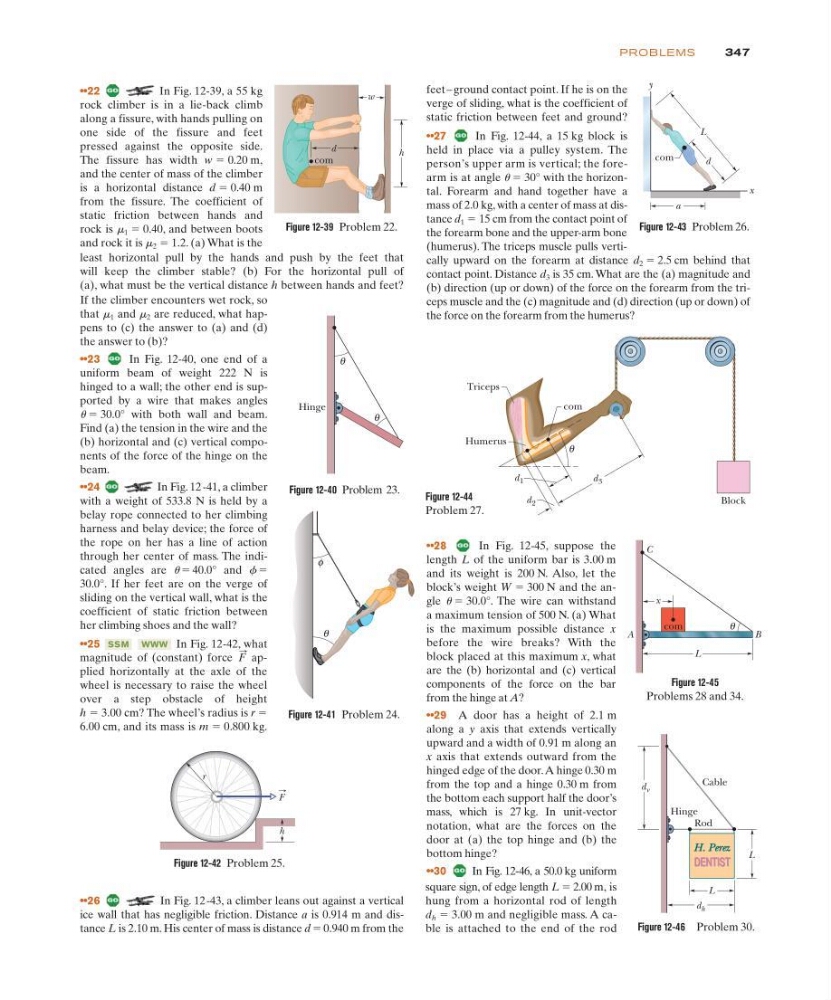
In Fig. 12-39, a 55 kg
rock climber is in a lie-back climb
along a fissure, with hands pulling on
one side of the fissure and feet
pressed against the opposite side.
The fissure has width w ϭ 0.20 m,
and the center of mass of the climber
is a horizontal distance d ϭ 0.40 m
from the fissure. The coefficient of
static friction between hands and
rock is m 1 ϭ 0.40, and between boots
and rock it is m 2 ϭ 1.2. (a) What is the
347
PROB LE M S
feet – ground contact point. If he is on the
verge of sliding, what is the coefficient of
static friction between feet and ground?
••27
In Fig. 12-44, a 15 kg block is
held in place via a pulley system. The
person’s upper arm is vertical; the forearm is at angle u ϭ 30° with the horizontal. Forearm and hand together have a
mass of 2.0 kg, with a center of mass at distance d 1 ϭ 15 cm from the contact point of
the forearm bone and the upper-arm bone
(humerus). The triceps muscle pulls vertically upward on the forearm at distance d 2 ϭ 2.5 cm behind that
contact point. Distance d 3 is 35 cm. What are the (a) magnitude and
(b) direction (up or down) of the force on the forearm from the triceps muscle and the (c) magnitude and (d) direction (up or down) of
the force on the forearm from the humerus?
h
w
com
d
Figure 12-39 Problem 22.
Figure 12-40 Problem 23.
θ
θ
Hinge
θ
φ
Figure 12-41 Problem 24.
If the climber encounters wet rock, so
that m 1 and m 2 are reduced, what happens to (c) the answer to (a) and (d)
the answer to (b)?
••23
In Fig. 12-40, one end of a
uniform beam of weight 222 N is
hinged to a wall; the other end is supported by a wire that makes angles
u ϭ 30.0° with both wall and beam.
Find (a) the tension in the wire and the
(b) horizontal and (c) vertical components of the force of the hinge on the
beam.
••24
In Fig. 12 -41, a climber
with a weight of 533.8 N is held by a
belay rope connected to her climbing
harness and belay device; the force of
the rope on her has a line of action
through her center of mass. The indicated angles are u ϭ 40.0° and f ϭ
30.0°. If her feet are on the verge of
sliding on the vertical wall, what is the
coefficient of static friction between
her climbing shoes and the wall?
••25
In Fig. 12-42, what
WWW
SSM
h
r
F
Figure 12-42 Problem 25.
x
y
a
d
com
L
Figure 12-43 Problem 26.
Block
com
Humerus
θ
d 3
d 1
d 2
Triceps
Figure 12-44
Problem 27.
••28
In Fig. 12-45, suppose the
length L of the uniform bar is 3.00 m
and its weight is 200 N. Also, let the
block’s weight W ϭ 300 N and the angle u ϭ 30.0°. The wire can withstand
a maximum tension of 500 N. (a) What
is the maximum possible distance x
before the wire breaks? With the
block placed at this maximum x, what
are the (b) horizontal and (c) vertical
components of the force on the bar
from the hinge at A?
••29 A door has a height of 2.1 m
along a y axis that extends vertically
upward and a width of 0.91 m along an
x axis that extends outward from the
hinged edge of the door.A hinge 0.30 m
from the top and a hinge 0.30 m from
the bottom each support half the door’s
mass, which is 27 kg. In unit-vector
notation, what are the forces on the
com
L
x
C
B
θ
A
Figure 12-45
Problems 28 and 34.
door at (a) the top hinge and (b) the
bottom hinge?
••30
In Fig. 12-46, a 50.0 kg uniform
least horizontal pull by the hands and push by the feet that
will keep the climber stable? (b) For the horizontal pull of
(a), what must be the vertical distance h between hands and feet?
••26
In Fig. 12 -43, a climber leans out against a vertical
ice wall that has negligible friction. Distance a is 0.914 m and distance L is 2.10 m. His center of mass is distance d ϭ 0.940 m from the
d v
Cable
Hinge
Rod
L
d h
L
Figure 12-46 Problem 30.
square sign, of edge length L ϭ 2.00 m, is
hung from a horizontal rod of length
d h ϭ 3.00 m and negligible mass. A cable is attached to the end of the rod
magnitude of (constant) force
applied horizontally at the axle of the
wheel is necessary to raise the wheel
over a step obstacle of height
h ϭ 3.00 cm? The wheel’s radius is r ϭ
6.00 cm, and its mass is m ϭ 0.800 kg.
F
:
In Fig. 12-39, a 55 kg
rock climber is in a lie-back climb
along a fissure, with hands pulling on
one side of the fissure and feet
pressed against the opposite side.
The fissure has width w ϭ 0.20 m,
and the center of mass of the climber
is a horizontal distance d ϭ 0.40 m
from the fissure. The coefficient of
static friction between hands and
rock is m 1 ϭ 0.40, and between boots
and rock it is m 2 ϭ 1.2. (a) What is the
347
PROB LE M S
feet – ground contact point. If he is on the
verge of sliding, what is the coefficient of
static friction between feet and ground?
••27
In Fig. 12-44, a 15 kg block is
held in place via a pulley system. The
person’s upper arm is vertical; the forearm is at angle u ϭ 30° with the horizontal. Forearm and hand together have a
mass of 2.0 kg, with a center of mass at distance d 1 ϭ 15 cm from the contact point of
the forearm bone and the upper-arm bone
(humerus). The triceps muscle pulls vertically upward on the forearm at distance d 2 ϭ 2.5 cm behind that
contact point. Distance d 3 is 35 cm. What are the (a) magnitude and
(b) direction (up or down) of the force on the forearm from the triceps muscle and the (c) magnitude and (d) direction (up or down) of
the force on the forearm from the humerus?
h
w
com
d
Figure 12-39 Problem 22.
Figure 12-40 Problem 23.
θ
θ
Hinge
θ
φ
Figure 12-41 Problem 24.
If the climber encounters wet rock, so
that m 1 and m 2 are reduced, what happens to (c) the answer to (a) and (d)
the answer to (b)?
••23
In Fig. 12-40, one end of a
uniform beam of weight 222 N is
hinged to a wall; the other end is supported by a wire that makes angles
u ϭ 30.0° with both wall and beam.
Find (a) the tension in the wire and the
(b) horizontal and (c) vertical components of the force of the hinge on the
beam.
••24
In Fig. 12 -41, a climber
with a weight of 533.8 N is held by a
belay rope connected to her climbing
harness and belay device; the force of
the rope on her has a line of action
through her center of mass. The indicated angles are u ϭ 40.0° and f ϭ
30.0°. If her feet are on the verge of
sliding on the vertical wall, what is the
coefficient of static friction between
her climbing shoes and the wall?
••25
In Fig. 12-42, what
WWW
SSM
h
r
F
Figure 12-42 Problem 25.
x
y
a
d
com
L
Figure 12-43 Problem 26.
Block
com
Humerus
θ
d 3
d 1
d 2
Triceps
Figure 12-44
Problem 27.
••28
In Fig. 12-45, suppose the
length L of the uniform bar is 3.00 m
and its weight is 200 N. Also, let the
block’s weight W ϭ 300 N and the angle u ϭ 30.0°. The wire can withstand
a maximum tension of 500 N. (a) What
is the maximum possible distance x
before the wire breaks? With the
block placed at this maximum x, what
are the (b) horizontal and (c) vertical
components of the force on the bar
from the hinge at A?
••29 A door has a height of 2.1 m
along a y axis that extends vertically
upward and a width of 0.91 m along an
x axis that extends outward from the
hinged edge of the door.A hinge 0.30 m
from the top and a hinge 0.30 m from
the bottom each support half the door’s
mass, which is 27 kg. In unit-vector
notation, what are the forces on the
com
L
x
C
B
θ
A
Figure 12-45
Problems 28 and 34.
door at (a) the top hinge and (b) the
bottom hinge?
••30
In Fig. 12-46, a 50.0 kg uniform
least horizontal pull by the hands and push by the feet that
will keep the climber stable? (b) For the horizontal pull of
(a), what must be the vertical distance h between hands and feet?
••26
In Fig. 12 -43, a climber leans out against a vertical
ice wall that has negligible friction. Distance a is 0.914 m and distance L is 2.10 m. His center of mass is distance d ϭ 0.940 m from the
d v
Cable
Hinge
Rod
L
d h
L
Figure 12-46 Problem 30.
square sign, of edge length L ϭ 2.00 m, is
hung from a horizontal rod of length
d h ϭ 3.00 m and negligible mass. A cable is attached to the end of the rod
magnitude of (constant) force
applied horizontally at the axle of the
wheel is necessary to raise the wheel
over a step obstacle of height
h ϭ 3.00 cm? The wheel’s radius is r ϭ
6.00 cm, and its mass is m ϭ 0.800 kg.
F
: