

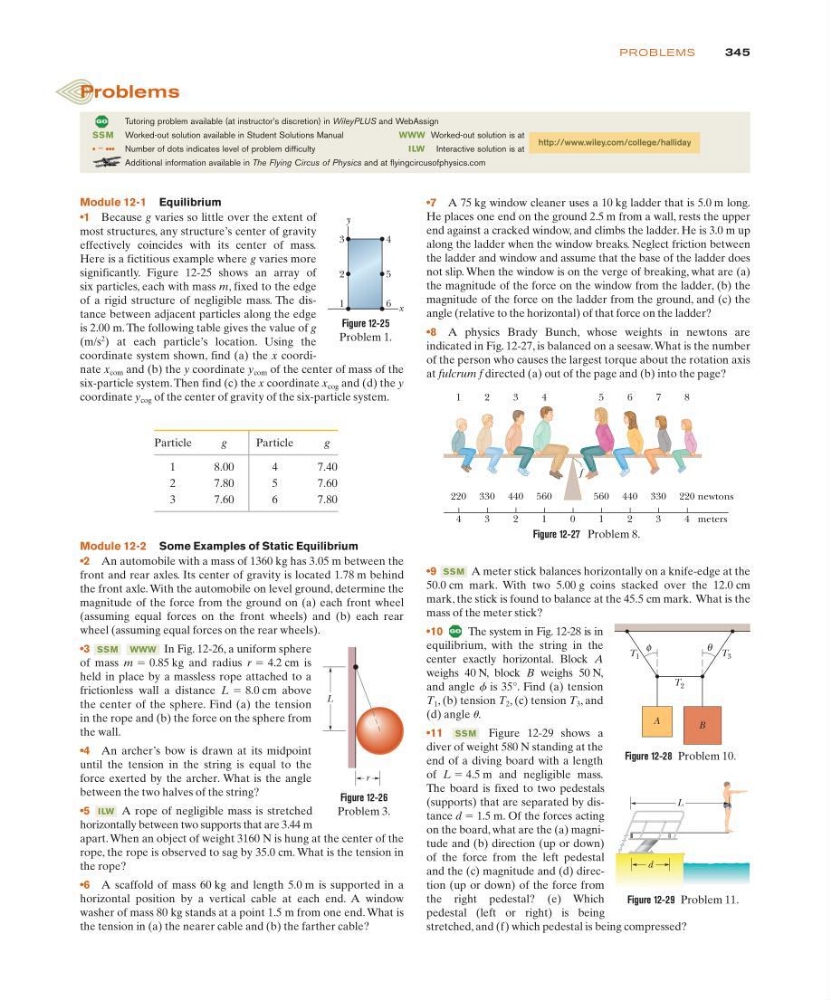
345
PROB LE M S
•7 A 75 kg window cleaner uses a 10 kg ladder that is 5.0 m long.
He places one end on the ground 2.5 m from a wall, rests the upper
end against a cracked window, and climbs the ladder. He is 3.0 m up
along the ladder when the window breaks. Neglect friction between
the ladder and window and assume that the base of the ladder does
not slip. When the window is on the verge of breaking, what are (a)
the magnitude of the force on the window from the ladder, (b) the
magnitude of the force on the ladder from the ground, and (c) the
angle (relative to the horizontal) of that force on the ladder?
•8 A physics Brady Bunch, whose weights in newtons are
indicated in Fig. 12-27, is balanced on a seesaw. What is the number
of the person who causes the largest torque about the rotation axis
at fulcrum f directed (a) out of the page and (b) into the page?
Module 12-1 Equilibrium
•1 Because g varies so little over the extent of
most structures, any structure’s center of gravity
effectively coincides with its center of mass.
Here is a fictitious example where g varies more
significantly. Figure 12-25 shows an array of
six particles, each with mass m, fixed to the edge
of a rigid structure of negligible mass. The distance between adjacent particles along the edge
is 2.00 m. The following table gives the value of g
(m/s
2
) at each particle’s location. Using the
coordinate system shown, find (a) the x coordinate x com and (b) the y coordinate y com of the center of mass of the
six-particle system. Then find (c) the x coordinate x cog and (d) the y
coordinate y cog of the center of gravity of the six-particle system.
Tutoring problem available (at instructor’s discretion) in WileyPLUS and WebAssign
SSM Worked-out solution available in Student Solutions Manual
• – ••• Number of dots indicates level of problem difficulty
Additional information available in The Flying Circus of Physics and at flyingcircusofphysics.com
WWW Worked-out solution is at
ILW Interactive solution is at
http://www.wiley.com/college/halliday
Problems
Particle
g
Particle
g
1
8.00
4
7.40
2
7.80
5
7.60
3
7.60
6
7.80
Module 12-2 Some Examples of Static Equilibrium
•2 An automobile with a mass of 1360 kg has 3.05 m between the
front and rear axles. Its center of gravity is located 1.78 m behind
the front axle. With the automobile on level ground, determine the
magnitude of the force from the ground on (a) each front wheel
(assuming equal forces on the front wheels) and (b) each rear
wheel (assuming equal forces on the rear wheels).
•3
In Fig. 12-26, a uniform sphere
of mass m 0.85 kg and radius r 4.2 cm is
held in place by a massless rope attached to a
frictionless wall a distance L 8.0 cm above
the center of the sphere. Find (a) the tension
in the rope and (b) the force on the sphere from
the wall.
•4 An archer’s bow is drawn at its midpoint
until the tension in the string is equal to the
force exerted by the archer. What is the angle
between the two halves of the string?
•5
A rope of negligible mass is stretched
horizontally between two supports that are 3.44 m
apart. When an object of weight 3160 N is hung at the center of the
rope, the rope is observed to sag by 35.0 cm. What is the tension in
the rope?
•6 A scaffold of mass 60 kg and length 5.0 m is supported in a
horizontal position by a vertical cable at each end. A window
washer of mass 80 kg stands at a point 1.5 m from one end. What is
the tension in (a) the nearer cable and (b) the farther cable?
ILW
ϭ
ϭ
ϭ
WWW
SSM
3
4
2
5
1
6
y
x
Figure 12-25
Problem 1.
L
r
Figure 12-26
Problem 3.
4
3
2
1
0
1
2
3
4 meters
220 330 440 560
560 440 330 220 newtons
1
2
3
4
5
6
7
8
f
Figure 12-27 Problem 8.
•9
A meter stick balances horizontally on a knife-edge at the
50.0 cm mark. With two 5.00 g coins stacked over the 12.0 cm
mark, the stick is found to balance at the 45.5 cm mark. What is the
mass of the meter stick?
•10
The system in Fig. 12-28 is in
equilibrium, with the string in the
center exactly horizontal. Block A
weighs 40 N, block B weighs 50 N,
and angle f is 35°. Find (a) tension
T 1 , (b) tension T 2 , (c) tension T 3 , and
(d) angle u.
•11
Figure 12-29 shows a
diver of weight 580 N standing at the
end of a diving board with a length
of L ϭ 4.5 m and negligible mass.
The board is fixed to two pedestals
(supports) that are separated by distance d ϭ 1.5 m. Of the forces acting
on the board, what are the (a) magnitude and (b) direction (up or down)
of the force from the left pedestal
and the (c) magnitude and (d) direction (up or down) of the force from
the right pedestal? (e) Which
pedestal (left or right) is being
stretched, and (f) which pedestal is being compressed?
SSM
SSM
T 2
T 3
T 1
θ
φ
A
B
Figure 12-28 Problem 10.
d
L
Figure 12-29 Problem 11.
PROB LE M S
•7 A 75 kg window cleaner uses a 10 kg ladder that is 5.0 m long.
He places one end on the ground 2.5 m from a wall, rests the upper
end against a cracked window, and climbs the ladder. He is 3.0 m up
along the ladder when the window breaks. Neglect friction between
the ladder and window and assume that the base of the ladder does
not slip. When the window is on the verge of breaking, what are (a)
the magnitude of the force on the window from the ladder, (b) the
magnitude of the force on the ladder from the ground, and (c) the
angle (relative to the horizontal) of that force on the ladder?
•8 A physics Brady Bunch, whose weights in newtons are
indicated in Fig. 12-27, is balanced on a seesaw. What is the number
of the person who causes the largest torque about the rotation axis
at fulcrum f directed (a) out of the page and (b) into the page?
Module 12-1 Equilibrium
•1 Because g varies so little over the extent of
most structures, any structure’s center of gravity
effectively coincides with its center of mass.
Here is a fictitious example where g varies more
significantly. Figure 12-25 shows an array of
six particles, each with mass m, fixed to the edge
of a rigid structure of negligible mass. The distance between adjacent particles along the edge
is 2.00 m. The following table gives the value of g
(m/s
2
) at each particle’s location. Using the
coordinate system shown, find (a) the x coordinate x com and (b) the y coordinate y com of the center of mass of the
six-particle system. Then find (c) the x coordinate x cog and (d) the y
coordinate y cog of the center of gravity of the six-particle system.
Tutoring problem available (at instructor’s discretion) in WileyPLUS and WebAssign
SSM Worked-out solution available in Student Solutions Manual
• – ••• Number of dots indicates level of problem difficulty
Additional information available in The Flying Circus of Physics and at flyingcircusofphysics.com
WWW Worked-out solution is at
ILW Interactive solution is at
http://www.wiley.com/college/halliday
Problems
Particle
g
Particle
g
1
8.00
4
7.40
2
7.80
5
7.60
3
7.60
6
7.80
Module 12-2 Some Examples of Static Equilibrium
•2 An automobile with a mass of 1360 kg has 3.05 m between the
front and rear axles. Its center of gravity is located 1.78 m behind
the front axle. With the automobile on level ground, determine the
magnitude of the force from the ground on (a) each front wheel
(assuming equal forces on the front wheels) and (b) each rear
wheel (assuming equal forces on the rear wheels).
•3
In Fig. 12-26, a uniform sphere
of mass m 0.85 kg and radius r 4.2 cm is
held in place by a massless rope attached to a
frictionless wall a distance L 8.0 cm above
the center of the sphere. Find (a) the tension
in the rope and (b) the force on the sphere from
the wall.
•4 An archer’s bow is drawn at its midpoint
until the tension in the string is equal to the
force exerted by the archer. What is the angle
between the two halves of the string?
•5
A rope of negligible mass is stretched
horizontally between two supports that are 3.44 m
apart. When an object of weight 3160 N is hung at the center of the
rope, the rope is observed to sag by 35.0 cm. What is the tension in
the rope?
•6 A scaffold of mass 60 kg and length 5.0 m is supported in a
horizontal position by a vertical cable at each end. A window
washer of mass 80 kg stands at a point 1.5 m from one end. What is
the tension in (a) the nearer cable and (b) the farther cable?
ILW
ϭ
ϭ
ϭ
WWW
SSM
3
4
2
5
1
6
y
x
Figure 12-25
Problem 1.
L
r
Figure 12-26
Problem 3.
4
3
2
1
0
1
2
3
4 meters
220 330 440 560
560 440 330 220 newtons
1
2
3
4
5
6
7
8
f
Figure 12-27 Problem 8.
•9
A meter stick balances horizontally on a knife-edge at the
50.0 cm mark. With two 5.00 g coins stacked over the 12.0 cm
mark, the stick is found to balance at the 45.5 cm mark. What is the
mass of the meter stick?
•10
The system in Fig. 12-28 is in
equilibrium, with the string in the
center exactly horizontal. Block A
weighs 40 N, block B weighs 50 N,
and angle f is 35°. Find (a) tension
T 1 , (b) tension T 2 , (c) tension T 3 , and
(d) angle u.
•11
Figure 12-29 shows a
diver of weight 580 N standing at the
end of a diving board with a length
of L ϭ 4.5 m and negligible mass.
The board is fixed to two pedestals
(supports) that are separated by distance d ϭ 1.5 m. Of the forces acting
on the board, what are the (a) magnitude and (b) direction (up or down)
of the force from the left pedestal
and the (c) magnitude and (d) direction (up or down) of the force from
the right pedestal? (e) Which
pedestal (left or right) is being
stretched, and (f) which pedestal is being compressed?
SSM
SSM
T 2
T 3
T 1
θ
φ
A
B
Figure 12-28 Problem 10.
d
L
Figure 12-29 Problem 11.