

334
CHAPTE R 12 EQU I LI B R I U M AN D E L ASTICITY
magnitude F of the net force. Because we know T c , we apply
the force balancing equations to the beam.
Calculations: For the horizontal balance, we can rewrite
F net, x ϭ 0 as
F h Ϫ T c ϭ 0,
(12-20)
and so
F h ϭ T c ϭ 6093 N.
For the vertical balance, we write F net,y ϭ 0 as
F v Ϫ mg Ϫ T r ϭ 0.
Substituting Mg for T r and solving for F v , we find that
F v ϭ (m ϩ M)g ϭ (85 kg ϩ 430 kg)(9.8 m/s
2
)
ϭ 5047 N.
From the Pythagorean theorem, we now have
(Answer)
Note that F is substantially greater than either the combined
weights of the safe and the beam, 5000 N, or the tension in
the horizontal wire, 6100 N.
ϭ 2(6093 N)
2 ϩ (5047 N)
2
Ϸ 7900 N.
F ϭ 2F
2
h ϩ F v
2
Sample Problem 12.02 Balancing a leaning boom
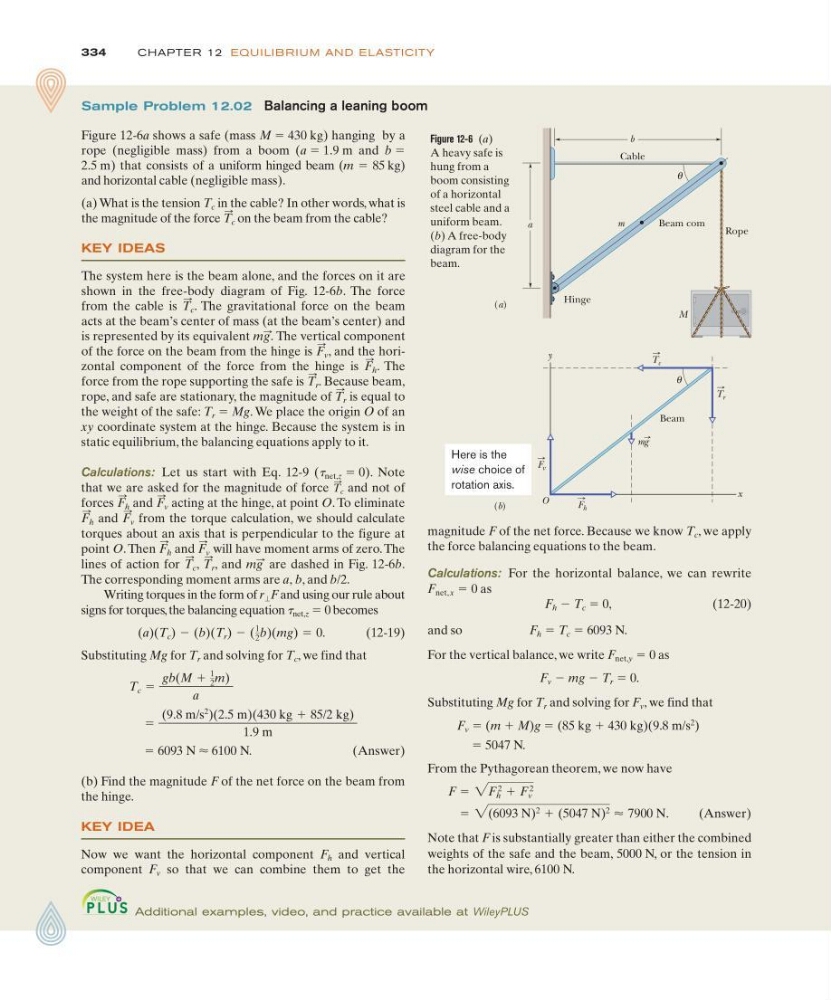
Figure 12-6a shows a safe (mass M ϭ 430 kg) hanging by a
rope (negligible mass) from a boom (a ϭ 1.9 m and b ϭ
2.5 m) that consists of a uniform hinged beam (m ϭ 85 kg)
and horizontal cable (negligible mass).
(a) What is the tension T c in the cable? In other words, what is
the magnitude of the force on the beam from the cable?
KEY IDEAS
The system here is the beam alone, and the forces on it are
shown in the free-body diagram of Fig. 12-6b. The force
from the cable is . The gravitational force on the beam
acts at the beam’s center of mass (at the beam’s center) and
is represented by its equivalent
The vertical component
of the force on the beam from the hinge is , and the horizontal component of the force from the hinge is . The
force from the rope supporting the safe is . Because beam,
rope, and safe are stationary, the magnitude of is equal to
T
:
r
T
:
r
F
:
h
F
:
v
mg
:
.
T
:
c
T
:
c
Additional examples, video, and practice available at WileyPLUS
the weight of the safe: T r ϭ Mg. We place the origin O of an
xy coordinate system at the hinge. Because the system is in
static equilibrium, the balancing equations apply to it.
Calculations: Let us start with Eq. 12-9 (t net,z ϭ 0). Note
that we are asked for the magnitude of force and not of
forces
and acting at the hinge, at point O. To eliminate
and
from the torque calculation, we should calculate
torques about an axis that is perpendicular to the figure at
point O. Then and will have moment arms of zero. The
lines of action for , , and
are dashed in Fig. 12-6b.
The corresponding moment arms are a, b, and b/2.
Writing torques in the form of r Ќ F and using our rule about
signs for torques, the balancing equation t net,z ϭ 0 becomes
(12-19)
Substituting Mg for T r and solving for T c , we find that
ϭ 6093 N Ϸ 6100 N.
(Answer)
(b) Find the magnitude F of the net force on the beam from
the hinge.
KEY IDEA
Now we want the horizontal component F h and vertical
component F v so that we can combine them to get the
ϭ
(9.8 m/s
2
)(2.5 m)(430 kg ϩ 85/2 kg)
1.9 m
T c ϭ
gb(M ϩ
1
2 m)
a
(a)(T c ) Ϫ (b)(T r ) Ϫ (
1
2 b)(mg) ϭ 0.
mg
:
T
:
r
T
:
c
F
:
v
F
:
h
F
:
v
F
:
h
F
:
v
F
:
h
T
:
c
Figure 12-6 (a)
A heavy safe is
hung from a
boom consisting
of a horizontal
steel cable and a
uniform beam.
(b) A free-body
diagram for the
beam.
b
a
Cable
Rope
Hinge
Beam com
θ
m
(a)
y
x
Beam
mg
(b)
θ
O
M
T c
T r
F v
F h
Here is the
wise choice of
rotation axis.
CHAPTE R 12 EQU I LI B R I U M AN D E L ASTICITY
magnitude F of the net force. Because we know T c , we apply
the force balancing equations to the beam.
Calculations: For the horizontal balance, we can rewrite
F net, x ϭ 0 as
F h Ϫ T c ϭ 0,
(12-20)
and so
F h ϭ T c ϭ 6093 N.
For the vertical balance, we write F net,y ϭ 0 as
F v Ϫ mg Ϫ T r ϭ 0.
Substituting Mg for T r and solving for F v , we find that
F v ϭ (m ϩ M)g ϭ (85 kg ϩ 430 kg)(9.8 m/s
2
)
ϭ 5047 N.
From the Pythagorean theorem, we now have
(Answer)
Note that F is substantially greater than either the combined
weights of the safe and the beam, 5000 N, or the tension in
the horizontal wire, 6100 N.
ϭ 2(6093 N)
2 ϩ (5047 N)
2
Ϸ 7900 N.
F ϭ 2F
2
h ϩ F v
2
Sample Problem 12.02 Balancing a leaning boom
Figure 12-6a shows a safe (mass M ϭ 430 kg) hanging by a
rope (negligible mass) from a boom (a ϭ 1.9 m and b ϭ
2.5 m) that consists of a uniform hinged beam (m ϭ 85 kg)
and horizontal cable (negligible mass).
(a) What is the tension T c in the cable? In other words, what is
the magnitude of the force on the beam from the cable?
KEY IDEAS
The system here is the beam alone, and the forces on it are
shown in the free-body diagram of Fig. 12-6b. The force
from the cable is . The gravitational force on the beam
acts at the beam’s center of mass (at the beam’s center) and
is represented by its equivalent
The vertical component
of the force on the beam from the hinge is , and the horizontal component of the force from the hinge is . The
force from the rope supporting the safe is . Because beam,
rope, and safe are stationary, the magnitude of is equal to
T
:
r
T
:
r
F
:
h
F
:
v
mg
:
.
T
:
c
T
:
c
Additional examples, video, and practice available at WileyPLUS
the weight of the safe: T r ϭ Mg. We place the origin O of an
xy coordinate system at the hinge. Because the system is in
static equilibrium, the balancing equations apply to it.
Calculations: Let us start with Eq. 12-9 (t net,z ϭ 0). Note
that we are asked for the magnitude of force and not of
forces
and acting at the hinge, at point O. To eliminate
and
from the torque calculation, we should calculate
torques about an axis that is perpendicular to the figure at
point O. Then and will have moment arms of zero. The
lines of action for , , and
are dashed in Fig. 12-6b.
The corresponding moment arms are a, b, and b/2.
Writing torques in the form of r Ќ F and using our rule about
signs for torques, the balancing equation t net,z ϭ 0 becomes
(12-19)
Substituting Mg for T r and solving for T c , we find that
ϭ 6093 N Ϸ 6100 N.
(Answer)
(b) Find the magnitude F of the net force on the beam from
the hinge.
KEY IDEA
Now we want the horizontal component F h and vertical
component F v so that we can combine them to get the
ϭ
(9.8 m/s
2
)(2.5 m)(430 kg ϩ 85/2 kg)
1.9 m
T c ϭ
gb(M ϩ
1
2 m)
a
(a)(T c ) Ϫ (b)(T r ) Ϫ (
1
2 b)(mg) ϭ 0.
mg
:
T
:
r
T
:
c
F
:
v
F
:
h
F
:
v
F
:
h
F
:
v
F
:
h
T
:
c
Figure 12-6 (a)
A heavy safe is
hung from a
boom consisting
of a horizontal
steel cable and a
uniform beam.
(b) A free-body
diagram for the
beam.
b
a
Cable
Rope
Hinge
Beam com
θ
m
(a)
y
x
Beam
mg
(b)
θ
O
M
T c
T r
F v
F h
Here is the
wise choice of
rotation axis.