

Proof
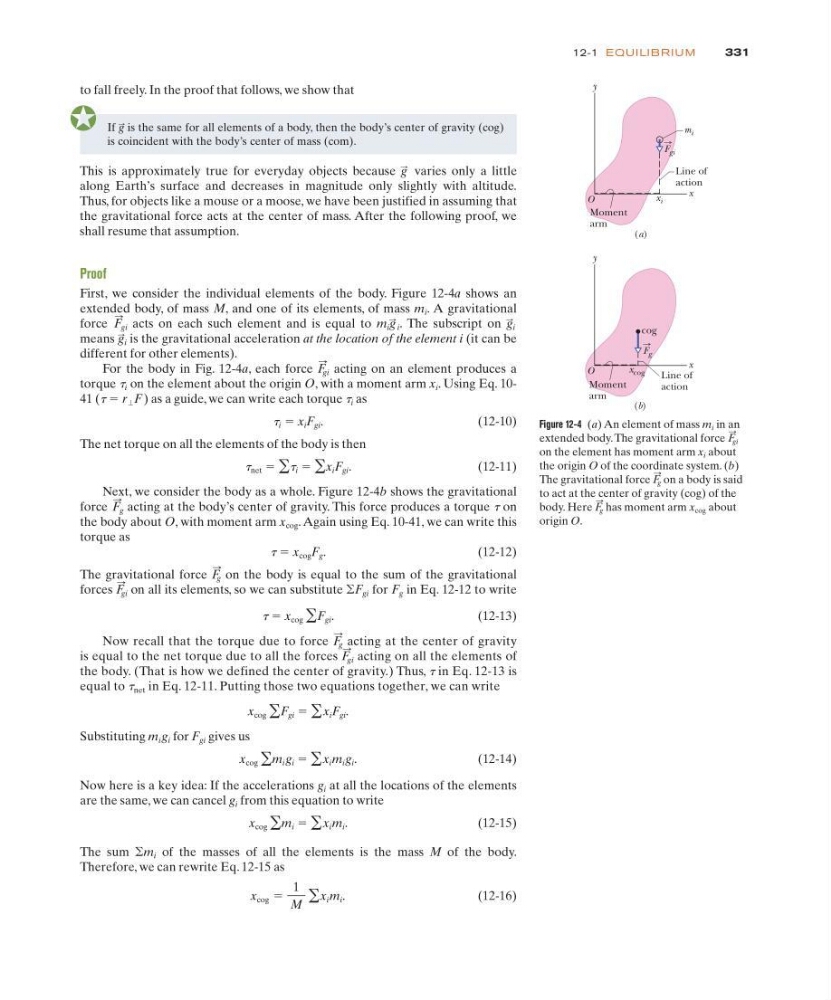
First, we consider the individual elements of the body. Figure 12-4a shows an
extended body, of mass M, and one of its elements, of mass m i . A gravitational
force
acts on each such element and is equal to
The subscript on
means is the gravitational acceleration at the location of the element i (it can be
different for other elements).
For the body in Fig. 12-4a, each force F
:
gi acting on an element produces a
torque t i on the element about the origin O, with a moment arm x i . Using Eq. 1041 (t ϭ r Ќ F ) as a guide, we can write each torque t i as
t i ϭ x i F gi .
( 1 2 - 1 0 )
The net torque on all the elements of the body is then
t net ϭ t i ϭ x i F gi .
( 1 2 - 1 1 )
Next, we consider the body as a whole. Figure 12-4b shows the gravitational
force
acting at the body’s center of gravity. This force produces a torque t on
the body about O, with moment arm x cog . Again using Eq. 10-41, we can write this
torque as
t ϭ x cog F g .
( 1 2 - 1 2 )
The gravitational force F
:
g on the body is equal to the sum of the gravitational
forces F
:
gi on all its elements, so we can substitute ͚F gi for F g in Eq. 12-12 to write
t ϭ x cog F gi .
(12-13)
Now recall that the torque due to force F
:
g acting at the center of gravity
is equal to the net torque due to all the forces F
:
gi acting on all the elements of
the body. (That is how we defined the center of gravity.) Thus, t in Eq. 12-13 is
equal to t net in Eq. 12-11. Putting those two equations together, we can write
x cog F gi ϭ x i F gi .
Substituting m i g i for F gi gives us
x cog m i g i ϭ x i m i g i .
( 1 2 - 1 4 )
Now here is a key idea: If the accelerations g i at all the locations of the elements
are the same, we can cancel g i from this equation to write
x cog m i ϭ x i m i .
( 1 2 - 1 5 )
The sum ͚m i of the masses of all the elements is the mass M of the body.
Therefore, we can rewrite Eq. 12-15 as
(12-16)
x cog ϭ
1
M ͚ x i m i .
͚
͚
͚
͚
͚
͚
͚
F
:
g
͚
͚
g
:
i
g
:
i
m i g
:
i .
F
:
gi
331
12-1 EQU I LI B R I U M
If is the same for all elements of a body, then the body’s center of gravity (cog)
is coincident with the body’s center of mass (com).
g
:
This is approximately true for everyday objects because varies only a little
along Earth’s surface and decreases in magnitude only slightly with altitude.
Thus, for objects like a mouse or a moose, we have been justified in assuming that
the gravitational force acts at the center of mass. After the following proof, we
shall resume that assumption.
g
:
O
x
y
x cog
cog
(b)
Line of
action
Moment
arm
F g
O
x
y
m i
x i
(a)
Line of
action
F gi
Moment
arm
Figure 12-4 (a) An element of mass m i in an
extended body. The gravitational force F
:
gi
on the element has moment arm x i about
the origin O of the coordinate system. (b)
The gravitational force F
:
g on a body is said
to act at the center of gravity (cog) of the
body. Here F
:
g has moment arm x cog about
origin O.
to fall freely. In the proof that follows, we show that
First, we consider the individual elements of the body. Figure 12-4a shows an
extended body, of mass M, and one of its elements, of mass m i . A gravitational
force
acts on each such element and is equal to
The subscript on
means is the gravitational acceleration at the location of the element i (it can be
different for other elements).
For the body in Fig. 12-4a, each force F
:
gi acting on an element produces a
torque t i on the element about the origin O, with a moment arm x i . Using Eq. 1041 (t ϭ r Ќ F ) as a guide, we can write each torque t i as
t i ϭ x i F gi .
( 1 2 - 1 0 )
The net torque on all the elements of the body is then
t net ϭ t i ϭ x i F gi .
( 1 2 - 1 1 )
Next, we consider the body as a whole. Figure 12-4b shows the gravitational
force
acting at the body’s center of gravity. This force produces a torque t on
the body about O, with moment arm x cog . Again using Eq. 10-41, we can write this
torque as
t ϭ x cog F g .
( 1 2 - 1 2 )
The gravitational force F
:
g on the body is equal to the sum of the gravitational
forces F
:
gi on all its elements, so we can substitute ͚F gi for F g in Eq. 12-12 to write
t ϭ x cog F gi .
(12-13)
Now recall that the torque due to force F
:
g acting at the center of gravity
is equal to the net torque due to all the forces F
:
gi acting on all the elements of
the body. (That is how we defined the center of gravity.) Thus, t in Eq. 12-13 is
equal to t net in Eq. 12-11. Putting those two equations together, we can write
x cog F gi ϭ x i F gi .
Substituting m i g i for F gi gives us
x cog m i g i ϭ x i m i g i .
( 1 2 - 1 4 )
Now here is a key idea: If the accelerations g i at all the locations of the elements
are the same, we can cancel g i from this equation to write
x cog m i ϭ x i m i .
( 1 2 - 1 5 )
The sum ͚m i of the masses of all the elements is the mass M of the body.
Therefore, we can rewrite Eq. 12-15 as
(12-16)
x cog ϭ
1
M ͚ x i m i .
͚
͚
͚
͚
͚
͚
͚
F
:
g
͚
͚
g
:
i
g
:
i
m i g
:
i .
F
:
gi
331
12-1 EQU I LI B R I U M
If is the same for all elements of a body, then the body’s center of gravity (cog)
is coincident with the body’s center of mass (com).
g
:
This is approximately true for everyday objects because varies only a little
along Earth’s surface and decreases in magnitude only slightly with altitude.
Thus, for objects like a mouse or a moose, we have been justified in assuming that
the gravitational force acts at the center of mass. After the following proof, we
shall resume that assumption.
g
:
O
x
y
x cog
cog
(b)
Line of
action
Moment
arm
F g
O
x
y
m i
x i
(a)
Line of
action
F gi
Moment
arm
Figure 12-4 (a) An element of mass m i in an
extended body. The gravitational force F
:
gi
on the element has moment arm x i about
the origin O of the coordinate system. (b)
The gravitational force F
:
g on a body is said
to act at the center of gravity (cog) of the
body. Here F
:
g has moment arm x cog about
origin O.
to fall freely. In the proof that follows, we show that